Periasamy Muthu, Herrera Jose Luis, Reis Felipe C G
Sanford Burnham Prebys Medical Discovery Institute at Lake Nona, Orlando, FL, USA.
Diabetes Metab J. 2017 Oct;41(5):327-336. doi: 10.4093/dmj.2017.41.5.327.
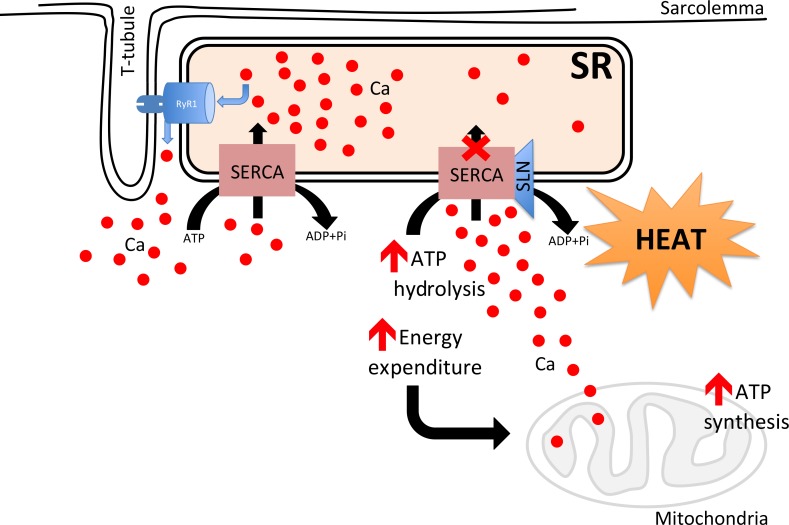
Obesity and diabetes has become a major epidemic across the globe. Controlling obesity has been a challenge since this would require either increased physical activity or reduced caloric intake; both are difficult to enforce. There has been renewed interest in exploiting pathways such as uncoupling protein 1 (UCP1)-mediated uncoupling in brown adipose tissue (BAT) and white adipose tissue to increase energy expenditure to control weight gain. However, relying on UCP1-based thermogenesis alone may not be sufficient to control obesity in humans. On the other hand, skeletal muscle is the largest organ and a major contributor to basal metabolic rate and increasing energy expenditure in muscle through nonshivering thermogenic mechanisms, which can substantially affect whole body metabolism and weight gain. In this review we will describe the role of Sarcolipin-mediated uncoupling of Sarcoplasmic Reticulum Calcium ATPase (SERCA) as a potential mechanism for increased energy expenditure both during cold and diet-induced thermogenesis.
肥胖和糖尿病已成为全球范围内的主要流行病。控制肥胖一直是一项挑战,因为这需要增加体力活动或减少热量摄入,而这两者都难以实施。人们重新对利用诸如棕色脂肪组织(BAT)和白色脂肪组织中解偶联蛋白1(UCP1)介导的解偶联等途径来增加能量消耗以控制体重增加产生了兴趣。然而,仅依靠基于UCP1的产热可能不足以控制人类肥胖。另一方面,骨骼肌是最大的器官,也是基础代谢率的主要贡献者,通过非颤抖性产热机制增加肌肉中的能量消耗,这会对全身代谢和体重增加产生重大影响。在这篇综述中,我们将描述肌脂蛋白介导的肌浆网钙ATP酶(SERCA)解偶联在寒冷和饮食诱导的产热过程中作为增加能量消耗的潜在机制所起的作用。