Xue Yudi, Zhu Lin, Yi Tao
School of Chinese Medicine, Hong Kong Baptist University, Kowloon Tong, Hong Kong Special Administrative Region, People's Republic of China.
Chem Cent J. 2017 Jul 24;11(1):67. doi: 10.1186/s13065-017-0299-8.
Resina Draconis, a bright red resin derived from Dracaena cochinchinensis, is a traditional medicine used in China. To improve its quality control approach, an ultra-performance liquid chromatography (UPLC) fingerprint method was developed for rapidly evaluating the quality of Resina Draconis.
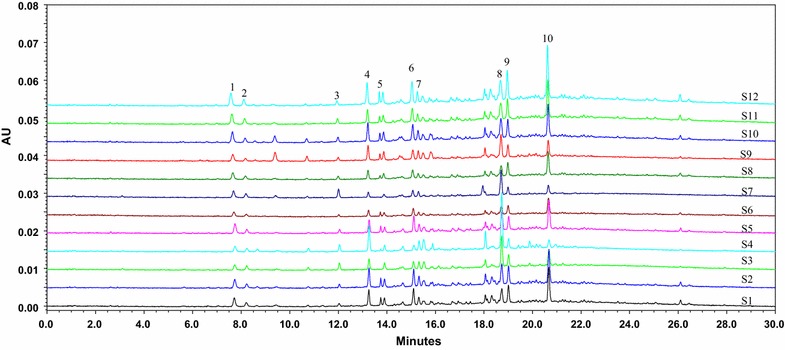
The precision, repeatability and stability of the proposed UPLC method were validated in the study. Twelve batches of Resina Draconis samples from various sources were analyzed by the present UPLC method. Common peaks in the chromatograms were adopted to calculate their relative retention time and relative peak area. The chromatographic data were processed by Similarity Evaluation System for Chromatographic Fingerprint of Traditional Chinese Medicine software (Version 2004 A) for similarity analysis.
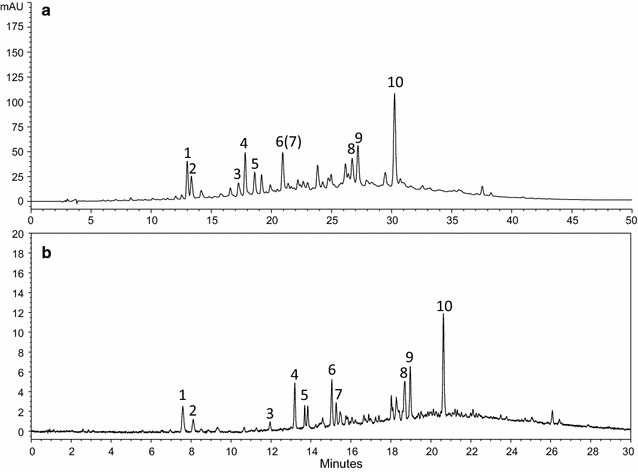
The present UPLC method demonstrated a satisfactory precision, repeatability and stability. The analysis time of the present UPLC method was shortened to 30 min, compared with that of the conventional HPLC method was 50 min. The similarities of the 12 Resina Draconis samples were 0.976, 0.993, 0.955, 0.789, 0.989, 0.995, 0.794, 0.994, 0.847, 0.987, 0.997, 0.986, respectively, which indicated that the samples were certainly regionally different. The similarities of the 12 samples showed more similar pattern except for samples 4, 7 and 9. Such variation in similarity may presumably be attributed to differences in source.
Compared with the conventional HPLC method, the present UPLC method showed several advantages including shorter analysis time, higher resolution and better separation performance. The UPLC fingerprinting established in the present paper provides a valuable reference for the quality control of Resina Draconis.
血竭是一种从柬埔寨龙血树中提取的鲜红色树脂,是中国传统药物。为改进其质量控制方法,开发了一种超高效液相色谱(UPLC)指纹图谱法,用于快速评估血竭的质量。
本研究对所提出的UPLC方法的精密度、重复性和稳定性进行了验证。采用本UPLC方法分析了12批来自不同来源的血竭样品。采用色谱图中的共有峰计算其相对保留时间和相对峰面积。采用《中药色谱指纹图谱相似度评价系统》软件(2004 A版)对色谱数据进行处理,进行相似度分析。
本UPLC方法具有良好的精密度、重复性和稳定性。本UPLC方法的分析时间缩短至30分钟,而传统HPLC方法为50分钟。12批血竭样品的相似度分别为0.976、0.993、0.955、0.789、0.989、0.995、0.794、0.994、0.847、0.987、0.997、0.986,表明样品存在明显的地域差异。除样品4、7和9外,12个样品的相似度呈现出更相似的模式。相似度的这种差异可能归因于来源的不同。
与传统HPLC方法相比,本UPLC方法具有分析时间短、分辨率高、分离性能好等优点。本文建立的UPLC指纹图谱为血竭的质量控制提供了有价值的参考。