Zhu Lili, Fang Lexia, Li Zongjin, Xie Xiaomei, Zhang Ling
1College of Pharmacy, Anhui University of Chinese Medicine, Hefei, 230012 China.
Institute of Pharmaceutical Analysis, Anhui Academy of Chinese Medicine, Hefei, 230012 Anhui China.
BMC Chem. 2019 Jan 30;13(1):7. doi: 10.1186/s13065-019-0527-5. eCollection 2019 Dec.
Chaenomelis Fructus is a type of traditional medicine used in China. At present, the quality standard of Chaenomelis Fructus is mainly based on the content of each component as a control index, lacking overall control. To improve the rapid identification of chemical ingredients for Chaenomelis Fructus, a new approach to the construction for Chaenomelis Fructus is presented in this paper.
The precision, repeatability and stability of the proposed HPLC method were validated in the study. Twenty batches of Chaenomelis Fructus samples from their geographical origin were analyzed by the HPLC method. Common peaks in the chromatograms were adopted to calculate their relative retention time and relative peak area. The chromatographic data were processed by the Similarity Evaluation System for Chromatographic Fingerprint of Traditional Chinese Medicine software (Version 2004 A) for similarity analysis.
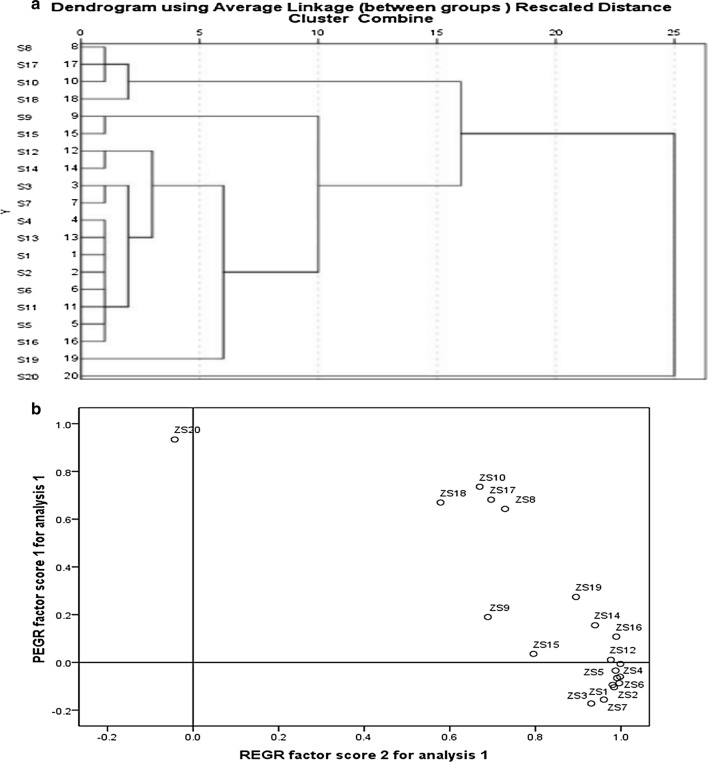
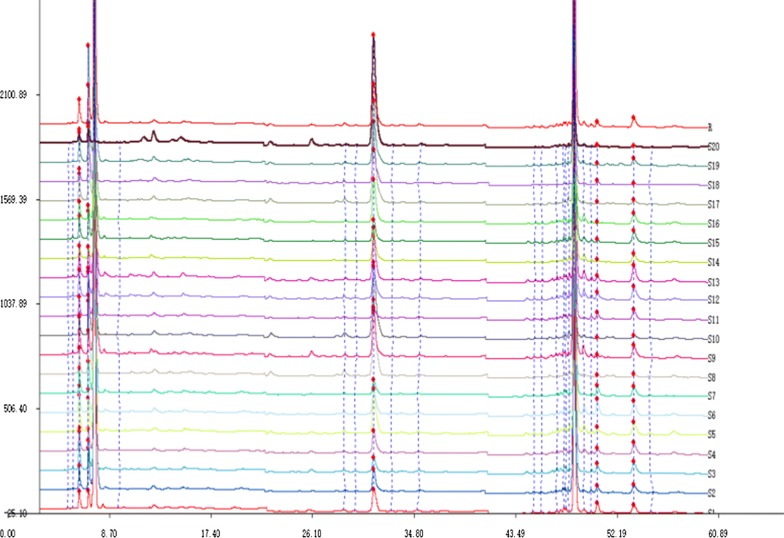
The HPLC method demonstrated satisfactory precision, repeatability and stability. The similarities of the 20 Chaenomelis Fructus samples were 0.967, 0.979, 0.965, 0.992, 0.994, 0.988, 0.974, 0.909, 0.993, 0.894, 0.983, 0.976, 0.992, 0.960, 0.990, 0.992, 0.901, 0.815, 0.947, and 0.504, indicating that the similarities of 19 samples showed a similar pattern with the exception of sample 20. Sample S20 could be considered adulterated. This was further confirmed by principal component analysis and hierarchical clustering analysis. The HPLC fingerprints of different Chaenomelis Fructus had obvious differences in area of common peaks, but less differences in the number of common peaks.
The chromatographic fingerprint of Chaenomelis Fructus with high characteristics and specificity can be used as a reference to control its quality, providing a fast quality evaluation tool for distinguishing between the authentic Chaenomelis Fructus and the adulterated products.
木瓜是中国常用的一种传统药材。目前,木瓜的质量标准主要以各成分含量作为控制指标,缺乏全面控制。为提高木瓜化学成分的快速鉴别能力,本文提出了一种构建木瓜质量控制的新方法。
本研究对所建立的高效液相色谱法(HPLC)的精密度、重复性和稳定性进行了验证。采用HPLC法对20批不同产地的木瓜样品进行分析。采用色谱图中的共有峰计算其相对保留时间和相对峰面积。色谱数据通过《中药色谱指纹图谱相似度评价系统》软件(2004 A版)进行处理,以进行相似度分析。
HPLC法的精密度、重复性和稳定性良好。20批木瓜样品的相似度分别为0.967、0.979、0.965、0.992、0.994、0.988、0.974、0.909、0.993、0.894、0.983、0.976、0.992、0.960、0.990、0.992、0.901、0.815、0.947和0.504,表明除第20号样品外,19个样品的相似度呈现相似模式。第20号样品(S20)可能被认为是掺假的。主成分分析和层次聚类分析进一步证实了这一点。不同木瓜的HPLC指纹图谱在共有峰面积上有明显差异,但在共有峰数量上差异较小。
具有高特征性和特异性的木瓜色谱指纹图谱可作为其质量控制的参考,为区分正品木瓜和掺假产品提供了一种快速的质量评价工具。