Cioncada Rossella, Maddaluno Marcella, Vo Hoa Thi My, Woodruff Matthew, Tavarini Simona, Sammicheli Chiara, Tortoli Marco, Pezzicoli Alfredo, De Gregorio Ennio, Carroll Michael C, D'Oro Ugo, Piccioli Diego
GSK Vaccines, Siena, Italy.
Boston Children's Hospital, Harvard Medical School, Boston, MA, United States of America.
PLoS One. 2017 Oct 31;12(10):e0185843. doi: 10.1371/journal.pone.0185843. eCollection 2017.
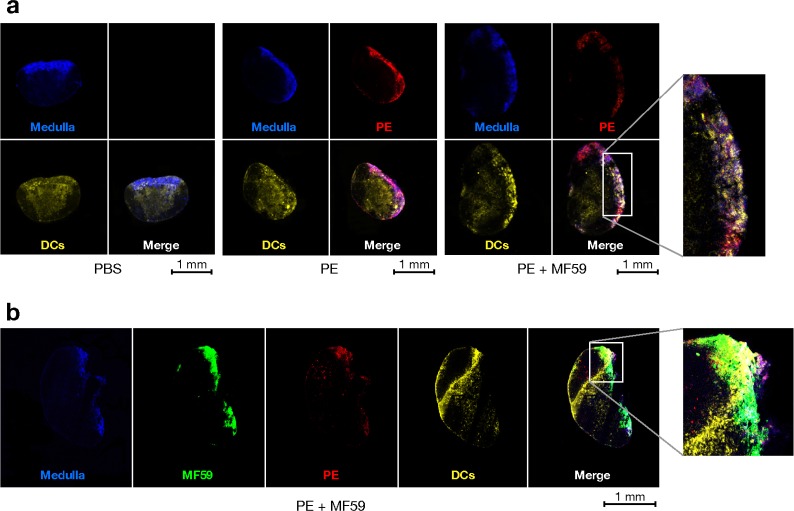
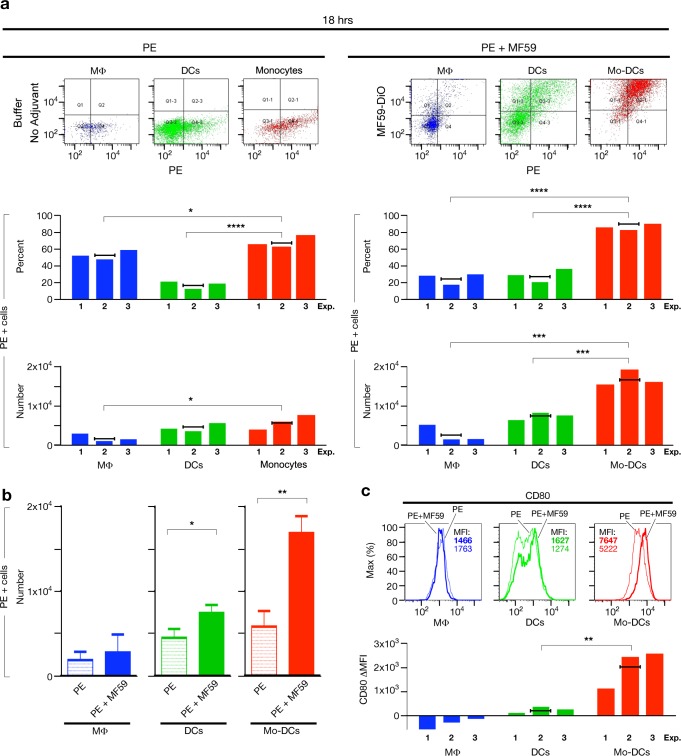
MF59 is an oil-in-water emulsion adjuvant approved for human influenza vaccination in European Union. The mode of action of MF59 is not fully elucidated yet, but results from several years of investigation indicate that MF59 establishes an immunocompetent environment at injection site which promotes recruitment of immune cells, including antigen presenting cells (APCs), that are facilitated to engulf antigen and transport it to draining lymph node (dLN) where the antigen is accumulated. In vitro studies showed that MF59 promotes the differentiation of monocytes to dendritic cells (Mo-DCs). Since after immunization with MF59, monocytes are rapidly recruited both at the injection site and in dLN and appear to have a morphological change toward a DC-like phenotype, we asked whether MF59 could play a role in inducing differentiation of Mo-DC in vivo. To address this question we immunized mice with the auto-fluorescent protein Phycoerythrin (PE) as model antigen, in presence or absence of MF59. We measured the APC phenotype and their antigen uptake within dLNs, the antigen distribution within the dLN compartments and the humoral response to PE. In addition, using Ovalbumin as model antigen, we measured the capacity of dLN APCs to induce antigen-specific CD4 T cell proliferation. Here, we show, for the first time, that MF59 promotes differentiation of Mo-DCs within dLNs from intranodal recruited monocytes and we suggest that this differentiation could take place in the medullary compartment of the LN. In addition we show that the Mo-DC subset represents the major source of antigen-loaded and activated APCs within the dLN when immunizing with MF59. Interestingly, this finding correlates with the enhanced triggering of antigen-specific CD4 T cell response induced by LN APCs. This study therefore demonstrates that MF59 is able to promote an immunocompetent environment also directly within the dLN, offering a novel insight on the mechanism of action of vaccine adjuvants based on emulsions.
MF59是一种水包油乳剂佐剂,在欧盟被批准用于人类流感疫苗接种。MF59的作用模式尚未完全阐明,但多年的研究结果表明,MF59在注射部位建立了一个免疫活性环境,促进免疫细胞的募集,包括抗原呈递细胞(APC),这些细胞便于吞噬抗原并将其运输到引流淋巴结(dLN),抗原在那里积累。体外研究表明,MF59促进单核细胞向树突状细胞(Mo-DC)分化。由于在用MF59免疫后,单核细胞在注射部位和dLN中均迅速募集,并且似乎向DC样表型发生形态学变化,我们询问MF59是否能在体内诱导Mo-DC分化中发挥作用。为了解决这个问题,我们以自身荧光蛋白藻红蛋白(PE)作为模型抗原,在有或没有MF59的情况下免疫小鼠。我们测量了dLN内APC的表型及其抗原摄取、dLN隔室内的抗原分布以及对PE的体液反应。此外,使用卵清蛋白作为模型抗原,我们测量了dLN APC诱导抗原特异性CD4 T细胞增殖的能力。在这里,我们首次表明,MF59促进dLN内来自结内募集单核细胞的Mo-DC分化,并且我们认为这种分化可能发生在淋巴结的髓质区室。此外,我们表明,在用MF59免疫时,Mo-DC亚群是dLN内负载抗原并被激活的APC的主要来源。有趣的是,这一发现与LN APC诱导的抗原特异性CD4 T细胞反应的增强触发相关。因此,这项研究表明,MF59也能够直接在dLN内促进免疫活性环境,为基于乳剂的疫苗佐剂的作用机制提供了新的见解。