Zhou Tan-Yang, Sun Jun-Hui, Zhang Yue-Lin, Zhou Guan-Hui, Nie Chun-Hui, Zhu Tong-Yin, Chen Sheng-Qun, Wang Bao-Quan, Wang Wei-Lin, Zheng Shu-Sen
Hepatobiliary and Pancreatic Interventional Treatment Center, Division of Hepatobiliary and Pancreatic Surgery, Key Laboratory of Combined Multi-Organ Transplantation, Ministry of Public Health, Key Laboratory of Precision Diagnosis and Treatment for Hepatobiliary and Pancreatic Tumor of Zhejiang Province, Zhejiang Province, Hangzhou 310003, China.
Collaborative Innovation Center for Diagnosis Treatment of Infectious Diseases, Zhejiang University, Hangzhou, Zhejiang, 310003, China.
Oncotarget. 2017 Apr 27;8(43):73684-73692. doi: 10.18632/oncotarget.17450. eCollection 2017 Sep 26.
To explore the diagnostic value of digital subtraction angiography (DSA) and the effectiveness of endovascular treatment for a post-pancreaticoduodenectomy hemorrhage (PPH).
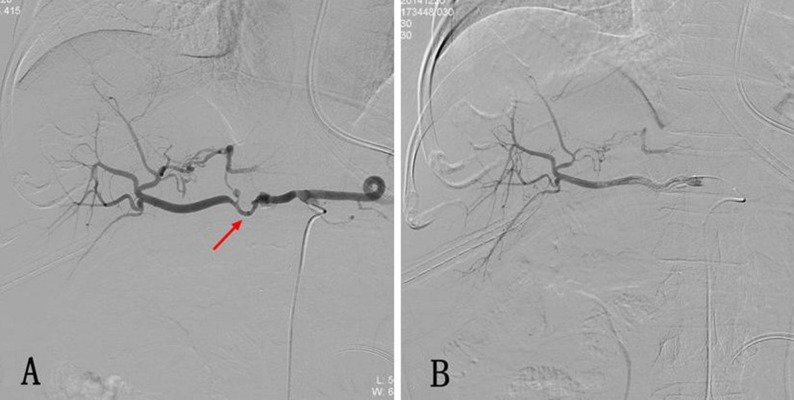
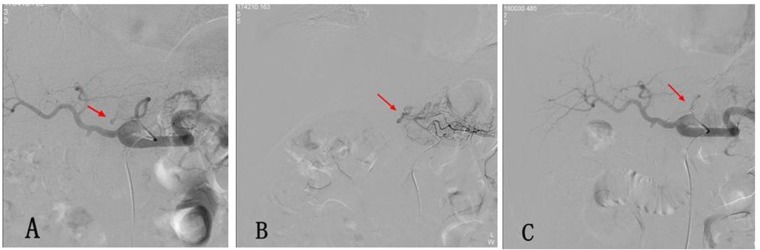
During the DSA examination, positive results were found in 29 patients, yielding a positive rate of 69.0%. The manifestations of the DSA examination included contrast medium extravasation, pseudoaneurysm, and artery walls coarse. All 29 patients with positive results underwent endovascular treatment, including transartery embolization (TAE) in 28 patients and covered stents placement in one patient. The technical success and clinical success rates were 100% and 72.4%, respectively. Re-bleeding occurred in 8 of the 29 patients after the first treatment (27.6%). The mortality of PPH was 17.2% (5 of 29). Two of the five PPH patients died following severe infections, and three died from multiple organ failure.
A DSA examination was conducted using clinical and imaging data of 42 patients, and endovascular treatment for delayed PPH was retrospectively analyzed.
DSA examination is a minimally invasive and rapid method for the diagnosis of delayed PPH. For patients with positive DSA results, endovascular treatment can be performed rapidly, safely, and effectively. Therefore, the DSA examination and endovascular treatment could be considered a preferred treatment approach for delayed PPH.
探讨数字减影血管造影(DSA)对胰十二指肠切除术后出血(PPH)的诊断价值及血管内治疗的有效性。
DSA检查中,29例患者结果为阳性,阳性率为69.0%。DSA检查表现为造影剂外渗、假性动脉瘤和动脉壁粗糙。29例阳性患者均接受了血管内治疗,其中28例行经动脉栓塞(TAE),1例行覆膜支架置入术。技术成功率和临床成功率分别为100%和72.4%。29例患者中8例(27.6%)首次治疗后再出血。PPH死亡率为17.2%(29例中的5例)。5例PPH患者中2例死于严重感染,3例死于多器官功能衰竭。
利用42例患者的临床和影像资料进行DSA检查,并对延迟性PPH的血管内治疗进行回顾性分析。
DSA检查是诊断延迟性PPH的一种微创、快速的方法。对于DSA结果阳性的患者,可快速、安全、有效地进行血管内治疗。因此,DSA检查和血管内治疗可被视为延迟性PPH的首选治疗方法。