Gui Yu, Pan Qinwen, Chen Xianchun, Xu Shuman, Luo Xiangdong, Chen Li
Breast Disease Center, Southwest Hospital, Third Military Medical University, Chongqing, China.
Burn Research Institute, Southwest Hospital, Third Military Medical University, Chongqing, China.
Oncotarget. 2017 May 13;8(43):75389-75399. doi: 10.18632/oncotarget.17853. eCollection 2017 Sep 26.
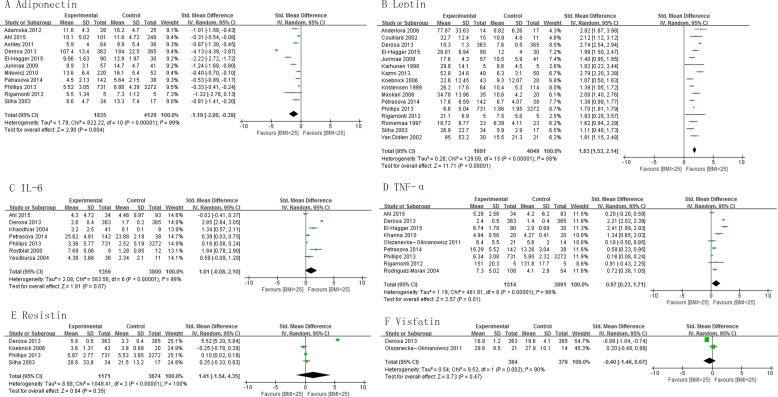
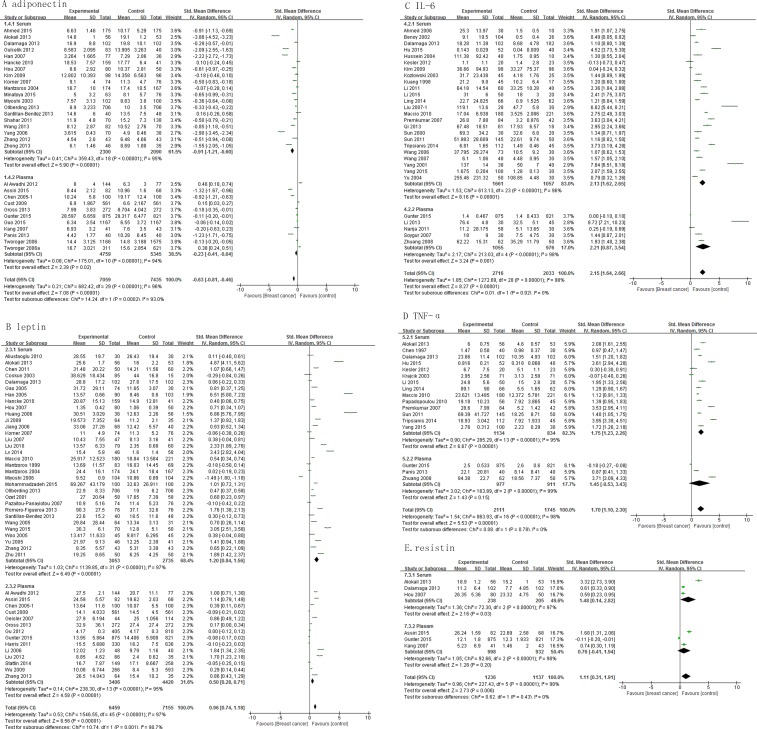
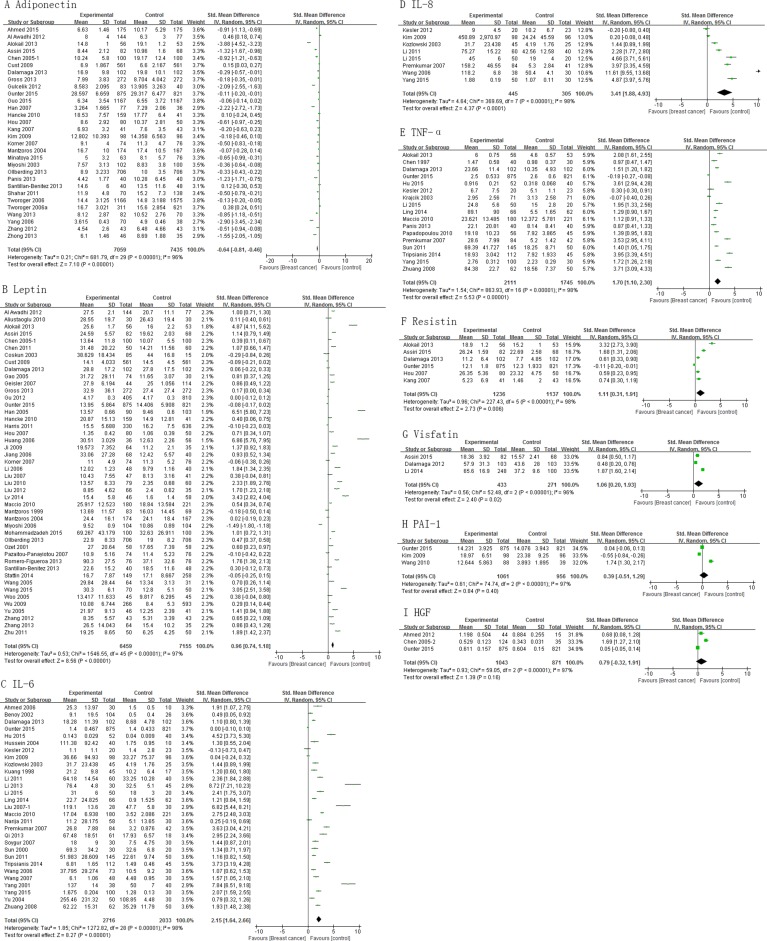
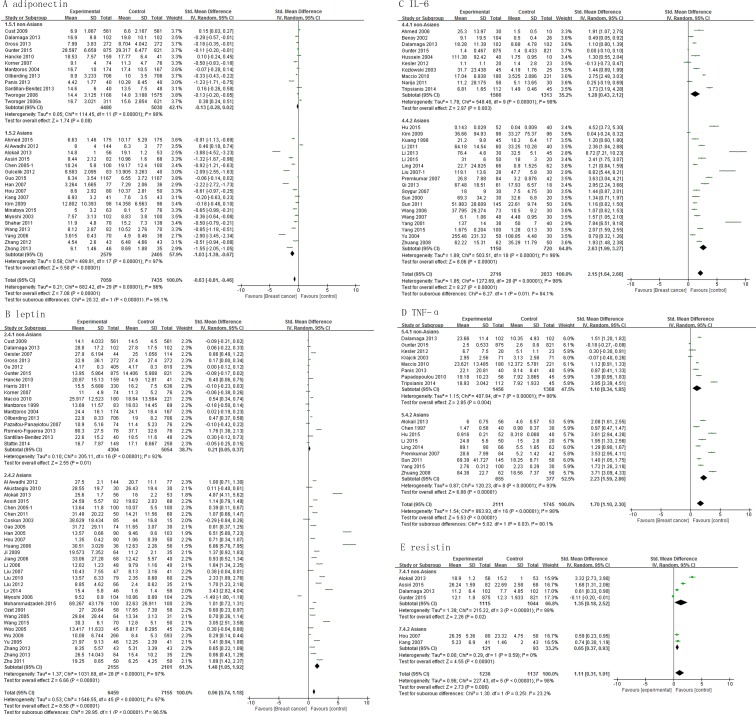
The risk of breast cancer is significantly increased among obese women as the deleterious adipokines can be over secreted and beneficial adipokines can be hyposecreted. We aim to evaluate the association between obesity-associated adipokines and breast cancer. We searched PubMed, EMBASE, Web of Science, and Chinese Biomedical Literature (CBM) databases for studies reporting association of obesity related adipokines with breast cancer published before Sept. 15, 2015. Initially, 26783 publications were identified, and later, 119 articles were selected for further meta-analysis. Out of these 119 studies, twenty-six studies had reported adipokine levels among obese and non-obese healthy subjects and ninety-three studies had reported adipokine levels among patients with breast cancer. The subjects with BMI >25 kg/m2 had significantly lower adiponectin levels and higher leptin and tumor necrosis factor-α (TNF-α) levels than those with BMI <25 kg/m2. Decreased concentrations of adiponectin, and increased concentrations of leptin, IL-6, IL-8, TNF-α, resistin and visfatin were significantly associated with risk of breast cancer. Adipokine levels were strongly associated with breast cancer among Asian women as compared to non-Asian women. Our results might explain the relationship of obesity, adipokine levels and risk of breast cancer, especially in Asian women.
肥胖女性患乳腺癌的风险显著增加,因为有害的脂肪因子可能分泌过多,而有益的脂肪因子可能分泌不足。我们旨在评估肥胖相关脂肪因子与乳腺癌之间的关联。我们检索了PubMed、EMBASE、科学网和中国生物医学文献数据库(CBM),以查找2015年9月15日前发表的关于肥胖相关脂肪因子与乳腺癌关联的研究。最初识别出26783篇出版物,之后选择了119篇文章进行进一步的荟萃分析。在这119项研究中,26项研究报告了肥胖和非肥胖健康受试者的脂肪因子水平,93项研究报告了乳腺癌患者的脂肪因子水平。体重指数(BMI)>25kg/m2的受试者与BMI<25kg/m2的受试者相比,脂联素水平显著降低,瘦素和肿瘤坏死因子-α(TNF-α)水平更高。脂联素浓度降低,瘦素、白细胞介素-6(IL-6)、白细胞介素-8(IL-8)、TNF-α、抵抗素和内脂素浓度升高与乳腺癌风险显著相关。与非亚洲女性相比,亚洲女性的脂肪因子水平与乳腺癌的关联更为密切。我们的研究结果可能解释了肥胖、脂肪因子水平与乳腺癌风险之间的关系,尤其是在亚洲女性中。