Mir Mohammad Muzaffar, Mir Rashid, Alghamdi Mushabab Ayed Abdullah, Wani Javed Iqbal, Sabah Zia Ul, Jeelani Mohammed, Marakala Vijaya, Sohail Shahzada Khalid, O'haj Mohamed, Alharthi Muffarah Hamid, Alamri Mohannad Mohammad S
Department of Basic Medical Sciences, College of Medicine, University of Bisha, Bisha 61922, Saudi Arabia.
Prince Fahd Bin Sultan Research Chair, Department of MLT, Faculty of Applied Medical Sciences, University of Tabuk, Tabuk 71491, Saudi Arabia.
J Pers Med. 2022 May 1;12(5):735. doi: 10.3390/jpm12050735.
Sedentary lifestyles, urbanization and improvements in socio-economic status have had serious effects on the burden of diabetes across the world. Diabetes is one of the 10 leading causes of death globally, and individuals with diabetes have a 2-3-fold increased risk of all-cause mortality. Adipose tissue is increasingly understood as a highly active endocrine gland that secretes many biologically active substances, including adipocytokines. However, the exact and discrete pathophysiological links between obesity and T2DM are not yet fully elucidated.
In the current study, we present the association of five diverse adipocytokines, adiponectin, leptin, resistin, visfatin and chemerin, with T2DM in 87 patients (46 males and 41 females) with type 2 diabetes mellitus and 85 healthy controls (44 males and 41 females) from the Asir region of Saudi Arabia. The patients were divided into four groups: normal BMI, overweight, obese and severely obese. The baseline biochemical characteristics, including HbA1c and anthropometric lipid indices, such as BMI and waist-hip ratio, were determined by standard procedures, whereas the selected adipokine levels were assayed by ELISA.
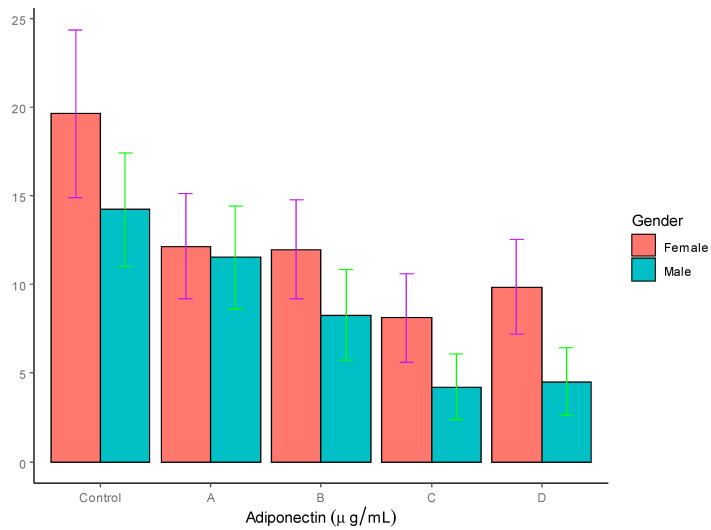
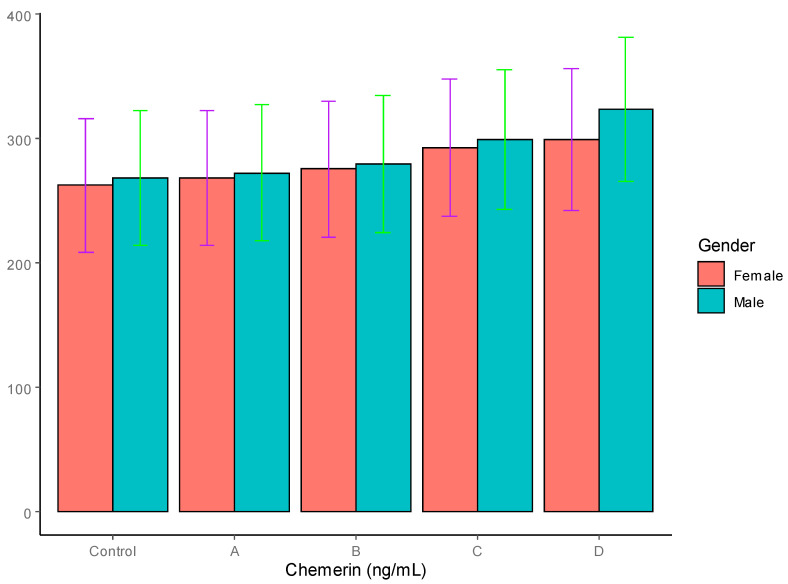
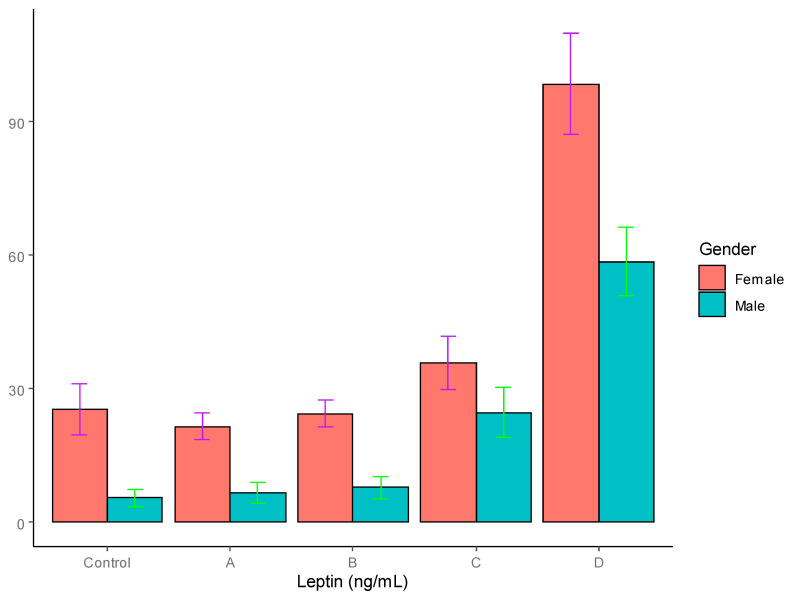
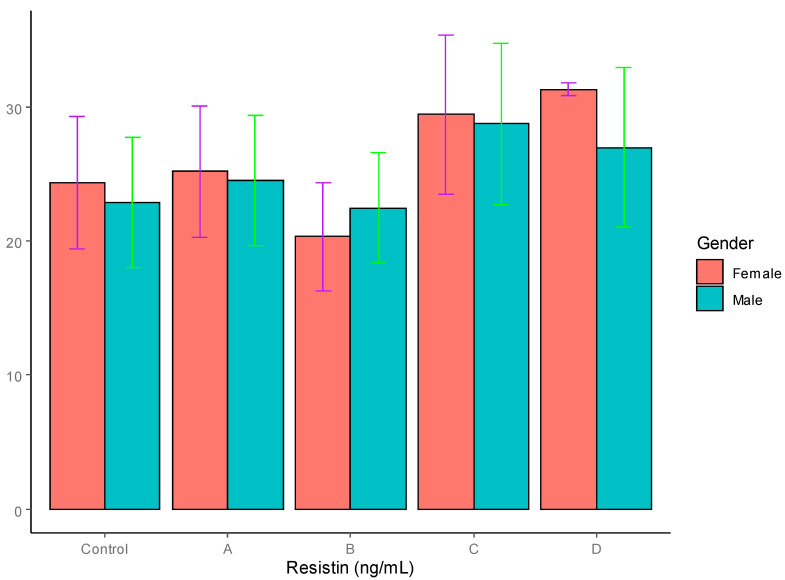
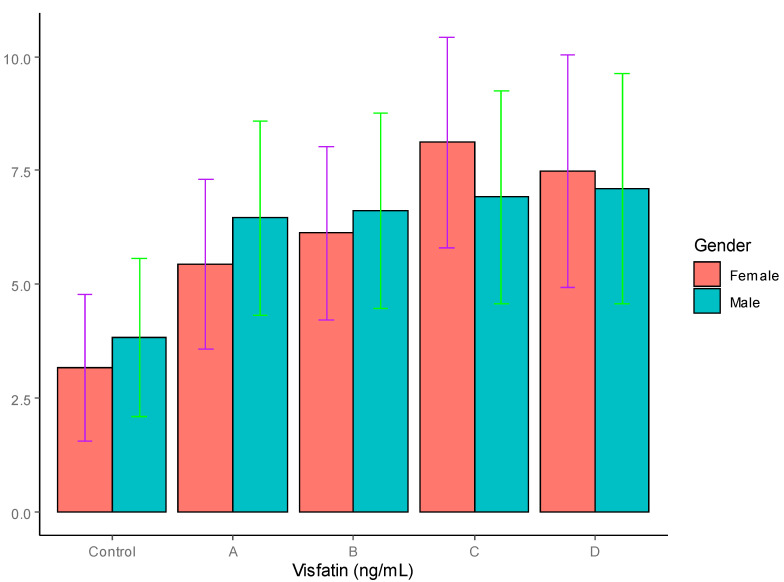
The results showed significantly decreased levels of adiponectin in the T2DM patients compared to the control group, and the decrease was more pronounced in obese and severely obese T2DM patients. Serum leptin levels were significantly higher in the females compared to the males in the controls as well as all the four groups of T2DM patients. In the male T2DM patients, a progressive increase was observed in the leptin levels as the BMI increased, although these only reached significantly altered levels in the obese and severely obese patients. The serum leptin levels were significantly higher in the severely obese female patients compared to the controls, patients with normal BMI, and overweight patients. The leptin/adiponectin ratio was significantly higher in the obese and severely obese patients compared to the controls, patients with normal BMI, and overweight patients in both genders. The serum resistin levels did not show any significant differences between the males and females in thr controls or in the T2DM groups, irrespective of the BMI status of the T2DM patients. The visfatin levels did not reveal any significant gender-based differences, but significantly higher levels of visfatin were observed in the T2DM patients, irrespective of their level of obesity, although the higher values were observed in the obese and highly obese patients. Similarly, the serum chemerin levels in the controls, as well as in T2DM patients, did not show any significant gender-based differences. However, in the T2DM patients, the chemerin levels showed a progressive increase, with the increase in BMI reaching highly significant levels in the obese and severely obese patients, respectively.
In summary, it is concluded that significantly altered concentrations of four adipokines, adiponectin, leptin, visfatin and chemerin, were found in the T2DM patient group compared to the controls, with more pronounced alterations observed in the obese and highly obese patients. Thus, it can be surmised that these four adipokines play a profound role in the onset, progression and associated complications of T2DM. In view of the relatively small sample size in our study, future prospective studies are needed on a large sample size to explore the in-depth relationship between adipokines and T2DM.
久坐不动的生活方式、城市化以及社会经济地位的改善对全球糖尿病负担产生了严重影响。糖尿病是全球十大主要死因之一,糖尿病患者全因死亡率增加2至3倍。脂肪组织越来越被认为是一种高度活跃的内分泌腺,可分泌多种生物活性物质,包括脂肪细胞因子。然而,肥胖与2型糖尿病(T2DM)之间确切且具体的病理生理联系尚未完全阐明。
在本研究中,我们呈现了沙特阿拉伯阿西尔地区87例2型糖尿病患者(46例男性和41例女性)和85例健康对照者(44例男性和41例女性)中五种不同脂肪细胞因子(脂联素、瘦素、抵抗素、内脏脂肪素和chemerin)与T2DM的关联。患者被分为四组:正常体重指数(BMI)、超重、肥胖和重度肥胖。通过标准程序测定包括糖化血红蛋白(HbA1c)在内的基线生化特征以及人体测量学脂质指标,如BMI和腰臀比,而所选脂肪细胞因子水平通过酶联免疫吸附测定(ELISA)法进行检测。
结果显示,与对照组相比,T2DM患者脂联素水平显著降低,且在肥胖和重度肥胖的T2DM患者中降低更为明显。在对照组以及所有四组T2DM患者中,女性血清瘦素水平显著高于男性。在男性T2DM患者中,随着BMI增加,瘦素水平逐渐升高,尽管仅在肥胖和重度肥胖患者中达到显著改变水平。与对照组、正常BMI患者和超重患者相比,重度肥胖女性患者血清瘦素水平显著更高。肥胖和重度肥胖患者的瘦素/脂联素比值显著高于对照组、正常BMI患者和超重患者(男女皆是)。在对照组或T2DM组中,无论T2DM患者的BMI状况如何,男性和女性血清抵抗素水平均未显示出任何显著差异。内脏脂肪素水平未显示出任何基于性别的显著差异,但在T2DM患者中观察到内脏脂肪素水平显著更高,无论其肥胖程度如何,尽管在肥胖和高度肥胖患者中观察到更高值。同样,对照组以及T2DM患者的血清chemerin水平未显示出任何基于性别的显著差异。然而,在T2DM患者中,chemerin水平逐渐升高,随着BMI增加,在肥胖和重度肥胖患者中分别达到高度显著水平。
总之,得出结论:与对照组相比,T2DM患者组中四种脂肪细胞因子(脂联素、瘦素、内脏脂肪素和chemerin)浓度显著改变,在肥胖和高度肥胖患者中观察到更明显的改变。因此,可以推测这四种脂肪细胞因子在T2DM的发病、进展及相关并发症中起重要作用。鉴于我们研究中的样本量相对较小,未来需要进行大样本量的前瞻性研究,以探索脂肪细胞因子与T2DM之间的深入关系。