Division of Digestive and General Surgery, Niigata University Graduate School of Medical and Dental Sciences, 1-757 Asahimachi-dori, Chuo-ku, Niigata City, Niigata, 951-8510, Japan.
Department of Gastroenterological Surgery, Niigata Cancer Center Hospital, 2-15-3 Kawagishi-cho, Chuo-ku, Niigata City, Niigata, 951-8566, Japan.
Genome Med. 2017 Oct 31;9(1):93. doi: 10.1186/s13073-017-0484-3.
Intertumoral heterogeneity represents a significant hurdle to identifying optimized targeted therapies in gastric cancer (GC). To realize precision medicine for GC patients, an actionable gene alteration-based molecular classification that directly associates GCs with targeted therapies is needed.
A total of 207 Japanese patients with GC were included in this study. Formalin-fixed, paraffin-embedded (FFPE) tumor tissues were obtained from surgical or biopsy specimens and were subjected to DNA extraction. We generated comprehensive genomic profiling data using a 435-gene panel including 69 actionable genes paired with US Food and Drug Administration-approved targeted therapies, and the evaluation of Epstein-Barr virus (EBV) infection and microsatellite instability (MSI) status.
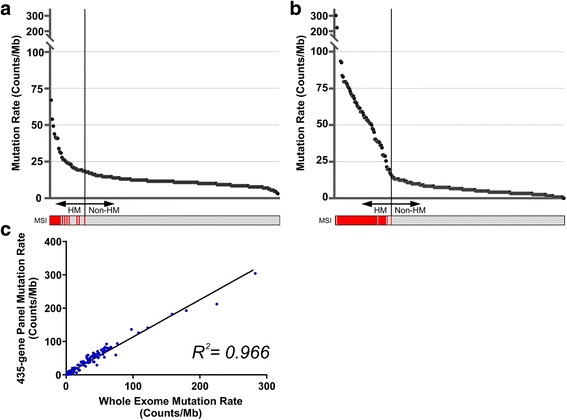
Comprehensive genomic sequencing detected at least one alteration of 435 cancer-related genes in 194 GCs (93.7%) and of 69 actionable genes in 141 GCs (68.1%). We classified the 207 GCs into four The Cancer Genome Atlas (TCGA) subtypes using the genomic profiling data; EBV (N = 9), MSI (N = 17), chromosomal instability (N = 119), and genomically stable subtype (N = 62). Actionable gene alterations were not specific and were widely observed throughout all TCGA subtypes. To discover a novel classification which more precisely selects candidates for targeted therapies, 207 GCs were classified using hypermutated phenotype and the mutation profile of 69 actionable genes. We identified a hypermutated group (N = 32), while the others (N = 175) were sub-divided into six clusters including five with actionable gene alterations: ERBB2 (N = 25), CDKN2A, and CDKN2B (N = 10), KRAS (N = 10), BRCA2 (N = 9), and ATM cluster (N = 12). The clinical utility of this classification was demonstrated by a case of unresectable GC with a remarkable response to anti-HER2 therapy in the ERBB2 cluster.
This actionable gene-based classification creates a framework for further studies for realizing precision medicine in GC.
肿瘤间异质性是胃癌(GC)中确定优化靶向治疗的重大障碍。为了实现 GC 患者的精准医疗,需要一种基于可操作基因改变的分子分类,该分类可直接将 GC 与靶向治疗相关联。
本研究纳入了 207 例日本 GC 患者。从手术或活检标本中获取福尔马林固定、石蜡包埋(FFPE)肿瘤组织,并进行 DNA 提取。我们使用包括 69 个与美国食品和药物管理局批准的靶向治疗相匹配的可操作基因的 435 个基因组合成综合基因组分析数据,并评估 Epstein-Barr 病毒(EBV)感染和微卫星不稳定性(MSI)状态。
综合基因组测序在 194 例 GC 中检测到 435 个癌症相关基因中至少有一个改变(93.7%),在 141 例 GC 中检测到 69 个可操作基因中有一个改变(68.1%)。我们使用基因组分析数据将 207 例 GC 分为 4 个癌症基因组图谱(TCGA)亚型;EBV(N=9)、MSI(N=17)、染色体不稳定性(N=119)和基因组稳定亚型(N=62)。可操作的基因改变并不具有特异性,并且广泛存在于所有 TCGA 亚型中。为了发现一种更精确地选择靶向治疗候选者的新分类,我们使用 207 例 GC 的超突变表型和 69 个可操作基因的突变谱对其进行分类。我们鉴定了一个超突变组(N=32),而其他(N=175)则分为六个簇,包括五个具有可操作基因改变的簇:ERBB2(N=25)、CDKN2A 和 CDKN2B(N=10)、KRAS(N=10)、BRCA2(N=9)和 ATM 簇(N=12)。在 ERBB2 簇中,对一例不可切除的 GC 患者进行抗 HER2 治疗后,显著缓解,证明了这种分类的临床实用性。
这种基于可操作基因的分类为实现 GC 精准医疗提供了一个框架。