• 文献检索
  • 文档翻译
  • 深度研究
  • 学术资讯
  • Suppr Zotero 插件Zotero 插件
  • 邀请有礼
  • 套餐&价格
  • 历史记录
应用&插件
Suppr Zotero 插件Zotero 插件浏览器插件Mac 客户端Windows 客户端微信小程序
定价
高级版会员购买积分包购买API积分包
服务
文献检索文档翻译深度研究API 文档MCP 服务
关于我们
关于 Suppr公司介绍联系我们用户协议隐私条款
关注我们

Suppr 超能文献

核心技术专利:CN118964589B侵权必究
粤ICP备2023148730 号-1Suppr @ 2026

文献检索

告别复杂PubMed语法,用中文像聊天一样搜索,搜遍4000万医学文献。AI智能推荐,让科研检索更轻松。

立即免费搜索

文件翻译

保留排版,准确专业,支持PDF/Word/PPT等文件格式,支持 12+语言互译。

免费翻译文档

深度研究

AI帮你快速写综述,25分钟生成高质量综述,智能提取关键信息,辅助科研写作。

立即免费体验

不变目标识别是人类对不变特征的个性化选择,不能简单地用分层前馈视觉模型来解释。

Invariant object recognition is a personalized selection of invariant features in humans, not simply explained by hierarchical feed-forward vision models.

机构信息

Department of Electrical Engineering, Shahid Rajaee Teacher Training University, Tehran, Iran.

Cognitive Science Research lab., Department of Computer Engineering, Shahid Rajaee Teacher Training University, Tehran, Iran.

出版信息

Sci Rep. 2017 Oct 31;7(1):14402. doi: 10.1038/s41598-017-13756-8.

DOI:10.1038/s41598-017-13756-8
PMID:29089520
原文链接:https://pmc.ncbi.nlm.nih.gov/articles/PMC5663844/
Abstract

One key ability of human brain is invariant object recognition, which refers to rapid and accurate recognition of objects in the presence of variations such as size, rotation and position. Despite decades of research into the topic, it remains unknown how the brain constructs invariant representations of objects. Providing brain-plausible object representations and reaching human-level accuracy in recognition, hierarchical models of human vision have suggested that, human brain implements similar feed-forward operations to obtain invariant representations. However, conducting two psychophysical object recognition experiments on humans with systematically controlled variations of objects, we observed that humans relied on specific (diagnostic) object regions for accurate recognition which remained relatively consistent (invariant) across variations; but feed-forward feature-extraction models selected view-specific (non-invariant) features across variations. This suggests that models can develop different strategies, but reach human-level recognition performance. Moreover, human individuals largely disagreed on their diagnostic features and flexibly shifted their feature extraction strategy from view-invariant to view-specific when objects became more similar. This implies that, even in rapid object recognition, rather than a set of feed-forward mechanisms which extract diagnostic features from objects in a hard-wired fashion, the bottom-up visual pathways receive, through top-down connections, task-related information possibly processed in prefrontal cortex.

摘要

人类大脑的一个关键能力是不变物体识别,即指在大小、旋转和位置等变化的情况下,对物体进行快速而准确的识别。尽管对这个主题进行了几十年的研究,但仍然不清楚大脑如何构建物体的不变表示。人类视觉的分层模型提供了具有大脑似然的物体表示,并在识别方面达到了人类水平的准确性,它们表明,人类大脑通过类似的前馈操作来获得不变的表示。然而,我们通过对人类进行了两个具有系统控制的物体变化的心理物理学物体识别实验,观察到人类依赖于特定的(诊断性的)物体区域进行准确识别,这些区域在变化中保持相对一致(不变);但是前馈特征提取模型在变化中选择了特定视图的(非不变)特征。这表明模型可以采用不同的策略,但可以达到人类水平的识别性能。此外,人类个体在他们的诊断特征上存在很大的分歧,并在物体变得更加相似时,灵活地将他们的特征提取策略从视图不变转换为视图特定。这意味着,即使在快速的物体识别中,也不是一组通过前馈机制以硬连线的方式从物体中提取诊断特征,而是通过自上而下的连接,从底部向上的视觉通路接收可能在前额叶皮层中处理的与任务相关的信息。
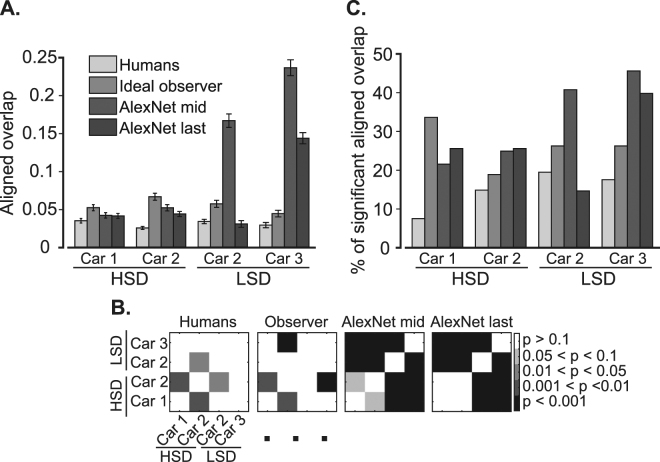
https://cdn.ncbi.nlm.nih.gov/pmc/blobs/3ce4/5663844/805467777c26/41598_2017_13756_Fig12_HTML.jpg
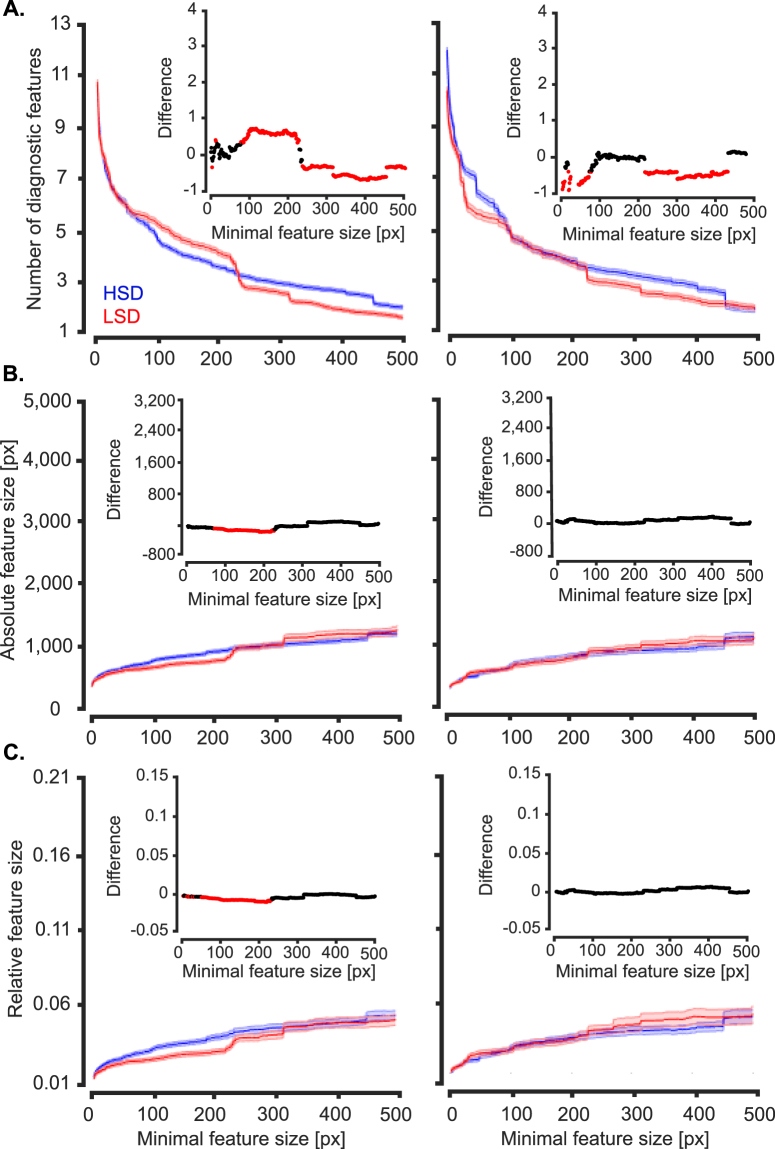
https://cdn.ncbi.nlm.nih.gov/pmc/blobs/3ce4/5663844/d792e9fef73d/41598_2017_13756_Fig1_HTML.jpg
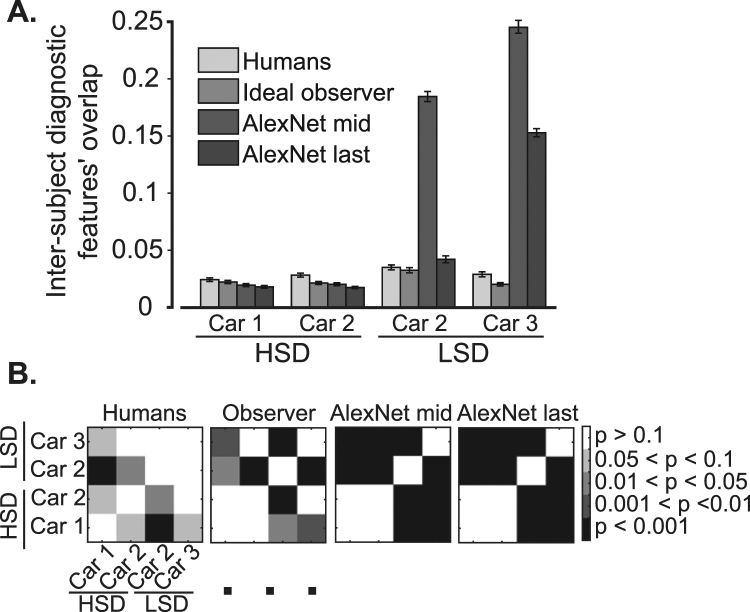
https://cdn.ncbi.nlm.nih.gov/pmc/blobs/3ce4/5663844/aa21d10d7f24/41598_2017_13756_Fig2_HTML.jpg
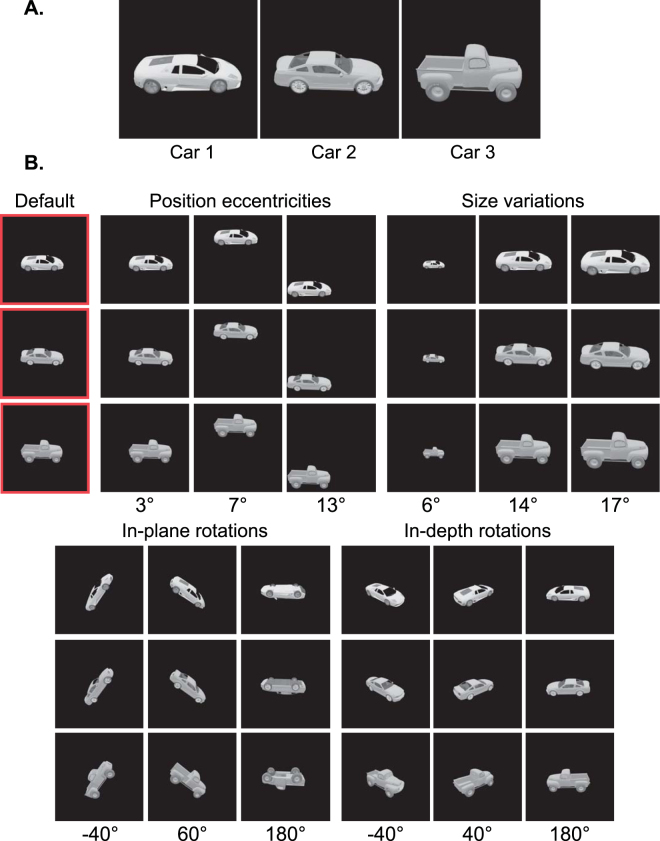
https://cdn.ncbi.nlm.nih.gov/pmc/blobs/3ce4/5663844/6b89a16cffd2/41598_2017_13756_Fig3_HTML.jpg
https://cdn.ncbi.nlm.nih.gov/pmc/blobs/3ce4/5663844/16e784ac137d/41598_2017_13756_Fig4_HTML.jpg
https://cdn.ncbi.nlm.nih.gov/pmc/blobs/3ce4/5663844/be2e96fa23cf/41598_2017_13756_Fig5_HTML.jpg
https://cdn.ncbi.nlm.nih.gov/pmc/blobs/3ce4/5663844/87dffd20d969/41598_2017_13756_Fig6_HTML.jpg
https://cdn.ncbi.nlm.nih.gov/pmc/blobs/3ce4/5663844/1c040b3a3148/41598_2017_13756_Fig7_HTML.jpg
https://cdn.ncbi.nlm.nih.gov/pmc/blobs/3ce4/5663844/28ec04709bdc/41598_2017_13756_Fig8_HTML.jpg
https://cdn.ncbi.nlm.nih.gov/pmc/blobs/3ce4/5663844/7cadf9a370da/41598_2017_13756_Fig9_HTML.jpg
https://cdn.ncbi.nlm.nih.gov/pmc/blobs/3ce4/5663844/67a8f24f63c6/41598_2017_13756_Fig10_HTML.jpg
https://cdn.ncbi.nlm.nih.gov/pmc/blobs/3ce4/5663844/7e0e9393e68b/41598_2017_13756_Fig11_HTML.jpg
https://cdn.ncbi.nlm.nih.gov/pmc/blobs/3ce4/5663844/805467777c26/41598_2017_13756_Fig12_HTML.jpg
https://cdn.ncbi.nlm.nih.gov/pmc/blobs/3ce4/5663844/d792e9fef73d/41598_2017_13756_Fig1_HTML.jpg
https://cdn.ncbi.nlm.nih.gov/pmc/blobs/3ce4/5663844/aa21d10d7f24/41598_2017_13756_Fig2_HTML.jpg
https://cdn.ncbi.nlm.nih.gov/pmc/blobs/3ce4/5663844/6b89a16cffd2/41598_2017_13756_Fig3_HTML.jpg
https://cdn.ncbi.nlm.nih.gov/pmc/blobs/3ce4/5663844/16e784ac137d/41598_2017_13756_Fig4_HTML.jpg
https://cdn.ncbi.nlm.nih.gov/pmc/blobs/3ce4/5663844/be2e96fa23cf/41598_2017_13756_Fig5_HTML.jpg
https://cdn.ncbi.nlm.nih.gov/pmc/blobs/3ce4/5663844/87dffd20d969/41598_2017_13756_Fig6_HTML.jpg
https://cdn.ncbi.nlm.nih.gov/pmc/blobs/3ce4/5663844/1c040b3a3148/41598_2017_13756_Fig7_HTML.jpg
https://cdn.ncbi.nlm.nih.gov/pmc/blobs/3ce4/5663844/28ec04709bdc/41598_2017_13756_Fig8_HTML.jpg
https://cdn.ncbi.nlm.nih.gov/pmc/blobs/3ce4/5663844/7cadf9a370da/41598_2017_13756_Fig9_HTML.jpg
https://cdn.ncbi.nlm.nih.gov/pmc/blobs/3ce4/5663844/67a8f24f63c6/41598_2017_13756_Fig10_HTML.jpg
https://cdn.ncbi.nlm.nih.gov/pmc/blobs/3ce4/5663844/7e0e9393e68b/41598_2017_13756_Fig11_HTML.jpg
https://cdn.ncbi.nlm.nih.gov/pmc/blobs/3ce4/5663844/805467777c26/41598_2017_13756_Fig12_HTML.jpg

相似文献

1
Invariant object recognition is a personalized selection of invariant features in humans, not simply explained by hierarchical feed-forward vision models.不变目标识别是人类对不变特征的个性化选择,不能简单地用分层前馈视觉模型来解释。
Sci Rep. 2017 Oct 31;7(1):14402. doi: 10.1038/s41598-017-13756-8.
2
Hard-wired feed-forward visual mechanisms of the brain compensate for affine variations in object recognition.大脑中固有的前馈视觉机制可补偿物体识别中的仿射变化。
Neuroscience. 2017 May 4;349:48-63. doi: 10.1016/j.neuroscience.2017.02.050. Epub 2017 Feb 27.
3
Accuracy of Rats in Discriminating Visual Objects Is Explained by the Complexity of Their Perceptual Strategy.老鼠辨别视觉物体的准确性可以用其感知策略的复杂性来解释。
Curr Biol. 2018 Apr 2;28(7):1005-1015.e5. doi: 10.1016/j.cub.2018.02.037. Epub 2018 Mar 15.
4
Humans and Deep Networks Largely Agree on Which Kinds of Variation Make Object Recognition Harder.人类和深度网络在哪些类型的变化会使目标识别更困难这一问题上基本达成一致。
Front Comput Neurosci. 2016 Aug 31;10:92. doi: 10.3389/fncom.2016.00092. eCollection 2016.
5
Object similarity affects the perceptual strategy underlying invariant visual object recognition in rats.物体相似度影响大鼠不变视觉物体识别背后的感知策略。
Front Neural Circuits. 2015 Mar 12;9:10. doi: 10.3389/fncir.2015.00010. eCollection 2015.
6
Development of novel tasks for studying view-invariant object recognition in rodents: Sensitivity to scopolamine.用于研究啮齿动物视图不变物体识别的新任务开发:对东莨菪碱的敏感性。
Behav Brain Res. 2018 May 15;344:48-56. doi: 10.1016/j.bbr.2018.01.030. Epub 2018 Feb 2.
7
Invariant visual object recognition: biologically plausible approaches.不变视觉物体识别:生物学上可行的方法。
Biol Cybern. 2015 Oct;109(4-5):505-35. doi: 10.1007/s00422-015-0658-2. Epub 2015 Sep 3.
8
View-invariant object recognition ability develops after discrimination, not mere exposure, at several viewing angles.在多个视角下,经过辨别而非仅仅是接触,才能发展出视角不变的物体识别能力。
Eur J Neurosci. 2010 Jan;31(2):327-35. doi: 10.1111/j.1460-9568.2009.07057.x. Epub 2010 Jan 13.
9
The dynamics of invariant object recognition in the human visual system.人类视觉系统中不变目标识别的动态
J Neurophysiol. 2014 Jan;111(1):91-102. doi: 10.1152/jn.00394.2013. Epub 2013 Oct 2.
10
Unsupervised changes in core object recognition behavior are predicted by neural plasticity in inferior temporal cortex.无监督的核心物体识别行为变化可由下颞叶皮层的神经可塑性预测。
Elife. 2021 Jun 11;10:e60830. doi: 10.7554/eLife.60830.

引用本文的文献

1
Caveats and Nuances of Model-Based and Model-Free Representational Connectivity Analysis.基于模型和无模型表征连通性分析的注意事项与细微差别
Front Neurosci. 2022 Mar 10;16:755988. doi: 10.3389/fnins.2022.755988. eCollection 2022.
2
A survey of brain network analysis by electroencephalographic signals.基于脑电图信号的脑网络分析综述
Cogn Neurodyn. 2022 Feb;16(1):17-41. doi: 10.1007/s11571-021-09689-8. Epub 2021 Jun 14.
3
Examining the Coding Strength of Object Identity and Nonidentity Features in Human Occipito-Temporal Cortex and Convolutional Neural Networks.

本文引用的文献

1
Recurrent computations for visual pattern completion.视觉模式完成的反复计算。
Proc Natl Acad Sci U S A. 2018 Aug 28;115(35):8835-8840. doi: 10.1073/pnas.1719397115. Epub 2018 Aug 13.
2
Generic decoding of seen and imagined objects using hierarchical visual features.基于分层视觉特征的可见和想象物体的通用解码。
Nat Commun. 2017 May 22;8:15037. doi: 10.1038/ncomms15037.
3
Task alters category representations in prefrontal but not high-level visual cortex.任务改变前额叶皮质而非高级视觉皮质中的类别表征。
检查人类枕颞叶皮层和卷积神经网络中对象身份和非身份特征的编码强度。
J Neurosci. 2021 May 12;41(19):4234-4252. doi: 10.1523/JNEUROSCI.1993-20.2021. Epub 2021 Mar 31.
4
Perceptual difficulty modulates the direction of information flow in familiar face recognition.感知难度调节熟悉面孔识别中的信息流方向。
Neuroimage. 2021 Jun;233:117896. doi: 10.1016/j.neuroimage.2021.117896. Epub 2021 Mar 3.
5
Spatial Frequency Effective for Increasing Perceived Glossiness by Contrast Enhancement.通过对比度增强提高感知光泽度的有效空间频率。
Front Psychol. 2021 Feb 5;12:625135. doi: 10.3389/fpsyg.2021.625135. eCollection 2021.
6
Scale and translation-invariance for novel objects in human vision.人类视觉中新奇物体的尺度和不变性。
Sci Rep. 2020 Jan 29;10(1):1411. doi: 10.1038/s41598-019-57261-6.
7
Lifelong Learning of Spatiotemporal Representations With Dual-Memory Recurrent Self-Organization.基于双记忆循环自组织的时空表征终身学习
Front Neurorobot. 2018 Nov 28;12:78. doi: 10.3389/fnbot.2018.00078. eCollection 2018.
8
Three-stage processing of category and variation information by entangled interactive mechanisms of peri-occipital and peri-frontal cortices.经枕旁和额旁皮质的纠缠交互机制对类别和变异信息的三阶段处理。
Sci Rep. 2018 Aug 15;8(1):12213. doi: 10.1038/s41598-018-30601-8.
Neuroimage. 2017 Jul 15;155:437-449. doi: 10.1016/j.neuroimage.2017.03.062. Epub 2017 Apr 4.
4
Low dimensional representation of face space by face-selective inferior temporal neurons.颞下回面部选择性神经元对面部空间的低维表征
Eur J Neurosci. 2017 May;45(10):1268-1278. doi: 10.1111/ejn.13556. Epub 2017 May 4.
5
Hard-wired feed-forward visual mechanisms of the brain compensate for affine variations in object recognition.大脑中固有的前馈视觉机制可补偿物体识别中的仿射变化。
Neuroscience. 2017 May 4;349:48-63. doi: 10.1016/j.neuroscience.2017.02.050. Epub 2017 Feb 27.
6
Average activity, but not variability, is the dominant factor in the representation of object categories in the brain.大脑中物体类别的表征中,平均活动而非变异性是主导因素。
Neuroscience. 2017 Mar 27;346:14-28. doi: 10.1016/j.neuroscience.2017.01.002. Epub 2017 Jan 11.
7
Comparison of deep neural networks to spatio-temporal cortical dynamics of human visual object recognition reveals hierarchical correspondence.将深度神经网络与人类视觉物体识别的时空皮层动力学进行比较,揭示了层级对应关系。
Sci Rep. 2016 Jun 10;6:27755. doi: 10.1038/srep27755.
8
Explicit information for category-orthogonal object properties increases along the ventral stream.明确的类别正交物体属性信息沿腹侧流增加。
Nat Neurosci. 2016 Apr;19(4):613-22. doi: 10.1038/nn.4247. Epub 2016 Feb 22.
9
Atoms of recognition in human and computer vision.人类视觉与计算机视觉中的识别原子。
Proc Natl Acad Sci U S A. 2016 Mar 8;113(10):2744-9. doi: 10.1073/pnas.1513198113. Epub 2016 Feb 16.
10
Representational dynamics of object recognition: Feedforward and feedback information flows.物体识别的表征动力学:前馈和反馈信息流。
Neuroimage. 2016 Mar;128:385-397. doi: 10.1016/j.neuroimage.2016.01.006. Epub 2016 Jan 13.