Department of Urology, Institute of Urology (Laboratory of Reconstructive Urology), West China Hospital, Sichuan University, Chengdu, Sichuan, P. R. China.
Department of Urology, The Second Affiliated Hospital of Kunming Medical University, Kunming, Yunnan, P. R. China.
Sci Rep. 2017 Oct 31;7(1):14429. doi: 10.1038/s41598-017-14862-3.
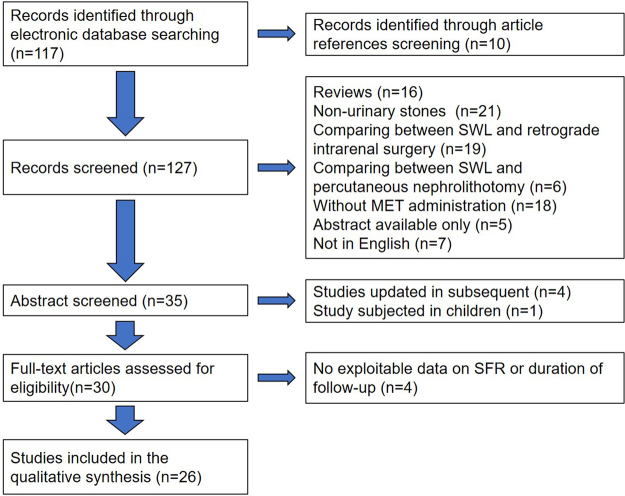
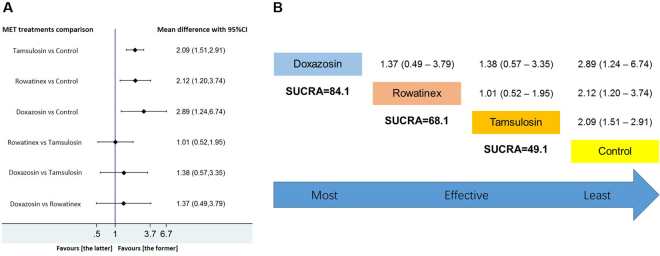
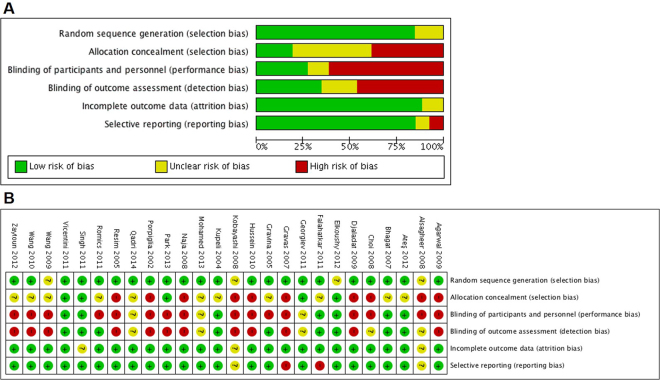
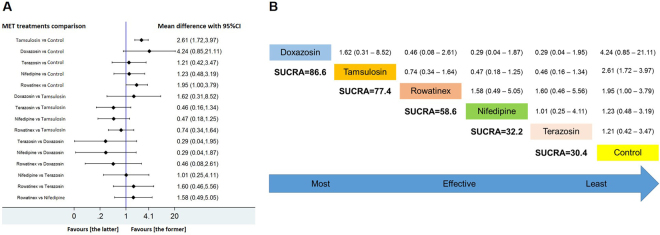
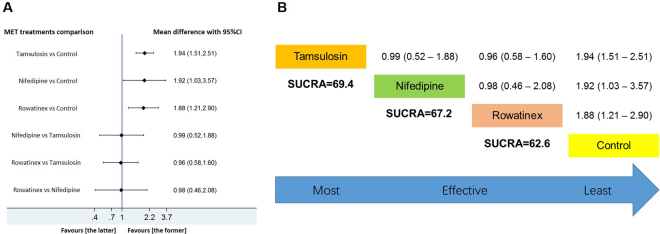
We applied a newly introduced method, network meta-analysis, to re-evaluate the expulsion effect of drugs including tamsulosin, doxazosin, nifedipine, terazosin and rowatinex after extracorporeal shock wave lithotripsy (ESWL) as described in the literature. A systematic search was performed in Medline, Embase and Cochrane Library for articles published before March 2016. Twenty-six studies with 2775 patients were included. The primary outcome was the number of patients with successful stone expulsion. The data were subdivided into three groups according to duration of follow-up. A standard network model was established in each subgroup. In 15-day follow-up results, SUCRA outcome showed the ranking of effects was: doxazosin > tamsulosin > rowatinex > nifedipine > terazosin (88.6, 77.4, 58.6, 32.2 and 30.4, respectively). In 45-day follow-up results, SUCRA ranking was: tamsulosin > nifedipine > rowatinex (69.4, 67.2 and 62.6, respectively). In 90-day follow-up results, SUCRA ranking was: doxazosin > rowatinex > tamsulosin (84.1, 68.1 and 49.1, respectively). In conclusion, doxazosin and tamsulosin have potential to be the first choice for pharmacological therapy to promote the expulsion of urinary stone fragments after ESWL, with this doxazosin can improve the SFR in the long term, while tamsulosin may result more in accelerating the process of expulsion.
我们应用一种新引入的方法,即网络荟萃分析,重新评估了文献中描述的体外冲击波碎石术(ESWL)后包括坦索罗辛、多沙唑嗪、硝苯地平、特拉唑嗪和罗通定在内的药物的排石效果。在 2016 年 3 月之前,我们在 Medline、Embase 和 Cochrane Library 中进行了系统检索。共纳入 26 项研究,共 2775 例患者。主要结局是成功排石的患者数量。根据随访时间将数据分为三组。在每组亚组中建立了标准网络模型。在 15 天随访结果中,SUCRA 结果显示作用的排序为:多沙唑嗪>坦索罗辛>罗通定>硝苯地平>特拉唑嗪(分别为 88.6、77.4、58.6、32.2 和 30.4)。在 45 天随访结果中,SUCRA 排序为:坦索罗辛>硝苯地平>罗通定(分别为 69.4、67.2 和 62.6)。在 90 天随访结果中,SUCRA 排序为:多沙唑嗪>罗通定>坦索罗辛(分别为 84.1、68.1 和 49.1)。总之,多沙唑嗪和坦索罗辛可能成为 ESWL 后促进尿石碎片排出的药物治疗的首选药物,其中多沙唑嗪可长期提高 SFR,而坦索罗辛可能更有助于加速排石过程。