Zhu Qian, Qiao Guo-Liang, Xu Chang, Guo De-Liang, Tang Jie, Duan Rui, Li Yun
Department of Hepatobiliary and Pancreatic Surgery, Jingmen First People's Hospital, Jingmen, Hubei Province.
Department of Medical Oncology, Capital Medical University Cancer Center, Beijing Shijitan Hospital, Beijing.
Cancer Manag Res. 2017 Oct 19;9:525-537. doi: 10.2147/CMAR.S146708. eCollection 2017.
The impact of ruptured hepatocellular carcinoma (HCC) on a patients outcome after hepatic resection remains insufficient. We aimed to identify the independent predictive factors of spontaneous tumor rupture (STR) for curative resection of HCC and to investigate the impact of STR of HCC on long-term survival after resection.
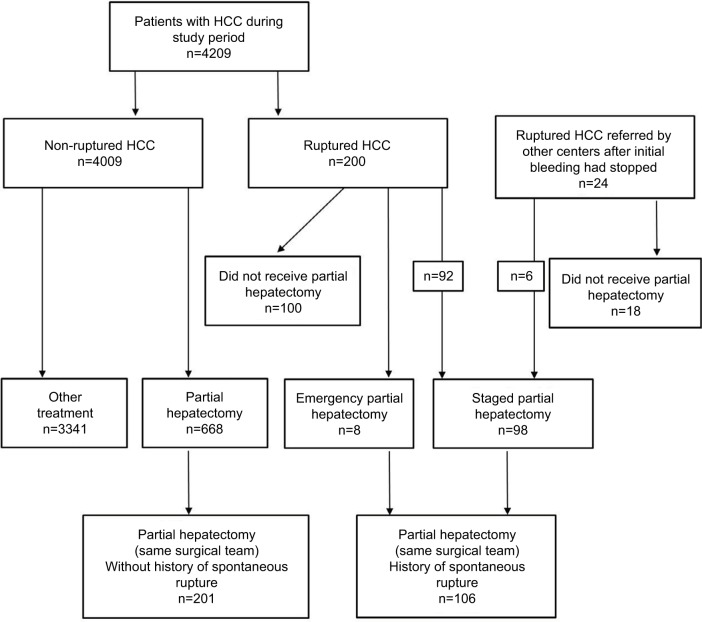
The clinicopathological parameters of 106 patients with ruptured HCC and 201 patients with non-ruptured HCC who underwent hepatic resection from 2007 to 2011 were investigated. Clinical features and factors associated with the clinical outcomes were compared between both groups.
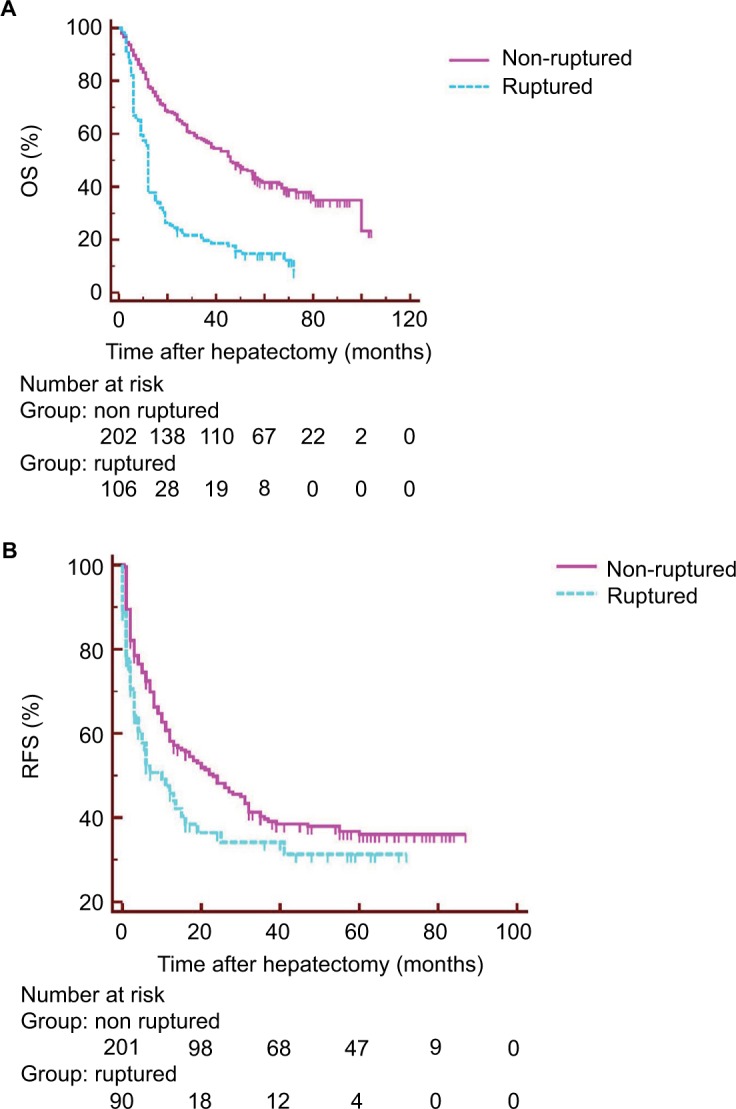
Of 774 HCC patients who underwent surgical resection, 106 (13.7%) had tumor rupture. Multivariate stepwise logistic regression analysis revealed hypertension, liver cirrhosis, total bilirubin (TB), tumor size and ascites to be independent prognostic factors for patients with ruptured HCC. The overall survival (OS) of patients in the ruptured HCC group was significantly poorer compared with those in the non-ruptured HCC group. The 1-, 3- and 5-year OS rates were 77.7%, 56.9% and 41.6%, respectively, in the non-ruptured HCC group and 37.7%, 19.7%, 14.%, respectively, in the ruptured HCC group (<0.001). Similar OS rates were found in patients with non-ruptured and ruptured HCC; patients in the non-ruptured HCC group had a significantly better recurrence-free survival (RFS) rate compared with those in the ruptured group (=0.016).
The presence of hypertension, liver cirrhosis, higher TB levels, tumor size >5 cm and ascites are the independent indicators of poorer prognosis for patients undergoing hepatic resection after ruptured HCC. The present study confirmed that tumor rupture itself had a negative impact on patient survival, but hepatic resection, when technically feasible, is safe and appropriate in selected patients and can result in OS and RFS rates comparable to that of patients with non-ruptured HCC.
肝细胞癌(HCC)破裂对肝切除术后患者预后的影响尚不明确。我们旨在确定HCC根治性切除术中自发性肿瘤破裂(STR)的独立预测因素,并研究HCC的STR对切除术后长期生存的影响。
对2007年至2011年接受肝切除的106例破裂HCC患者和201例未破裂HCC患者的临床病理参数进行研究。比较两组的临床特征及与临床结局相关的因素。
在774例行手术切除的HCC患者中,106例(13.7%)发生肿瘤破裂。多因素逐步逻辑回归分析显示,高血压、肝硬化、总胆红素(TB)、肿瘤大小和腹水是破裂HCC患者的独立预后因素。与未破裂HCC组相比,破裂HCC组患者的总生存期(OS)明显较差。未破裂HCC组的1年、3年和5年OS率分别为77.7%、56.9%和41.6%,而破裂HCC组分别为37.7%、19.7%、14%(P<0.001)。未破裂和破裂HCC患者的OS率相似;未破裂HCC组患者的无复发生存期(RFS)率明显高于破裂组(P=0.016)。
高血压、肝硬化、TB水平升高、肿瘤大小>5 cm和腹水的存在是破裂HCC肝切除术后患者预后较差的独立指标。本研究证实肿瘤破裂本身对患者生存有负面影响,但在技术可行的情况下,肝切除对部分患者是安全且合适的,其OS和RFS率与未破裂HCC患者相当。