Chan Wan Ying, Chong Le Roy
Department of Radiology, Changi General Hospital, Singapore 529889, Singapore.
Korean J Radiol. 2017 Nov-Dec;18(6):957-963. doi: 10.3348/kjr.2017.18.6.957. Epub 2017 Sep 21.
Lister's tubercle is used as a standard anatomical landmark in hand surgery and arthroscopy procedures. In this study, we aimed to evaluate and propose a classification for anatomical variants of Lister's tubercle.
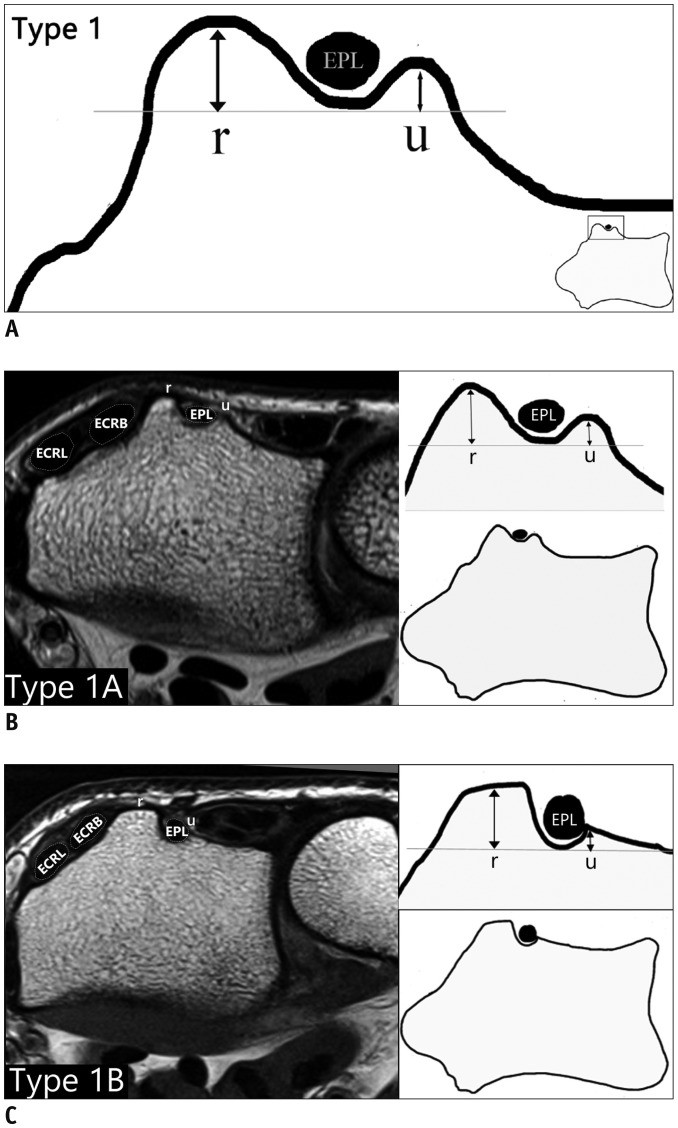
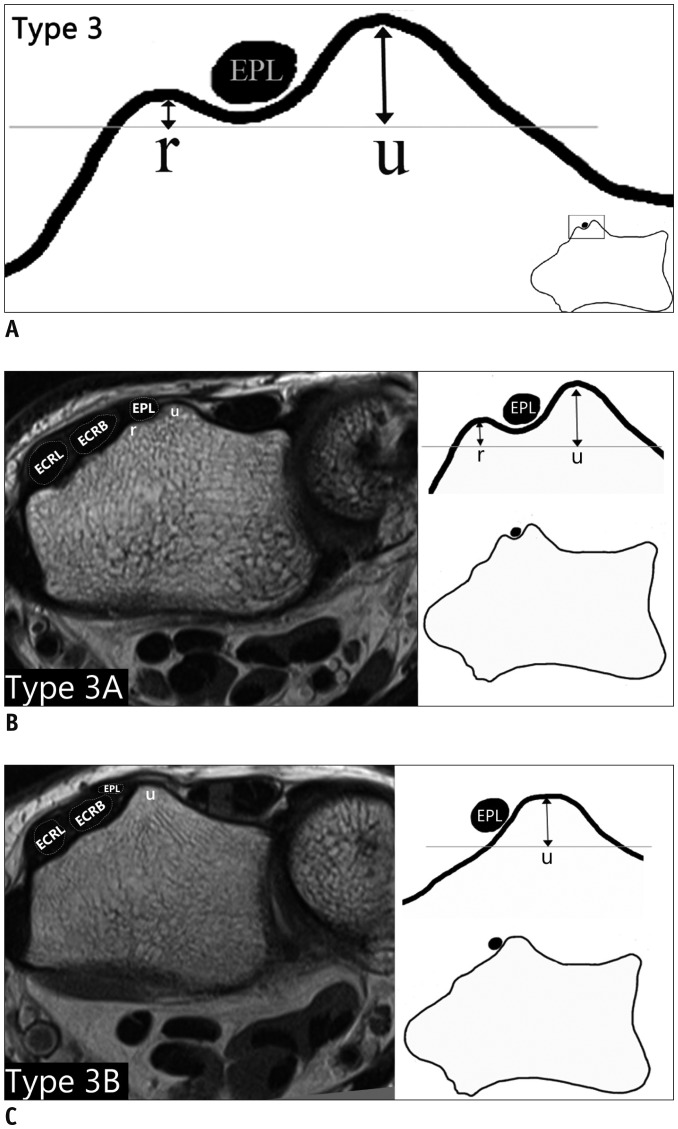
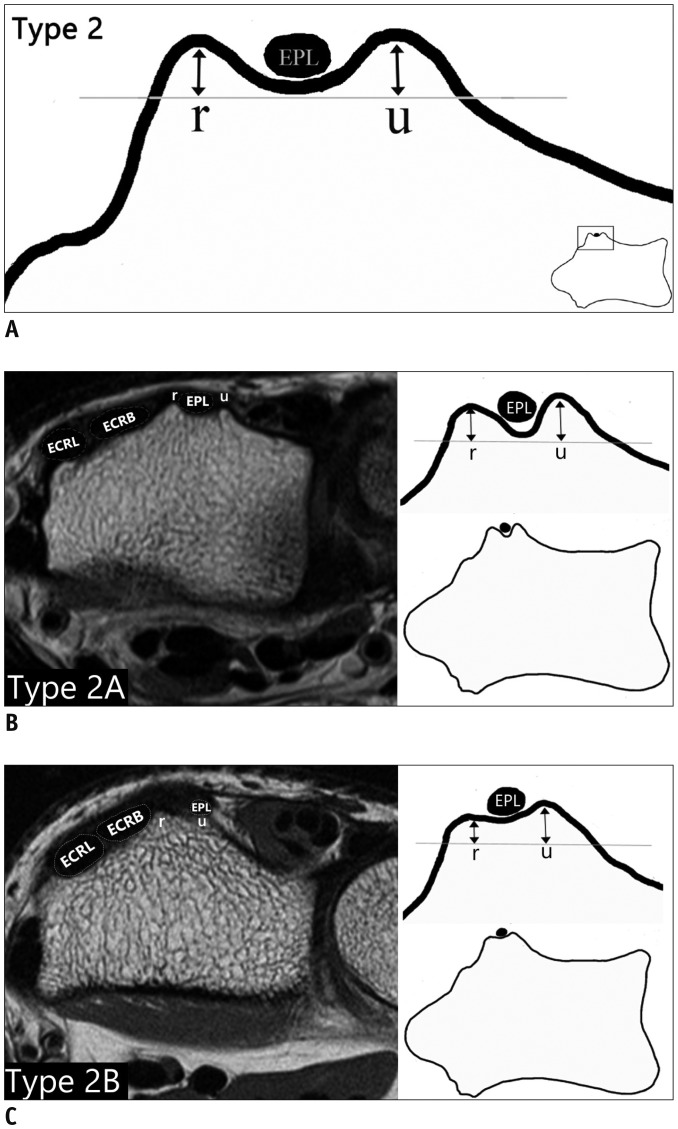
Between September 2011 and July 2014, 360 MRI examinations for wrists performed using 1.5T scanners in a single institution were retrospectively evaluated. The prevalence of anatomical variants of Lister's tubercle based on the heights and morphology of its radial and ulnar peaks was assessed. These were classified into three distinct types: radial peak larger than ulnar peak (Type 1), similar radial and ulnar peaks (Type 2) and ulnar peak larger than radial peak (Type 3). Each type was further divided into 2 subtypes (A and B) based on the morphology of the peaks.
The proportions of Type 1, Type 2, and Type 3 variants in the study population were 69.2, 21.4, and 9.5%, respectively. For the subtypes, the Type 1A variant was the most common (41.4%) and conformed to the classical appearance of Lister's tubercle; whereas, Type 3A and 3B variants were rare configurations (6.4% and 3.1%, respectively) wherein the extensor pollicis longus tendon coursed along the radial aspect of Lister's tubercle.
Anatomical variations of Lister's tubercle have potential clinical implications for certain pathological conditions and pre-procedural planning. The proposed classification system facilitates a better understanding of these anatomical variations and easier identification of at-risk and rare variants.
在手部手术和关节镜手术中,李斯特结节用作标准解剖标志。在本研究中,我们旨在评估并提出李斯特结节解剖变异的分类。
回顾性评估2011年9月至2014年7月间在单一机构使用1.5T扫描仪对腕部进行的360例MRI检查。根据其桡侧和尺侧峰的高度和形态评估李斯特结节解剖变异的发生率。这些变异分为三种不同类型:桡侧峰大于尺侧峰(1型)、桡侧和尺侧峰相似(2型)以及尺侧峰大于桡侧峰(3型)。根据峰的形态,每种类型进一步分为2个亚型(A和B)。
研究人群中1型、2型和3型变异的比例分别为69.2%、21.4%和9.5%。对于各亚型,1A型变异最为常见(41.4%),符合李斯特结节的经典外观;而3A型和3B型变异是罕见的形态(分别为6.4%和3.1%),其中拇长伸肌腱沿李斯特结节的桡侧走行。
李斯特结节的解剖变异对某些病理状况和术前规划具有潜在临床意义。所提出的分类系统有助于更好地理解这些解剖变异,并更容易识别有风险和罕见的变异。