Guo Yang, Ma Yong, Pan Ya-Lan, Zheng Su-Yang, Wang Jian-Wei, Huang Gui-Cheng
Institute of Traumatology & Orthopedics and Laboratory of New Techniques of Restoration & Reconstruction of Orthopedics and Traumatology, Nanjing University of Chinese Medicine, Nanjing, Jiangsu Province, China.
Department of Traumatology & Orthopedics, Affiliated Hospital of Nanjing University of Chinese Medicine, Nanjing, Jiangsu Province, China.
Neural Regen Res. 2017 Sep;12(9):1519-1528. doi: 10.4103/1673-5374.215264.
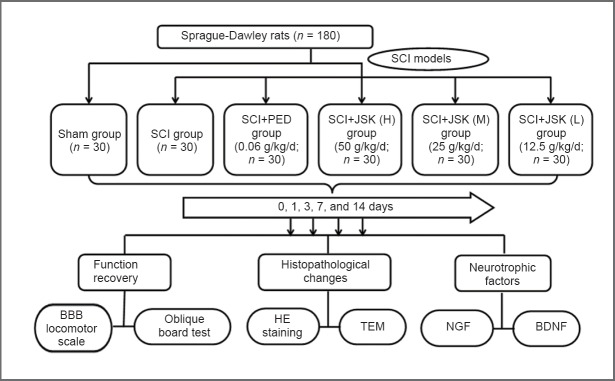
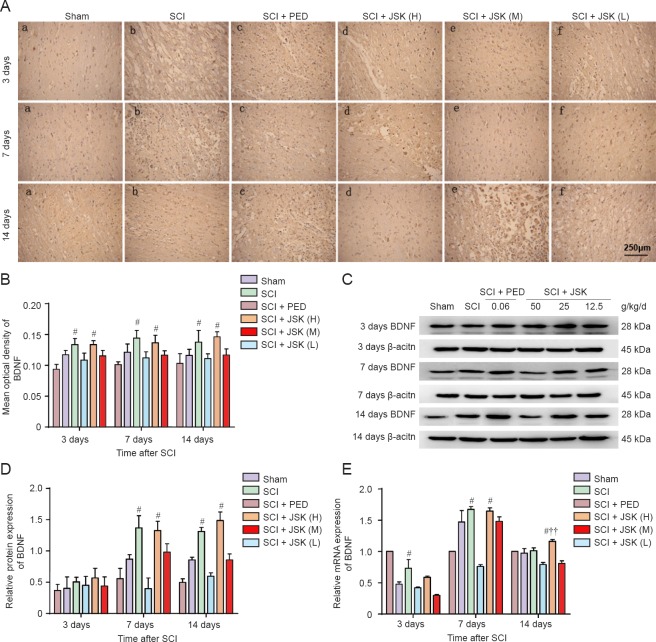
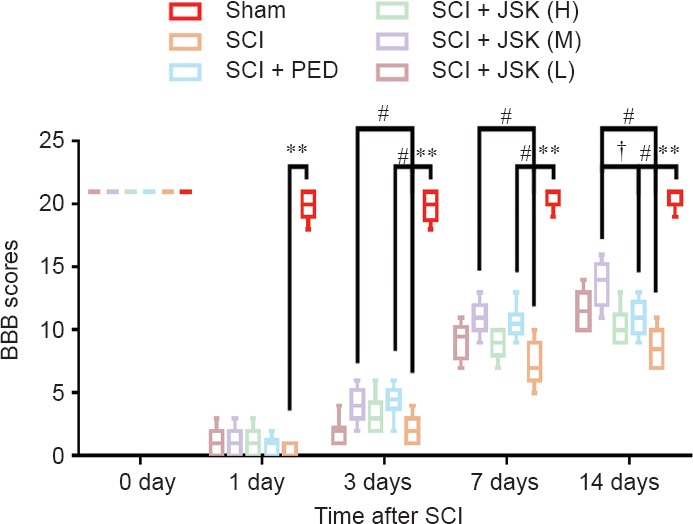
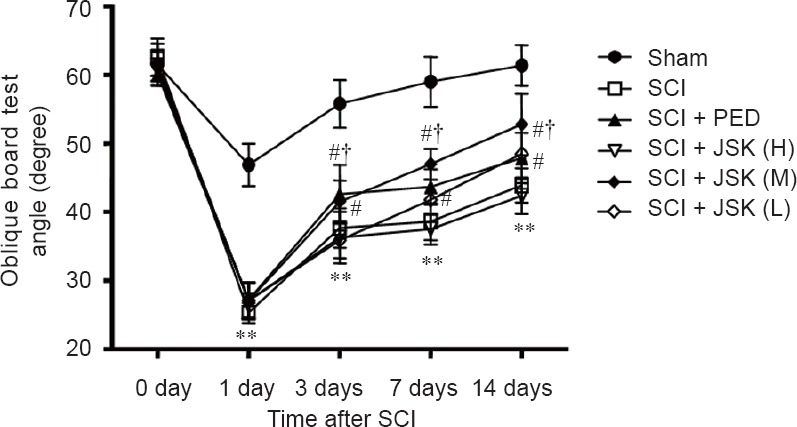
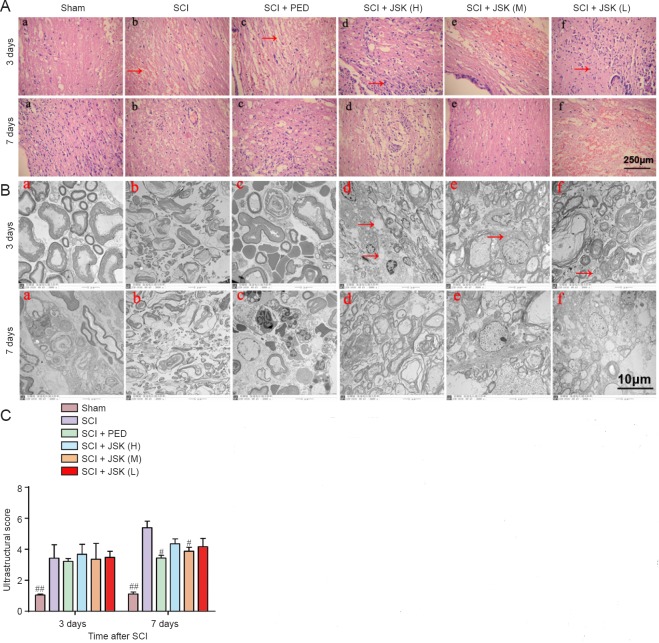
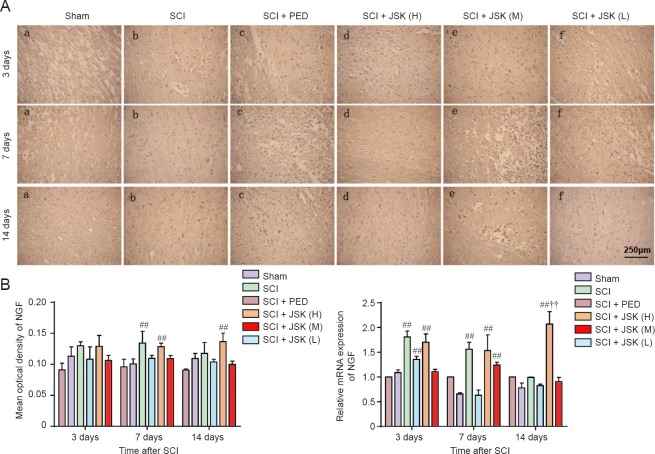
The Chinese medicine compound, , can promote recovery of neurological function by inhibiting lipid peroxidation, scavenging oxygen free radicals, and effectively improving the local microenvironment after spinal cord injury. However, the mechanism remains unclear. Thus, we established a rat model of acute spinal cord injury using a modified version of Allen's method. (50, 25, and 12.5 g/kg/d) and prednisolone were administered 30 minutes after anesthesia. Basso, Beattie, and Bresnahan locomotor scale scores and the oblique board test showed improved motor function recovery in the prednisone group and moderate-dose group compared with the other groups at 3-7 days post-injury. The rats in the moderate-dose group recovered best at 14 days post-injury. Hematoxylin-eosin staining and transmission electron microscopy showed that the survival rate of neurons in treatment groups increased after 3-7 days of administration. Further, the structure of neurons and glial cells was more distinct, especially in prednisolone and moderate-dose groups. Western blot assay and immunohistochemistry showed that expression of brain-derived neurotrophic factor (BDNF) in injured segments was maintained at a high level after 7-14 days of treatment. In contrast, expression of nerve growth factor (NGF) was down-regulated at 7 days after spinal cord injury. Real-time fluorescence quantitative polymerase chain reaction showed that expression of BDNF and NGF mRNA was induced in injured segments by prednisolone and . At 3-7 days after injury, the effect of prednisolone was greater, while 14 days after injury, the effect of moderate-dose was greater. These results confirm that can upregulate BDNF and NGF expression for a prolonged period after spinal cord injury and promote repair of acute spinal cord injury, with its effect being similar to prednisolone.
中药复方[具体复方名称未给出]可通过抑制脂质过氧化、清除氧自由基以及有效改善脊髓损伤后的局部微环境来促进神经功能恢复。然而,其机制仍不清楚。因此,我们采用改良的艾伦氏方法建立了大鼠急性脊髓损伤模型。在麻醉30分钟后给予具体中药复方名称未给出和泼尼松龙。在损伤后3至7天,巴索、比蒂和布雷斯纳汉运动量表评分以及斜板试验显示,与其他组相比,泼尼松龙组和中剂量[具体中药复方名称未给出]组的运动功能恢复有所改善。中剂量[具体中药复方名称未给出]组的大鼠在损伤后14天恢复最佳。苏木精-伊红染色和透射电子显微镜显示,给药3至7天后,治疗组神经元的存活率增加。此外,神经元和神经胶质细胞的结构更加清晰,尤其是在泼尼松龙组和中剂量[具体中药复方名称未给出]组。蛋白质印迹分析和免疫组织化学显示,治疗7至14天后,损伤节段中脑源性神经营养因子(BDNF)的表达维持在高水平。相比之下,脊髓损伤7天后神经生长因子(NGF)的表达下调。实时荧光定量聚合酶链反应显示,泼尼松龙和[具体中药复方名称未给出]可诱导损伤节段中BDNF和NGF mRNA的表达。在损伤后3至7天,泼尼松龙的作用更大,而在损伤后14天,中剂量[具体中药复方名称未给出]的作用更大。这些结果证实,[具体中药复方名称未给出]可在脊髓损伤后长期上调BDNF和NGF的表达,并促进急性脊髓损伤的修复,其效果与泼尼松龙相似。