Department of Psychological and Brain Sciences, Indiana University, 1101 East 10th Street, Bloomington, IN, 47405, USA.
Department of Bioengineering, University of Pennsylvania, Philadelphia, PA, USA.
Brain Struct Funct. 2018 Apr;223(3):1091-1106. doi: 10.1007/s00429-017-1539-3. Epub 2017 Oct 31.
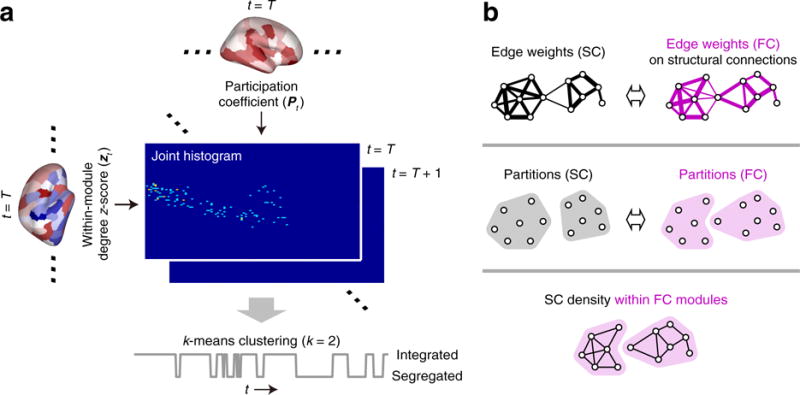
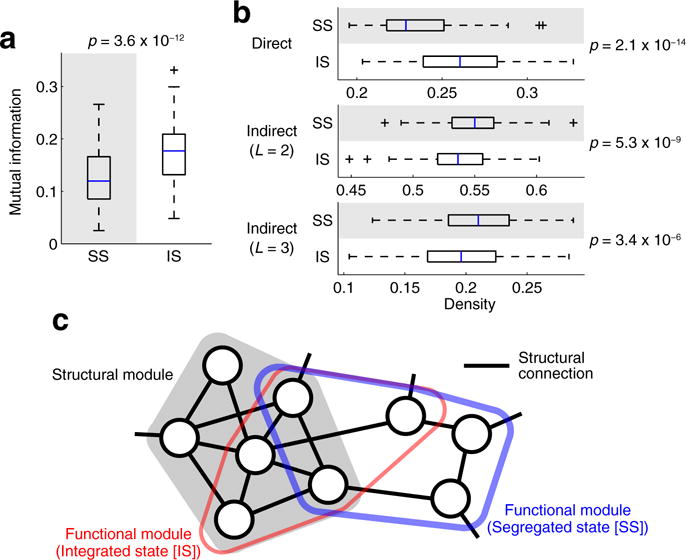
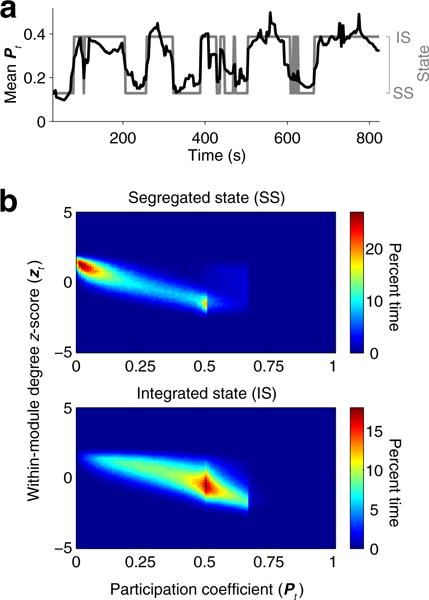
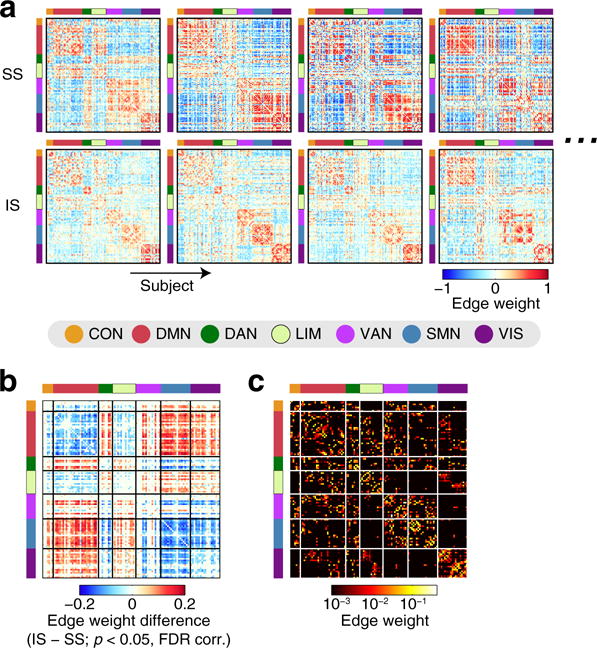
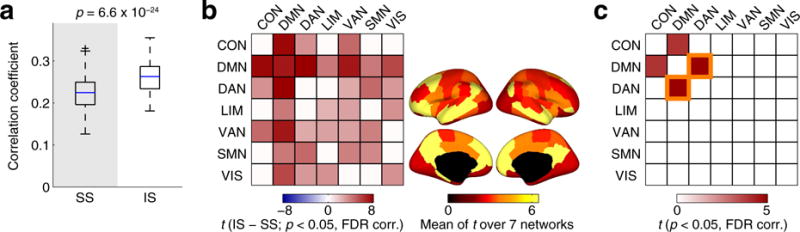
Structural white matter connections are thought to facilitate integration of neural information across functionally segregated systems. Recent studies have demonstrated that changes in the balance between segregation and integration in brain networks can be tracked by time-resolved functional connectivity derived from resting-state functional magnetic resonance imaging (rs-fMRI) data and that fluctuations between segregated and integrated network states are related to human behavior. However, how these network states relate to structural connectivity is largely unknown. To obtain a better understanding of structural substrates for these network states, we investigated how the relationship between structural connectivity, derived from diffusion tractography, and functional connectivity, as measured by rs-fMRI, changes with fluctuations between segregated and integrated states in the human brain. We found that the similarity of edge weights between structural and functional connectivity was greater in the integrated state, especially at edges connecting the default mode and the dorsal attention networks. We also demonstrated that the similarity of network partitions, evaluated between structural and functional connectivity, increased and the density of direct structural connections within modules in functional networks was elevated during the integrated state. These results suggest that, when functional connectivity exhibited an integrated network topology, structural connectivity and functional connectivity were more closely linked to each other and direct structural connections mediated a larger proportion of neural communication within functional modules. Our findings point out the possibility of significant contributions of structural connections to integrative neural processes underlying human behavior.
结构的白质连接被认为有助于在功能上分离的系统之间整合神经信息。最近的研究表明,通过来自静息态功能磁共振成像(rs-fMRI)数据的时变功能连接,可以追踪大脑网络中分离和整合之间平衡的变化,并且分离和整合网络状态之间的波动与人类行为有关。然而,这些网络状态与结构连接的关系在很大程度上是未知的。为了更好地了解这些网络状态的结构基础,我们研究了结构连接(源自扩散张量成像)与功能连接(通过 rs-fMRI 测量)之间的关系如何随大脑中分离和整合状态之间的波动而变化。我们发现,结构连接和功能连接之间的边缘权重相似性在整合状态下更大,特别是在默认模式和背侧注意网络之间的连接边缘上。我们还证明了,在整合状态下,结构和功能连接之间的网络分区相似性增加,功能网络中模块内的直接结构连接密度升高。这些结果表明,当功能连接表现出整合的网络拓扑时,结构连接和功能连接之间的联系更加紧密,并且直接的结构连接在功能模块内的神经通讯中占更大的比例。我们的发现指出了结构连接对人类行为下的整合神经过程的重要贡献的可能性。