Ostendorf Danielle M, Lyden Kate, Pan Zhaoxing, Wyatt Holly R, Hill James O, Melanson Edward L, Catenacci Victoria A
Department of Epidemiology, Colorado School of Public Health, Anschutz Medical Campus, University of Colorado, Aurora, Colorado, USA.
Department of Medicine, Anschutz Health and Wellness Center, Anschutz Medical Campus, University of Colorado, Aurora, Colorado, USA.
Obesity (Silver Spring). 2018 Jan;26(1):53-60. doi: 10.1002/oby.22052. Epub 2017 Nov 1.
The objective of this study was to compare patterns of objectively measured moderate-to-vigorous physical activity (MVPA, ≥ 3.00 metabolic equivalents [METs]), light-intensity physical activity (LPA, 1.50-2.99 METs), and sedentary behavior (SB, < 1.50 METs) in successful weight loss maintainers (WLMs), normal weight controls (NC), and controls with overweight/obesity (OC).
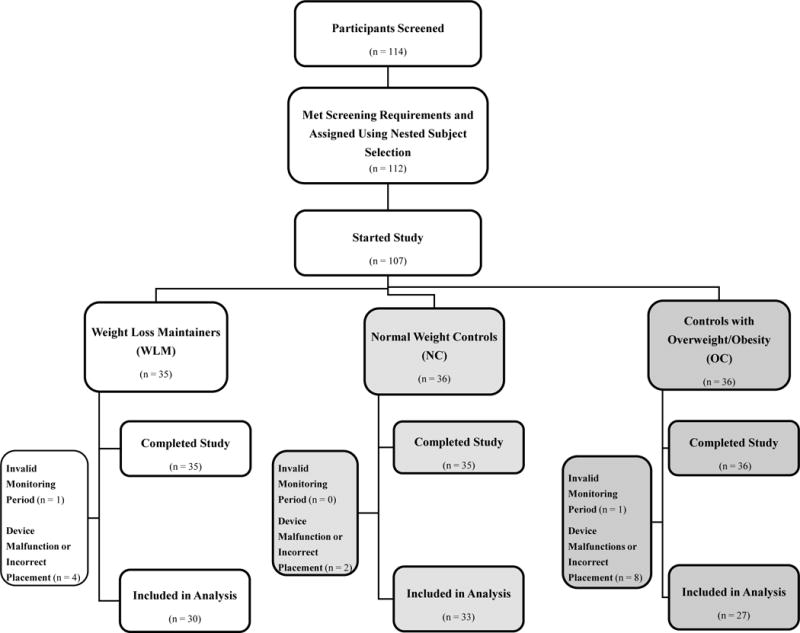
Participants (18-65 y) were recruited in three groups: WLM (maintaining ≥ 13.6-kg weight loss for ≥ 1 year, n = 30), NC (BMI matched to current BMI of WLM, n = 33), and OC (BMI matched to pre-weight loss BMI of WLM, n = 27). All participants wore the activPAL for 1 week.
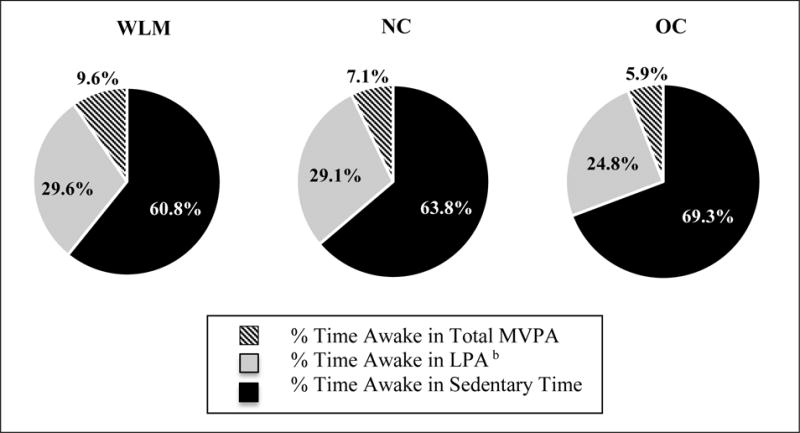
Compared with OC and NC, WLM spent more awake time in total MVPA (WLM: 9.6 ± 3.9%, NC: 7.1 ± 2.1%, OC: 5.9 ± 2.0%; P < 0.01) and more time in sustained (≥ 10 min) bouts of MVPA (WLM: 39 ± 33, NC: 17 ± 14, OC: 9 ± 11 min/d; P < 0.01). Compared with OC, WLM and NC spent more awake time in LPA (WLM: 29.6 ± 7.9%, NC: 29.1 ± 8.3%, OC: 24.8 ± 6.7%; P = 0.04) and less awake time sedentary (WLM: 60.8 ± 9.3%, NC: 63.8 ± 9.5%, OC: 69.3 ± 7.5%; P < 0.01).
Results provide additional data supporting the important role of MVPA in weight loss maintenance and suggest notable differences in LPA and SB between normal weight individuals and those with overweight/obesity. Increasing LPA and/or decreasing SB may be additional potential targets for weight management interventions.
本研究的目的是比较成功减重维持者(WLMs)、正常体重对照组(NC)和超重/肥胖对照组(OC)在客观测量的中度至剧烈身体活动(MVPA,≥3.00代谢当量[METs])、轻度身体活动(LPA,1.50 - 2.99 METs)和久坐行为(SB,<1.50 METs)方面的模式。
招募了三组参与者(18 - 65岁):WLMs(维持体重减轻≥13.6 kg达≥1年,n = 30)、NC(BMI与WLMs当前BMI匹配,n = 33)和OC(BMI与WLMs减重前BMI匹配,n = 27)。所有参与者佩戴activPAL一周。
与OC和NC相比,WLMs在总MVPA中的清醒时间更多(WLMs:9.6±3.9%,NC:7.1±2.1%,OC:5.9±2.0%;P < 0.01),并且在持续(≥10分钟)的MVPA时段中花费的时间更多(WLMs:39±33,NC:17±14,OC:9±11分钟/天;P < 0.01)。与OC相比,WLMs和NC在LPA中的清醒时间更多(WLMs:29.6±7.9%,NC:29.1±8.3%,OC:24.8±6.7%;P = 0.04),而久坐的清醒时间更少(WLMs:60.8±9.3%,NC:63.8±9.5%,OC:69.3±7.5%;P < 0.01)。
结果提供了更多数据支持MVPA在体重减轻维持中的重要作用,并表明正常体重个体与超重/肥胖个体在LPA和SB方面存在显著差异。增加LPA和/或减少SB可能是体重管理干预的其他潜在目标。