Newton Yulia, Novak Adam M, Swatloski Teresa, McColl Duncan C, Chopra Sahil, Graim Kiley, Weinstein Alana S, Baertsch Robert, Salama Sofie R, Ellrott Kyle, Chopra Manu, Goldstein Theodore C, Haussler David, Morozova Olena, Stuart Joshua M
Department of Biomolecular Engineering and Bioinformatics, University of California, Santa Cruz, California.
Stanford University, Stanford, California.
Cancer Res. 2017 Nov 1;77(21):e111-e114. doi: 10.1158/0008-5472.CAN-17-0580.
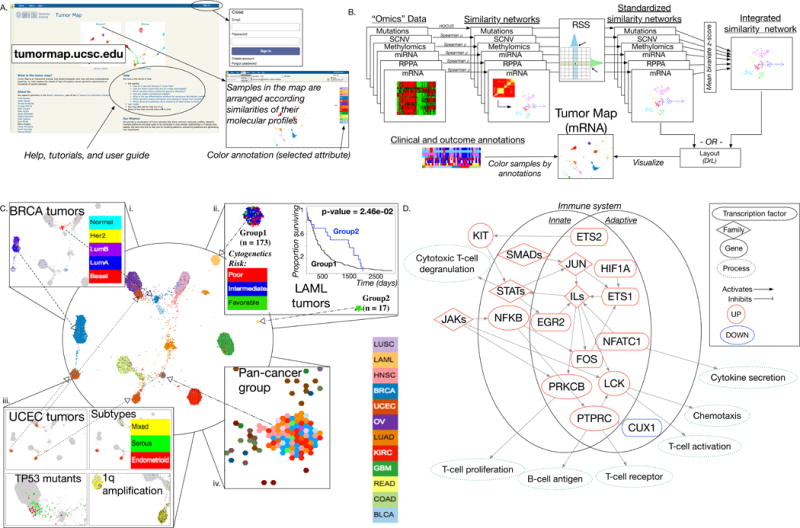
Vast amounts of molecular data are being collected on tumor samples, which provide unique opportunities for discovering trends within and between cancer subtypes. Such cross-cancer analyses require computational methods that enable intuitive and interactive browsing of thousands of samples based on their molecular similarity. We created a portal called TumorMap to assist in exploration and statistical interrogation of high-dimensional complex "omics" data in an interactive and easily interpretable way. In the TumorMap, samples are arranged on a hexagonal grid based on their similarity to one another in the original genomic space and are rendered with Google's Map technology. While the important feature of this public portal is the ability for the users to build maps from their own data, we pre-built genomic maps from several previously published projects. We demonstrate the utility of this portal by presenting results obtained from The Cancer Genome Atlas project data. .
目前正在收集大量肿瘤样本的分子数据,这为发现癌症亚型内部和之间的趋势提供了独特的机会。这种跨癌症分析需要能够基于分子相似性对数千个样本进行直观且交互式浏览的计算方法。我们创建了一个名为TumorMap的门户网站,以一种交互式且易于解释的方式协助对高维复杂“组学”数据进行探索和统计查询。在TumorMap中,样本基于它们在原始基因组空间中的彼此相似性排列在六边形网格上,并使用谷歌地图技术进行呈现。虽然这个公共门户网站的重要功能是用户能够根据自己的数据构建图谱,但我们也根据之前发表的几个项目预先构建了基因组图谱。我们通过展示从癌症基因组图谱项目数据中获得的结果来证明这个门户网站的实用性。