Department of International and Community Oral Health, Tohoku University Graduate School of Dentistry.
Department of Preventive Medicine and Epidemiology, Tohoku Medical Megabank Organization, Tohoku University.
J Epidemiol. 2018 Mar 5;28(3):133-139. doi: 10.2188/jea.JE20160184. Epub 2017 Oct 28.
Secondhand smoke (SHS) causes many deaths. Inequalities in SHS have been reported in several countries; however, the evidence in Asian countries is scarce. We aimed to investigate the association between socioeconomic status (SES) and SHS at home and the workplace/school among non-smoking Japanese adults.
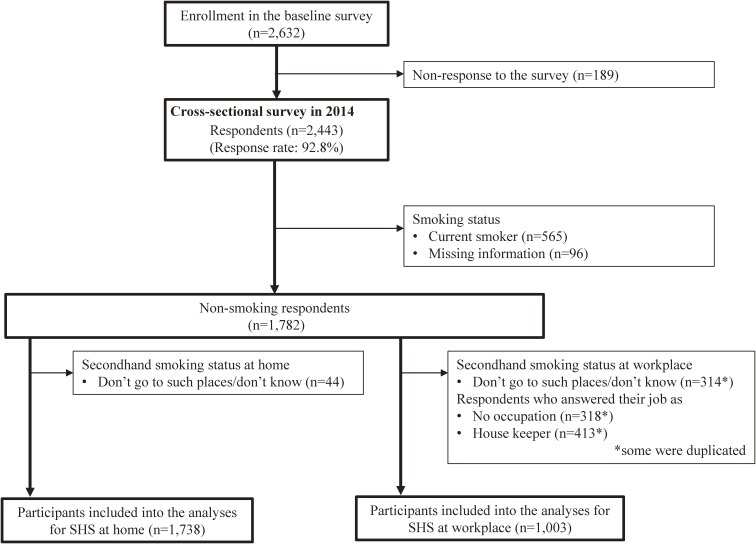
Cross-sectional data from the Miyagi Prefectural Health Survey 2014 were analyzed. Self-reported questionnaires were randomly distributed to residents ≥20 years of age and 2,443 (92.8%) responded. The data of the 1,738 and 1,003 respondents were included to the analyses for SHS in the past month at home and at the workplace/school, respectively. Ordered logistic regression models considering possible confounders, including knowledge of the adverse health effects of tobacco, were applied.
The prevalence of SHS at home and the workplace/school was 19.0% and 39.0%, respectively. Compared with ≥13 years of education, odds ratios (ORs) and 95% confidence intervals (CIs) for SHS at home were 1.94 (95% CI, 1.42-2.64) for 10-12 years and 3.00 (95% CI, 1.95-4.60) for ≤9 years; those for SHS at the workplace/school were 1.80 (95% CI, 1.36-2.39) and 3.82 (95% CI, 2.29-6.36), respectively. Knowledge of the adverse health effects of tobacco was significantly associated with lower SHS at home (OR 0.95; 95% CI, 0.91-0.98) but it was not associated with SHS at the workplace/school (OR 1.02; 95% CI, 0.98-1.06).
Social inequalities in SHS existed among Japanese non-smoking adults. Knowledge about tobacco was negatively associated with SHS at home but not at workplace/school.
二手烟(SHS)导致许多人死亡。几个国家已经报告了 SHS 方面的不平等现象;然而,亚洲国家的证据很少。我们旨在调查非吸烟日本成年人中家庭和工作场所/学校的社会经济地位(SES)与 SHS 之间的关联。
分析了 2014 年宫城县健康调查的横断面数据。向 20 岁及以上的居民随机分发了自我报告的问卷,有 2443 人(92.8%)做出了回应。对过去一个月在家中和工作场所/学校接触 SHS 的 1738 名和 1003 名受访者的数据进行了分析。考虑到可能的混杂因素,包括对烟草不良健康影响的认识,应用了有序逻辑回归模型。
在家中和工作场所/学校接触 SHS 的比例分别为 19.0%和 39.0%。与≥13 年教育相比,在家中接触 SHS 的比值比(OR)和 95%置信区间(CI)为 10-12 年为 1.94(95%CI,1.42-2.64),≤9 年为 3.00(95%CI,1.95-4.60);在工作场所/学校接触 SHS 的 OR 分别为 1.80(95%CI,1.36-2.39)和 3.82(95%CI,2.29-6.36)。对烟草不良健康影响的认识与在家中接触 SHS 的风险显著降低相关(OR 0.95;95%CI,0.91-0.98),但与工作场所/学校接触 SHS 无关(OR 1.02;95%CI,0.98-1.06)。
在非吸烟的日本成年人中,存在 SHS 方面的社会不平等现象。关于烟草的知识与在家中接触 SHS 呈负相关,但与工作场所/学校接触 SHS 无关。