Division of Earth and Ocean Sciences, Nicholas School of the Environment, Duke University, Durham, NC, 27708, USA.
Université de Brest - UMR 6539 CNRS/UBO/IRD/Ifremer, Laboratoire des sciences de l'environnement marin - IUEM, Rue Dumont D'Urville, Plouzané, 29280, France.
Sci Rep. 2017 Nov 1;7(1):14845. doi: 10.1038/s41598-017-14109-1.
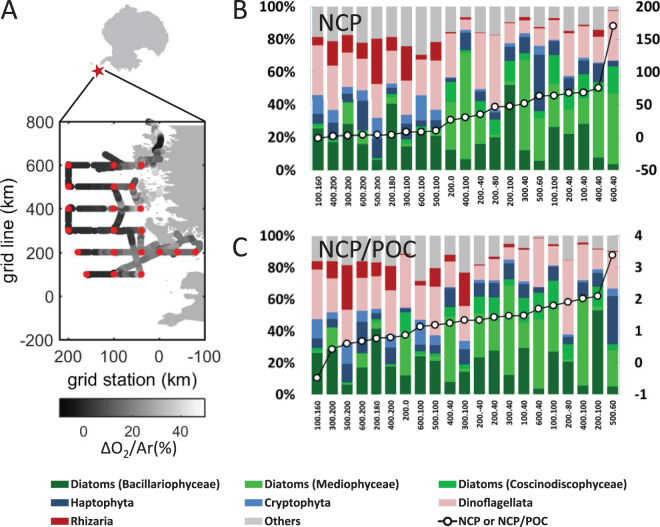
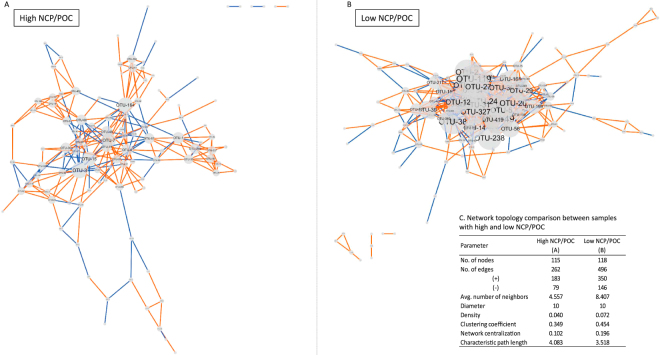
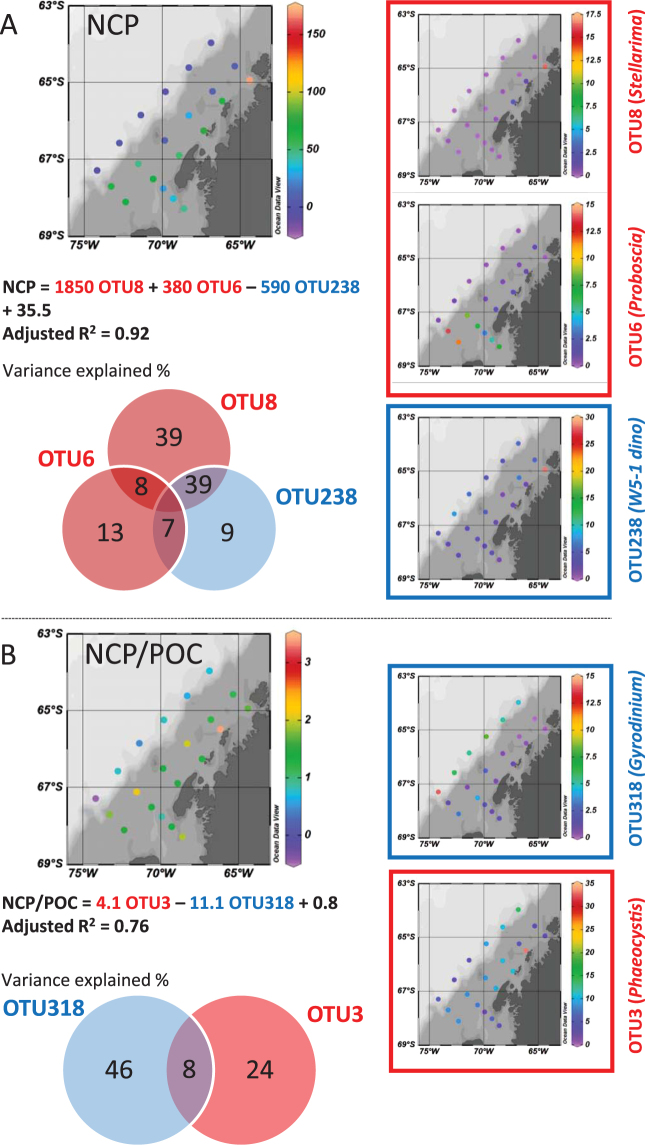
Despite our current realization of the tremendous diversity that exists in plankton communities, we have little understanding of how this biodiversity influences the biological carbon pump other than broad paradigms such as diatoms contributing disproportionally to carbon export. Here we combine high-resolution underway O/Ar, which provides an estimate of net community production, with high-throughput 18 S ribosomal DNA sequencing to elucidate the relationship between eukaryotic plankton community structure and carbon export potential at the Western Antarctica Peninsula (WAP), a region which has experienced rapid warming and ecosystem changes. Our results show that in a diverse plankton system comprised of ~464 operational taxonomic units (OTUs) with at least 97% 18 S identity, as few as two or three key OTUs, i.e. large diatoms, Phaeocystis, and mixotrophic/phagotrophic dinoflagellates, can explain a large majority of the spatial variability in the carbon export potential (76-92%). Moreover, we find based on a community co-occurrence network analysis that ecosystems with lower export potential have more tightly coupled communities. Our results indicate that defining plankton communities at a deeper taxonomic resolution than by functional groups and accounting for the differences in size and coupling between groups can substantially improve organic carbon flux predictions.
尽管我们目前已经认识到浮游生物群落存在着巨大的多样性,但除了硅藻不成比例地促进碳输出等广泛模式外,我们对这种生物多样性如何影响生物碳泵知之甚少。在这里,我们将高分辨率的现场 O/Ar 结合起来,该方法提供了净群落生产力的估计,同时结合高通量 18S 核糖体 DNA 测序,以阐明在经历快速变暖的南极洲西部半岛(WAP)的浮游生物群落结构与碳输出潜力之间的关系。我们的结果表明,在一个由大约 464 个具有至少 97%18S 同一性的操作分类单元(OTUs)组成的多样化浮游生物系统中,仅两三个关键的 OTUs,即大型硅藻、Phaeocystis 和混合营养/吞噬性甲藻,就可以解释碳输出潜力的大部分空间变异性(76-92%)。此外,我们根据群落共生网络分析发现,具有较低输出潜力的生态系统具有更紧密耦合的群落。我们的结果表明,将浮游生物群落定义为比功能群更深的分类分辨率,并考虑到群体之间大小和耦合的差异,可以大大提高有机碳通量预测。