Department of Life Sciences, Indianapolis Zoo, Indianapolis, USA.
Department of Zoology, University of Oxford, Oxford, UK.
Sci Rep. 2017 Nov 1;7(1):14307. doi: 10.1038/s41598-017-14393-x.
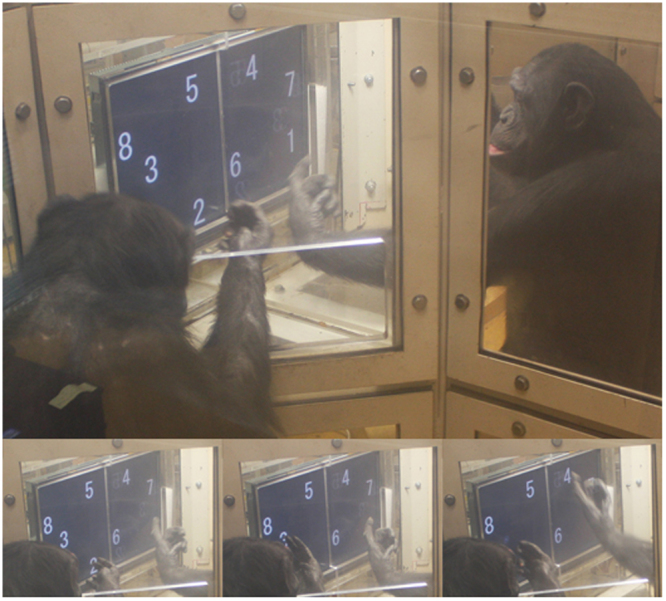
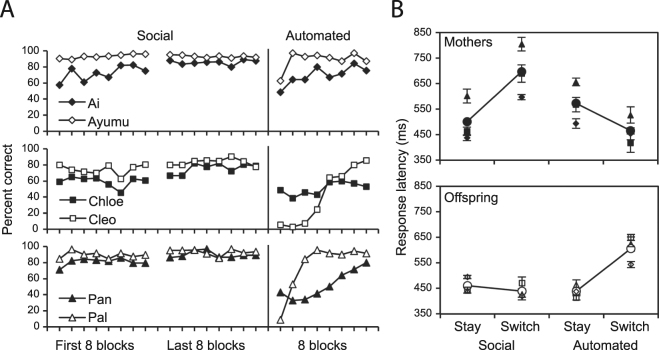
Social coordination can provide optimal solutions to many kinds of group dilemmas, and non-human subjects have been shown to perform single actions successively or simultaneously with partners to maximize food rewards in a variety of experimental settings. Less attention has been given to showing how animals are able to produce multiple (rather than single) intermixed and co-regulated actions, even though many species' signal transmissions and social interactions rely on extended bouts of coordinated turn-taking. Here we report on coordination behaviour in three pairs of chimpanzees (mother/offspring dyads) during an experimentally induced turn-taking scenario. Participants were given a "shared" version of a computer-based serial ordering task that they had previously mastered individually. We found that minimal trial-and-error learning was necessary for the participants to solve the new social version of the task, and that information flow was more pronounced from mothers toward offspring than the reverse, mirroring characteristics of social learning in wild chimpanzees. Our experiment introduces a novel paradigm for studying behavioural coordination in non-humans, able to yield insights into the evolution of turn-taking which underlies a range of social interactions, including communication and language.
社会协调可以为许多类型的群体困境提供最佳解决方案,并且已经证明非人类主体能够在各种实验环境中与合作伙伴连续或同时执行单一动作,以最大限度地提高食物奖励。然而,人们对动物如何能够产生多种(而不是单一)混合和共同调节的动作关注较少,尽管许多物种的信号传递和社会互动依赖于协调轮流的长时间进行。在这里,我们报告了在一个实验诱导的轮流情景中,三只黑猩猩(母子对)之间的协调行为。参与者被给予一个他们之前单独掌握的基于计算机的序列排序任务的“共享”版本。我们发现,参与者只需要进行最少的试错学习就可以解决新的社交版本任务,并且信息流从母亲流向后代的程度比相反方向更强,这反映了野生黑猩猩社会学习的特点。我们的实验引入了一种研究非人类行为协调的新范例,能够深入了解轮流行为的演变,轮流行为是一系列社会互动的基础,包括沟通和语言。