Suzuki Seiya, Yoshimura Masamichi
Graduate School of Engineering, Toyota Technological Institute, 2-12-1 Hisakata, Tempaku, Nagoya, 468-8511, Japan.
Sci Rep. 2017 Nov 1;7(1):14851. doi: 10.1038/s41598-017-14782-2.
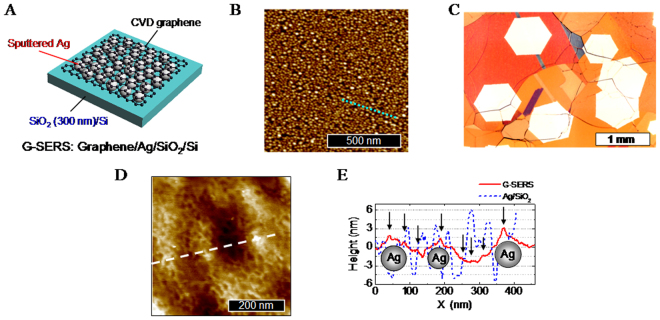
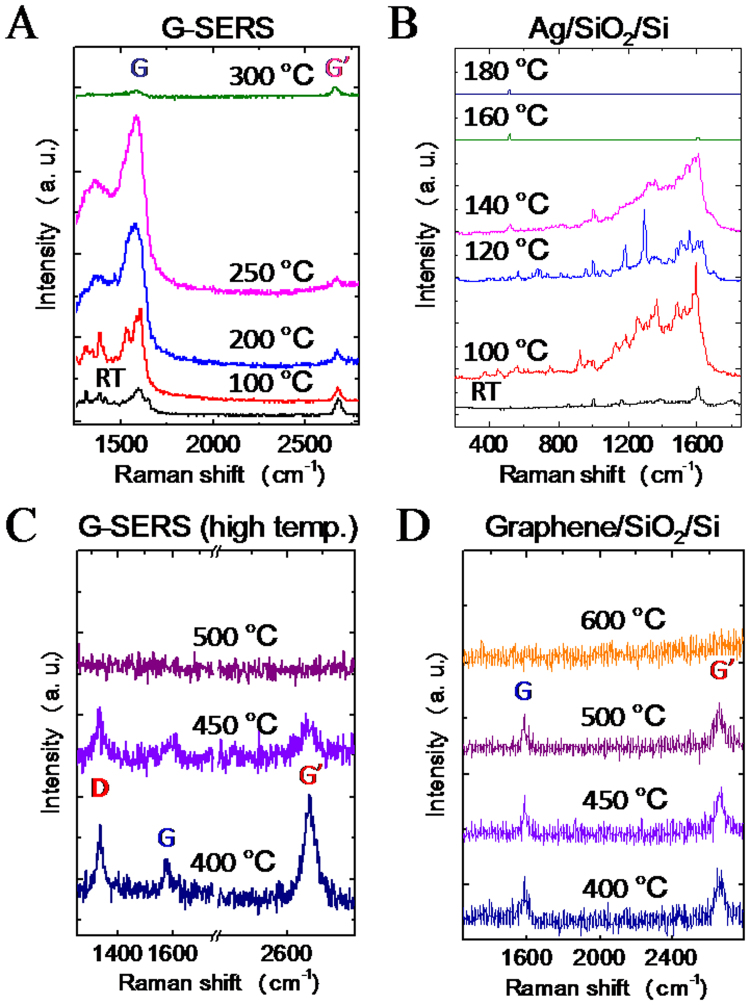
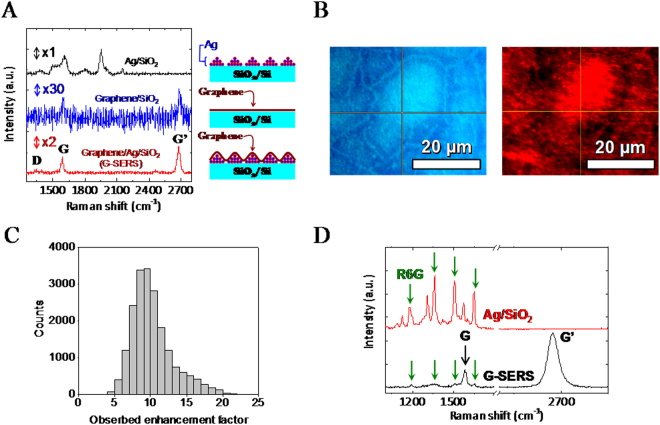
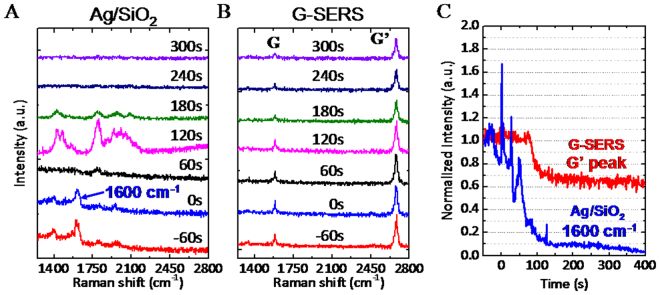
Surface enhanced Raman spectroscopy (SERS) is a novel method to sense molecular and lattice vibrations at a high sensitivity. Although nanostructured silver surface provides intense SERS signals, the silver surface is unstable under acidic environment and heated environment. Graphene, a single atomic carbon layer, has a prominent stability for chemical agents, and its honeycomb lattice completely prevents the penetration of small molecules. Here, we fabricated a SERS substrate by combining nanostructured silver surface and single-crystal monolayer graphene (G-SERS), and focused on its chemical stability. The G-SERS substrate showed SERS even in concentrated hydrochloric acid (35-37%) and heated air up to 400 °C, which is hardly obtainable by normal silver SERS substrates. The chemically stable G-SERS substrate posesses a practical and feasible application, and its high chemical stability provides a new type of SERS technique such as molecular detections at high temperatures or in extreme acidic conditions.
表面增强拉曼光谱(SERS)是一种以高灵敏度检测分子和晶格振动的新方法。尽管纳米结构银表面能提供强烈的SERS信号,但银表面在酸性环境和加热环境下不稳定。石墨烯是一种单原子碳层,对化学试剂具有显著的稳定性,其蜂窝晶格完全阻止小分子渗透。在此,我们通过将纳米结构银表面与单晶单层石墨烯相结合制备了一种SERS基底(G-SERS),并关注其化学稳定性。G-SERS基底即使在浓盐酸(35-37%)中以及在高达400 °C的热空气中仍显示出SERS信号,这是普通银SERS基底难以实现的。化学稳定的G-SERS基底具有实际可行的应用,其高化学稳定性提供了一种新型的SERS技术,如在高温或极端酸性条件下的分子检测。