Kwon Ji-Soo, Kim Taeeun, Kim Sun-Mi, Sung Heungsup, Shin Sung, Kim Young Hoon, Shin Eui-Cheol, Kim Sung-Han, Han Duck Jong
Biomedical Science and Engineering Interdisciplinary Program, KAIST, Daejeon, Korea.
Department of Infectious Disease, Asan Medical Center, University of Ulsan College of Medicine, Seoul, Korea.
Immune Netw. 2017 Oct;17(5):317-325. doi: 10.4110/in.2017.17.5.317. Epub 2017 Oct 25.
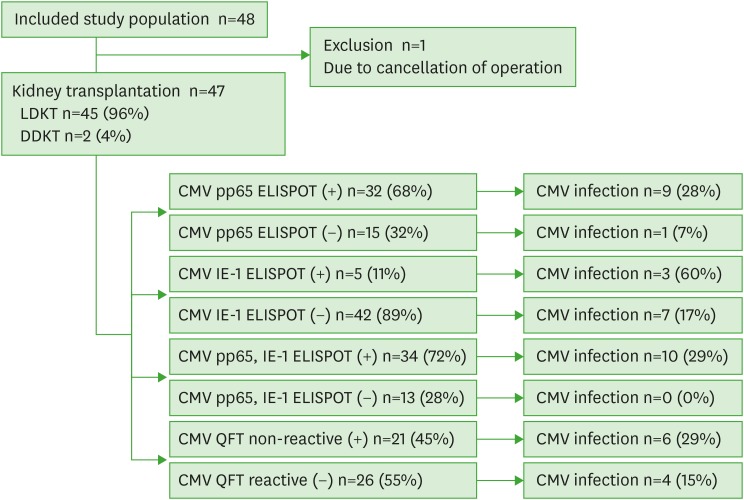
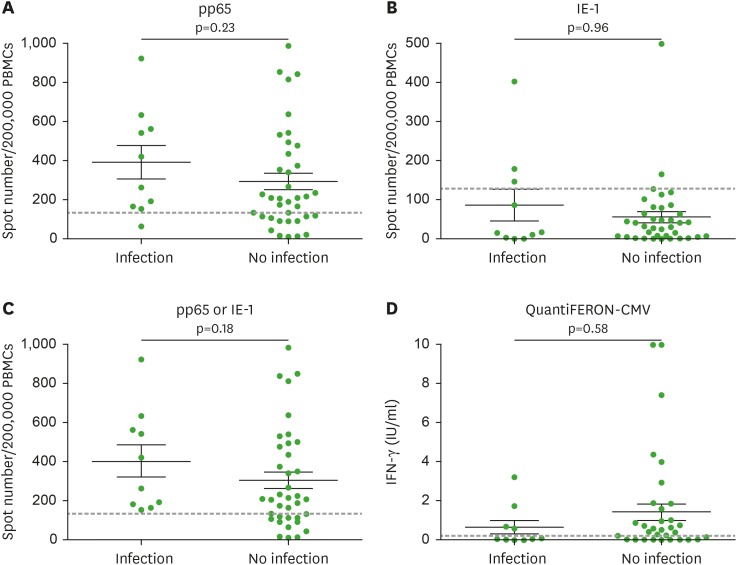
Cytomegalovirus (CMV) is one of the most important opportunistic infections in transplant recipients. Tests for CMV-specific T cell responses have been proposed to change the current risk stratification strategy using CMV assays. We evaluated the usefulness of pre-transplant CMV-specific T cell assays in kidney transplant (KT) candidates for predicting the development of CMV infection after transplantation comparing the results of the overlapping peptides (OLPs)-based enzyme-linked immunospot (ELISPOT) assay and the commercial QuantiFERON-CMV assay. We prospectively enrolled all cases of KT over a 5-month period, except donor CMV-seropositive and recipient seronegative transplants that are at highest risk of CMV infection. All the patients underwent QuantiFERON-CMV, CMV OLPs-based pp65, and immediate-early 1 (IE-1)-specific ELISPOT assays before transplantation. The primary outcome was the incidence of CMV infection at 6 months after transplant. The total of 47 KT recipients consisted of 45 living-donor KTs and 2 deceased-donor KTs. There was no association between positive QuantiFERON-CMV results and CMV infection. However, 10 of 34 patients with phosphoprotein 65 (pp65)- or IE-1-specific ELISPOT results higher than cut-off value developed CMV infections compared with none of 13 patients with results lower than cut-off value developed CMV. The OLPs-based ELISPOT assays are more useful than the QuantiFERON-CMV assay for predicting CMV infection. Patients with higher CMV-specific T cell immunity at baseline appear to be more likely to develop CMV infections after KT, suggesting that the abrupt decline in CMV-specific T cell responses after immunosuppression, or high CMV-specific T cell responses due to frequent CMV activation before KT, may promote CMV infection.
巨细胞病毒(CMV)是移植受者最重要的机会性感染之一。有人提出检测CMV特异性T细胞反应,以改变目前使用CMV检测的风险分层策略。我们通过比较基于重叠肽(OLP)的酶联免疫斑点(ELISPOT)检测和商业化的QuantiFERON-CMV检测结果,评估肾移植(KT)候选者移植前CMV特异性T细胞检测对预测移植后CMV感染发生情况的有用性。我们前瞻性纳入了5个月期间所有的KT病例,但不包括CMV感染风险最高的供体CMV血清学阳性和受体血清学阴性的移植病例。所有患者在移植前均接受了QuantiFERON-CMV检测、基于CMV OLP的pp65检测以及即刻早期蛋白1(IE-1)特异性ELISPOT检测。主要结局是移植后6个月时CMV感染的发生率。47例KT受者中,有45例为活体供肾KT,2例为尸体供肾KT。QuantiFERON-CMV检测结果阳性与CMV感染之间无关联。然而,34例磷蛋白65(pp65)或IE-1特异性ELISPOT检测结果高于临界值的患者中有10例发生了CMV感染,而13例检测结果低于临界值的患者均未发生CMV感染。基于OLP的ELISPOT检测在预测CMV感染方面比QuantiFERON-CMV检测更有用。基线时CMV特异性T细胞免疫较高的患者在KT后似乎更易发生CMV感染,这表明免疫抑制后CMV特异性T细胞反应的突然下降,或KT前因频繁CMV激活导致的高CMV特异性T细胞反应,可能会促进CMV感染。