Tiwari Rameshwar, Singh Puneet Kumar, Singh Surender, Nain Pawan K S, Nain Lata, Shukla Pratyoosh
Enzyme Technology and Protein Bioinformatics Laboratory, Department of Microbiology, Maharshi Dayanand University, Rohtak, Haryana 124001 India.
Division of Microbiology, Indian Agricultural Research Institute, New Delhi, 110012 India.
Biotechnol Biofuels. 2017 Oct 30;10:246. doi: 10.1186/s13068-017-0932-8. eCollection 2017.
Saccharification is the most crucial and cost-intensive process in second generation biofuel production. The deficiency of β-glucosidase in commercial enzyme leads to incomplete biomass hydrolysis. The decomposition of biomass at high temperature environments leads us to isolate thermotolerant microbes with β-glucosidase production potential.
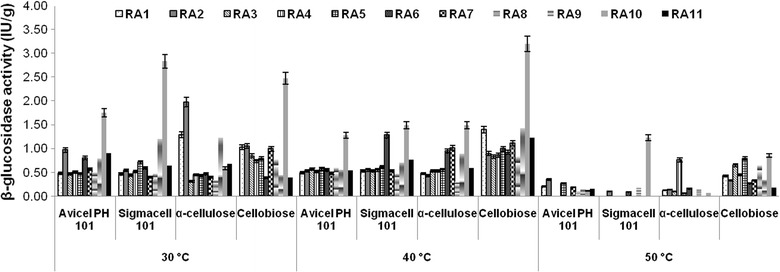
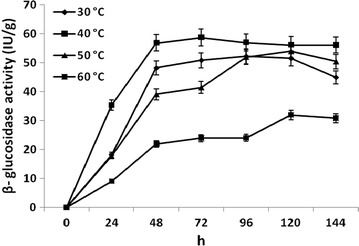
A total of 11 isolates were obtained from compost and cow dung samples that were able to grow at 50 °C. On the basis of qualitative and quantitative estimation of β-glucosidase enzyme production, RA10 was selected for further studies. The medium components and growth conditions were optimized and β-glucosidase enzyme production was enhanced up to 19.8-fold. The β-glucosidase from RA10 retained 78% of activity at 80 °C temperature and 68.32% of enzyme activity was stable even at 50 °C after 48 h of incubation. The supplementation of β-glucosidase from RA10 into commercial cellulase enzyme resulted in 1.34-fold higher glucose release. Furthermore, β-glucosidase was also functionally elucidated by cloning and overexpression of full length GH1 family β-glucosidase gene from RA10. The purified protein was characterized as thermostable β-glucosidase enzyme.
The thermostable β-glucosidase enzyme from RA10 would facilitate efficient saccharification of cellulosic biomass into fermentable sugar. Consequently, after saccharification, thermostable β-glucosidase enzyme would be recovered and reused to reduce the cost of overall bioethanol production process.
糖化是第二代生物燃料生产中最关键且成本最高的过程。商业酶中β-葡萄糖苷酶的缺乏导致生物质水解不完全。高温环境下生物质的分解促使我们去分离具有产β-葡萄糖苷酶潜力的耐热微生物。
从堆肥和牛粪样品中总共获得了11株能够在50℃生长的菌株。基于对β-葡萄糖苷酶产量的定性和定量评估,选择RA10进行进一步研究。对培养基成分和生长条件进行了优化,β-葡萄糖苷酶产量提高了19.8倍。RA10的β-葡萄糖苷酶在80℃时保留了78%的活性,即使在50℃孵育48小时后仍有68.32%的酶活性保持稳定。将RA10的β-葡萄糖苷酶添加到商业纤维素酶中,葡萄糖释放量提高了1.34倍。此外,还通过克隆和过表达RA10的全长GH1家族β-葡萄糖苷酶基因对β-葡萄糖苷酶进行了功能阐释。纯化后的蛋白质被鉴定为耐热β-葡萄糖苷酶。
RA10的耐热β-葡萄糖苷酶将有助于将纤维素生物质高效糖化转化为可发酵糖。因此,糖化后,耐热β-葡萄糖苷酶将被回收再利用,以降低整个生物乙醇生产过程的成本。