Nonaka Manabu, Sakitani Eri, Ono Erika, Yamamura Yukie, Seo Yukako, Shibata Noriyuki, Pawankar Ruby, Yoshihara Toshio
Department of Otolaryngology, Tokyo Women's Medical University, Tokyo 162-8666, Japan.
First Department of Pathology, Tokyo Women's Medical University, Tokyo 162-8666, Japan.
Asia Pac Allergy. 2017 Oct;7(4):221-226. doi: 10.5415/apallergy.2017.7.4.221. Epub 2017 Oct 23.
Kimura disease (KD) is a systemic soft-tissue disease that leads to formation of painless masses in lymph nodes, with the highest predilection for the head and neck and especially the parotid gland. KD lesions are characterized by marked eosinophil infiltration, production of IgE and increased expression of T-helper type 2 (Th2) cytokines (interleukin [IL]-4, IL-5, etc.). Skewing to a Th2 inflammation is also demonstrated in the peripheral blood, with elevated eosinophils and high IgE levels. It is thought that basophils may play important roles in orchestrating this Th2 inflammation via IL-4 production leading to the induction of IgE synthesis as well as eosinophil infiltration. However, there are no reports as yet on the role of basophils in KD.
The present study was performed to investigate the potential role of basophils in the pathogenesis of KD. In this context we also examined the expression of IL-4 in basophils in the KD lesions.
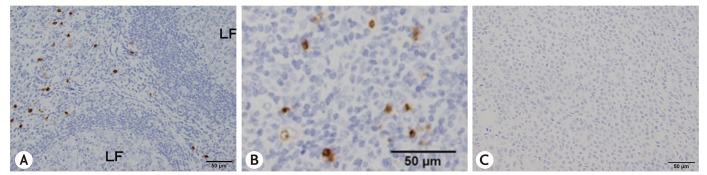
By immunohistochemistry using a monoclonal antibody against a basophil marker ProMBP1 we investigated the number and distribution of basophils in the KD lesions. By double immunohistochemistry we analyzed the colocalization of IL-4 in basophils.
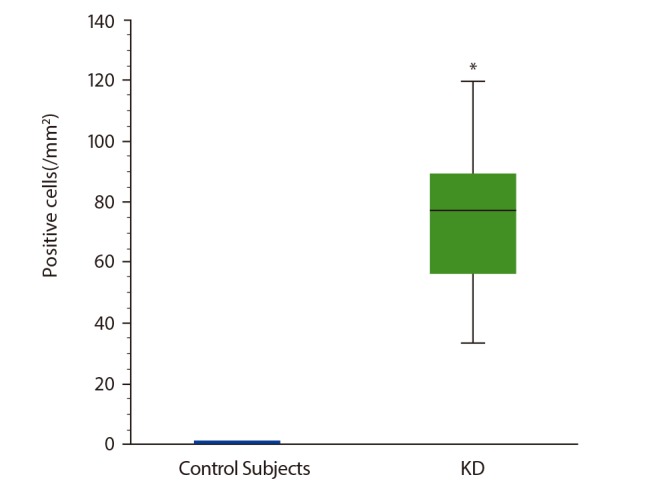
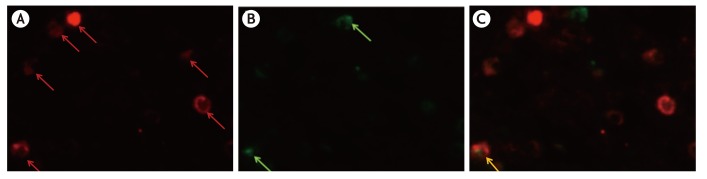
There was an increased number of basophils infiltrating the KD parotid gland lesions as compared to that in normal control parotid tissue. By double-immunofluorescence we found that approximately 7% of IL-4-positive cells in KD patients' parotid glands were basophils.
Basophils may also play a role in the pathogenesis of KD, leading to the induction of IgE synthesis and eosinophil infiltration.
木村病(KD)是一种系统性软组织疾病,可导致淋巴结出现无痛性肿块,最常发生于头颈部,尤其是腮腺。KD病变的特征是显著的嗜酸性粒细胞浸润、IgE产生以及2型辅助性T细胞(Th2)细胞因子(白细胞介素[IL]-4、IL-5等)表达增加。外周血中也表现为向Th2炎症倾斜,嗜酸性粒细胞增多且IgE水平升高。据认为,嗜碱性粒细胞可能通过产生IL-4在协调这种Th2炎症中发挥重要作用,从而导致IgE合成诱导以及嗜酸性粒细胞浸润。然而,目前尚无关于嗜碱性粒细胞在KD中作用的报道。
本研究旨在探讨嗜碱性粒细胞在KD发病机制中的潜在作用。在此背景下,我们还检测了KD病变中嗜碱性粒细胞中IL-4的表达。
通过使用抗嗜碱性粒细胞标志物ProMBP1的单克隆抗体进行免疫组织化学,我们研究了KD病变中嗜碱性粒细胞的数量和分布。通过双重免疫组织化学,我们分析了IL-4在嗜碱性粒细胞中的共定位。
与正常对照腮腺组织相比,浸润KD腮腺病变的嗜碱性粒细胞数量增加。通过双重免疫荧光,我们发现KD患者腮腺中约7%的IL-4阳性细胞为嗜碱性粒细胞。
嗜碱性粒细胞可能也在KD的发病机制中起作用,导致IgE合成诱导和嗜酸性粒细胞浸润。