Wang Xuying, Chen Jiageng, Liu Xiaoqian, Gao Fei, Zhao Haozuo, Han Duolan, Jing Xiyue, Liu Yuanyuan, Cui Zhuang, Li Changping, Ma Jun
Department of Health Statistics, College of Public Health, Tianjin Medical University, Heping District, Tianjin, People's Republic of China.
Diabetes Ther. 2017 Dec;8(6):1379-1392. doi: 10.1007/s13300-017-0327-7. Epub 2017 Nov 1.
Lifestyle behaviors are essential elements of diabetes care. The aims of this study were to identify distinct subgroups of people with type 2 diabetes based on personal levels of lifestyle behaviors and explore the different characteristics across these subgroups.
In 2015 and 2016, 1504 outpatients with a diagnosis of type 2 diabetes were selected via two-stage simple random sampling from 10 municipal district hospitals in Tianjin. Participants accepted an invitation by experienced physicians to complete a questionnaire containing demographic and lifestyle content. Clinical data were collected by reviewing medical records. Latent class analysis was applied to identify patterns of lifestyle behaviors. Multinomial logistic regression was used to investigate the characteristics of the subgroups.
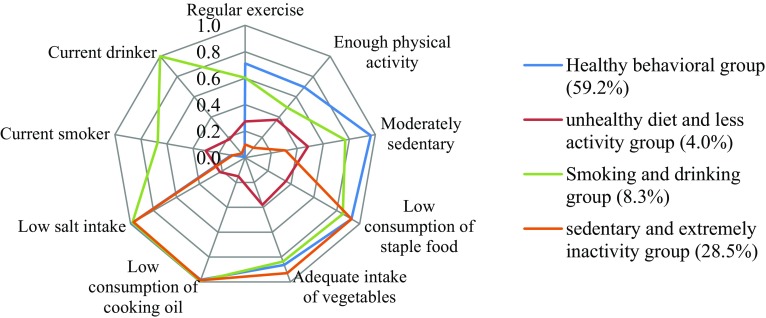
The final model yielded a four-class solution: the healthy behavioral group, unhealthy diet and less activity group, smoking and drinking group, and sedentary and extremely inactive group. Further analysis found that variables, including age, sex, general/central obesity, treatment modalities, glycemic control, diabetes duration, and diabetes-related complications and comorbidities, were disproportionately distributed across the four latent classes (P < 0.05). Participants in the unhealthy diet and less activity group were more likely to have a longer duration of diabetes, poor glycemic control and more diabetes-related diseases relative to the other three latent classes.
Identification and characterization of subgroups based on lifestyle behaviors in individuals with type 2 diabetes can help health care providers to shift to targeted intervention strategies.
生活方式行为是糖尿病护理的重要组成部分。本研究的目的是根据个人生活方式行为水平确定2型糖尿病患者的不同亚组,并探讨这些亚组之间的不同特征。
2015年和2016年,通过两阶段简单随机抽样从天津市10家市区医院选取了1504例诊断为2型糖尿病的门诊患者。参与者接受经验丰富的医生邀请,完成一份包含人口统计学和生活方式内容的问卷。通过查阅病历收集临床数据。应用潜在类别分析来确定生活方式行为模式。采用多项逻辑回归分析来研究亚组的特征。
最终模型得出四类结果:健康行为组、不健康饮食与活动较少组、吸烟饮酒组以及久坐与极度不活动组。进一步分析发现,年龄、性别、全身性/中心性肥胖、治疗方式、血糖控制、糖尿病病程以及糖尿病相关并发症和合并症等变量在这四个潜在类别中的分布不均衡(P < 0.05)。与其他三个潜在类别相比,不健康饮食与活动较少组的参与者患糖尿病的病程更长、血糖控制较差且患糖尿病相关疾病更多。
根据2型糖尿病患者的生活方式行为确定亚组并对其进行特征描述,有助于医疗保健提供者转向有针对性的干预策略。