Zhang Guanrong, Luo Caibing, Cui Ying, Lu Yifan, Yang Yang
Information and Statistics Center, Guangdong Provincial People's Hospital, Guangdong Academy of Medical Sciences, Guangzhou, Guangdong, China.
State Key Laboratory of Oncology in South China, Logistics Department, Sun Yat-sen University Cancer Center, Guangzhou, Guangdong, China.
PeerJ. 2020 May 11;8:e9025. doi: 10.7717/peerj.9025. eCollection 2020.
Identifying the clustering patterns of health risk behaviors (HRBs) within individuals and their health impacts are essential to develop lifestyle promotion strategies. This study aimed to explore the clustering of a range of HRBs and the associations between such identified clusters and diabetes in Southern Chinese adults.
Data from 5,734 adults aged 35-75 years and underwent health examinations from November 2012 to December 2013 at a tertiary hospital in Guangzhou were analyzed. Behavioral characteristics, including smoking, alcohol use, physical activity, and sleep duration and quality, were measured by questionnaires. Latent class analysis was conducted by gender to identify HRBs clustering patterns, and logistic regression models were used to estimate the associations between behavioral patterns and diabetes.
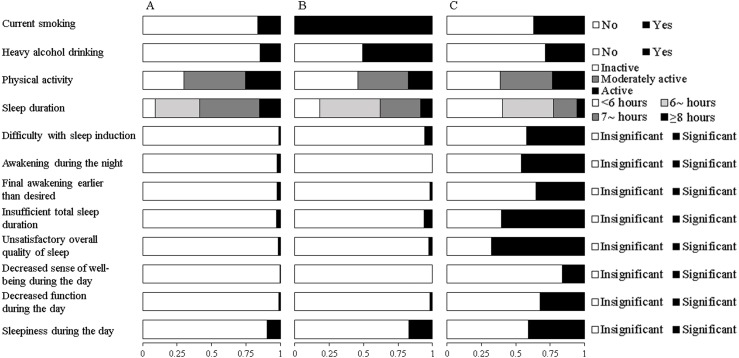
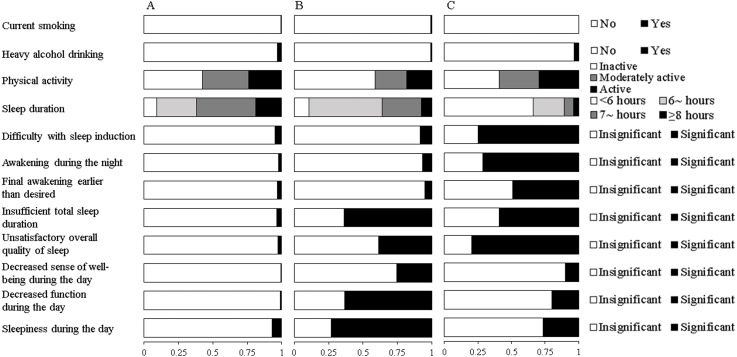
Three distinct behavioral clusters emerged in both genders. Male classes were defined as: (1) healthy lifestyle (Class 1, 62.9%); (2) cumulate harmful habits (Class 2, 27.1%); (3) poor sleep and risky habits (Class 3, 10.0%). Female classes were: (1) healthy lifestyle (Class 1, 83.0%); (2) inactive, daytime dysfunction (Class 2, 5.7%); (3) poor sleep habits (Class 3, 11.3%). Individuals of Class 2 and Class 3 showed a higher likelihood of diabetes across genders (multivariable-adjusted ORs [95% CIs], 2.03 [1.49-2.76] and 2.61 [1.78-3.81] among males, 2.64 [1.16-5.98] and 1.81 [1.07-3.06] among females) when compared with those of Class 1.
Our data provided additional evidence of HRBs clustering among adults, and such clustering was associated with an increased risk of diabetes. These findings have implications for identifying vulnerable subgroups and developing diabetes prevention programs.
识别个体健康风险行为(HRB)的聚集模式及其对健康的影响对于制定生活方式促进策略至关重要。本研究旨在探讨一系列健康风险行为在华南地区成年人中的聚集情况,以及这些已识别的聚集模式与糖尿病之间的关联。
分析了2012年11月至2013年12月在广州一家三级医院接受健康检查的5734名35 - 75岁成年人的数据。通过问卷调查测量行为特征,包括吸烟、饮酒、身体活动以及睡眠时间和质量。按性别进行潜在类别分析以识别健康风险行为的聚集模式,并使用逻辑回归模型估计行为模式与糖尿病之间的关联。
男女均出现了三种不同的行为聚集类型。男性类别定义为:(1)健康生活方式(第1类,62.9%);(2)累积有害习惯(第2类,27.1%);(3)睡眠不佳和高风险习惯(第3类,10.0%)。女性类别为:(1)健康生活方式(第1类,83.0%);(2)不活动、白天功能障碍(第2类,5.7%);(3)睡眠习惯不佳(第3类,11.3%)。与第1类个体相比跨性别来看,第2类和第3类个体患糖尿病的可能性更高(多变量调整后的比值比[95%置信区间],男性中为2.03[(1.49 - 2.76)]和2.61[(1.78 - 3.81)],女性中为2.64[(1.16 - 5.98)]和1.81[(1.07 - 3.06)])。
我们的数据为成年人中健康风险行为的聚集提供了更多证据,且这种聚集与糖尿病风险增加相关。这些发现对于识别易患亚组和制定糖尿病预防计划具有重要意义。