Qi Tao, Ye Lei, Wang Bo, Zhang Bin, Chen Jun
Department of Infertility and Sexual Medicine, the Third Affiliated Hospital of Sun Yat-Sen University, Guangzhou, Guangdong, China.
Medicine (Baltimore). 2017 Nov;96(44):e8414. doi: 10.1097/MD.0000000000008414.
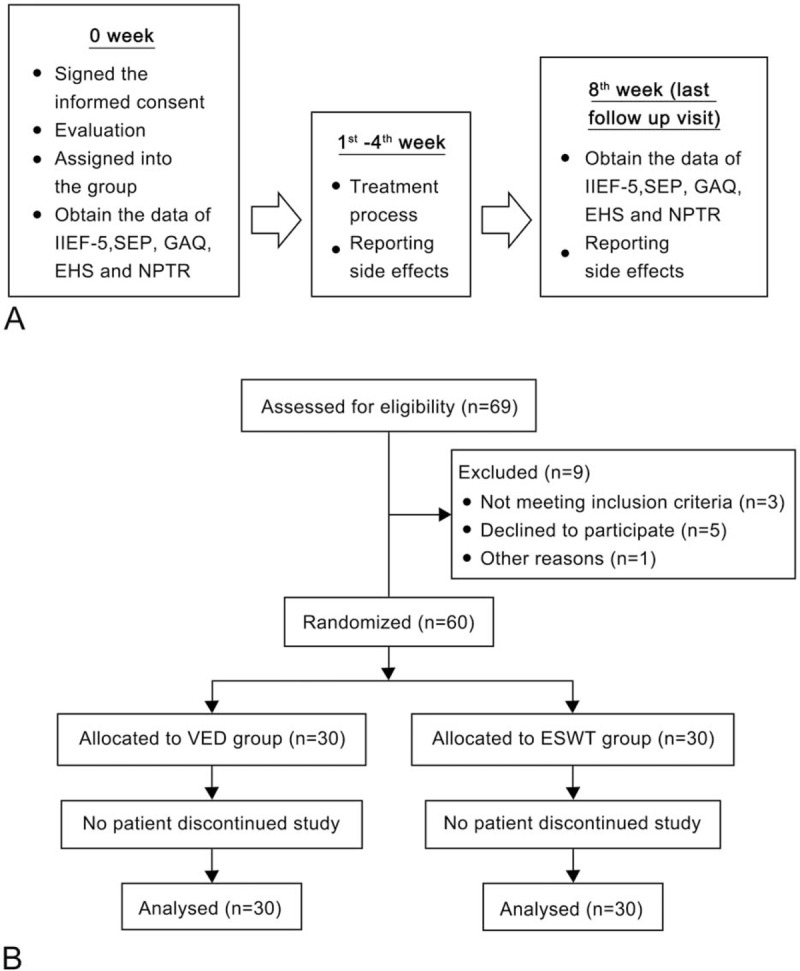
This randomized clinical trial (October 2012-December 2013) compared extracorporeal shock wave therapy (ESWT) and a vacuum erectile device (VED) for management of erectile dysfunction (ED).
Consecutive Chinese patients (20-55 years) with ED, abnormal nocturnal penile tumescence and rigidity (NPTR), and international index of erectile function-5 items (IIEF-5) score <22 were randomized to receive ESWT or VED (twice weekly, 4 weeks). Primary outcomes were treatment efficacy and success rate 4 weeks after completion of therapy. Secondary outcomes included changes in IIEF-5 score, sex encounter profile (SEP) score, erection hardness score (EHS) and NPTR assessments 4 weeks post-therapy. All enrolled patients (n = 30 per group) completed the study. At baseline, age, IIEF-5 score, SEP score, EHS, and NPTR assessments were similar between groups.
Four weeks post-therapy, IIEF-5 score increased in the ESWT (15.03 ± 3.00 vs. 11.60 ± 2.28) and VED (15.10 ± 3.06 vs. 11.53 ± 2.27) groups, as did SEP score, EHS, and NPTR measures (all P < .05). Efficacy in the ESWT and VED groups was excellent in 10% and 13.3%, respectively, and moderate in 63.3% and 53.3%, respectively. Treatment success rate in the ESWT and VED groups was 73.3% and 67.7%, respectively.
VED use and ESWT have comparable efficacies in the treatment of ED in Chinese patients.
这项随机临床试验(2012年10月至2013年12月)比较了体外冲击波疗法(ESWT)和真空勃起装置(VED)治疗勃起功能障碍(ED)的效果。
连续纳入年龄在20 - 55岁之间、患有勃起功能障碍、夜间阴茎勃起功能和硬度异常(NPTR)且国际勃起功能指数-5项(IIEF-5)评分<22的中国患者,随机分为接受ESWT组或VED组(每周两次,共4周)。主要结局指标为治疗结束后4周的治疗效果和成功率。次要结局指标包括治疗后4周IIEF-5评分、性活动情况评分(SEP)、勃起硬度评分(EHS)和NPTR评估。所有纳入患者(每组n = 30)均完成了研究。基线时,两组在年龄、IIEF-5评分、SEP评分、EHS和NPTR评估方面相似。
治疗后4周,ESWT组(15.03 ± 3.00 vs. 11.60 ± 2.28)和VED组(15.10 ± 3.06 vs. 11.53 ± 2.27)的IIEF-5评分均升高,SEP评分、EHS和NPTR指标也均升高(所有P < 0.05)。ESWT组和VED组的疗效分别有10%为优和13.3%为优,分别有63.3%和53.3%为中等。ESWT组和VED组的治疗成功率分别为73.3%和67.7%。
在中国患者中,使用VED和ESWT治疗ED的疗效相当。