Lee Seung Ho, Jin Young-Joo, Lee Jin-Woo
Department of Internal Medicine, Inha University Hospital, Inha University School of Medicine The Korean Liver Cancer Study Group WCSL (World Class Smart Lab), Inha University, Incheon, South Korea.
Medicine (Baltimore). 2017 Nov;96(44):e8486. doi: 10.1097/MD.0000000000008486.
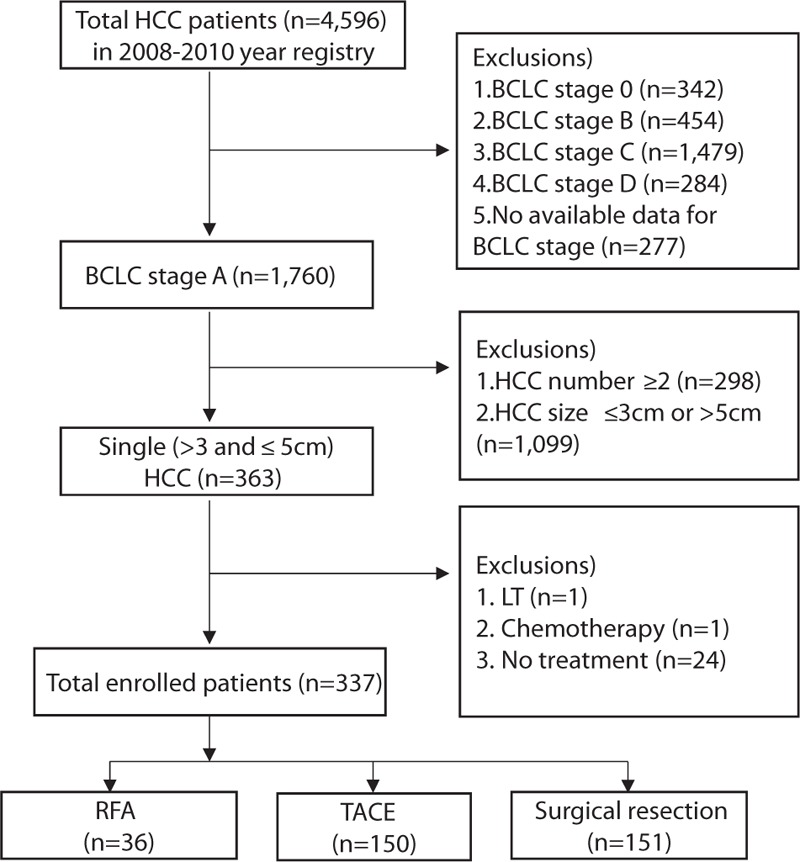
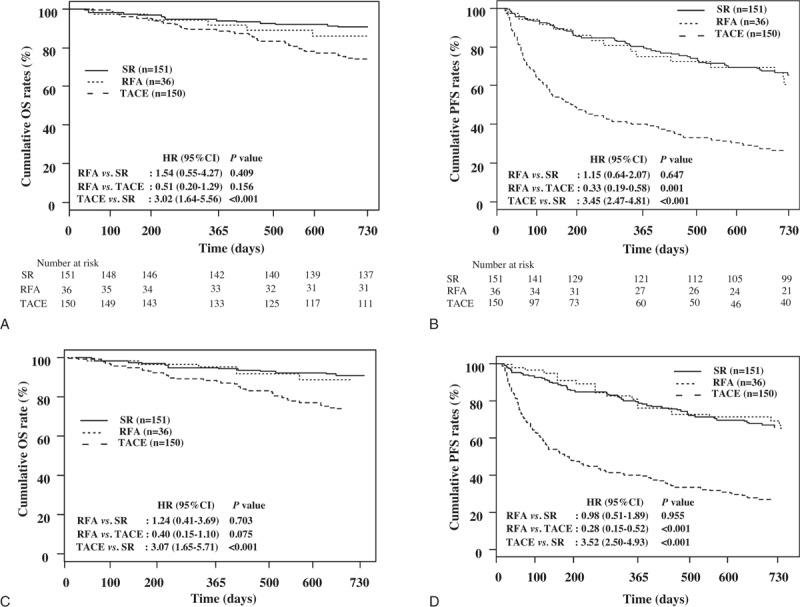
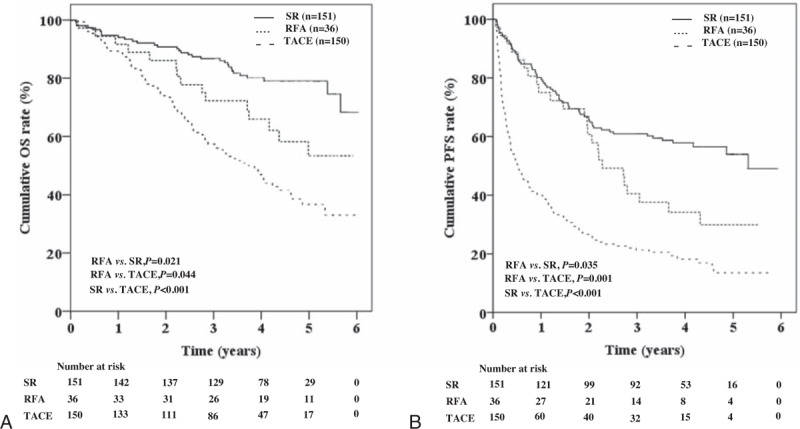
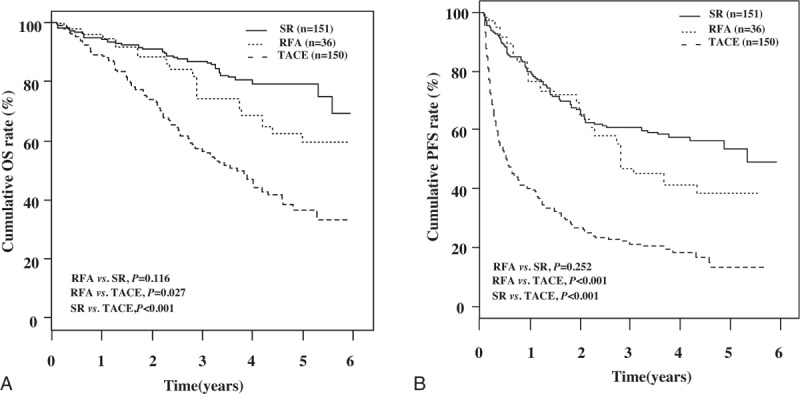
We retrospectively compared overall survival (OS) and progression-free survival (PFS) of patients with single (3-5 cm) hepatocellular carcinoma (HCC) with Barcelona Clinic Liver Cancer (BCLC) stage A treated by surgical resection (SR), radiofrequency ablation (RFA), or transarterial chemoembolization (TACE).Of the 38,167 HCC patients registered between 2008 and 2010 at Korea Central Cancer Registry, National Cancer Center of South Korea, 13% patients were randomly abstracted, and 4596 patients could be analyzed. Of these 4596 patients, 337 patients with single 3 to 5 cm sized HCC with BCLC stage A were enrolled. OSs and PFSs among SR (n = 151), RFA (n = 36), and TACE groups (n = 150) were compared, respectively. Propensity score (PS) weighting was used to adjust differences among 3 groups.Median follow-up duration was 45 months (range, 1-73 months). After PS weighting, the cumulative OS rates were significantly higher in the SR (P < .001) and RFA (P = .027) groups than in the TACE group, respectively, but not statistically different between SR and RFA groups (P = .116). The cumulative PFS rates were significantly higher in the SR (P < .001) and RFA (P < .001) groups than in the TACE group, respectively. TACE (hazard ratio [HR] 2.46, P < .001), serum albumin (HR 0.57, P = .002), and tumor size (HR 1.66, P = .001) were predictors for OS. TACE (HR 3.14, P < .001), serum bilirubin (HR 1.38, P = .020), and tumor size (HR 1.32, P = .024) were predictors for PFS.RFA has better OS and PFS rates than TACE, and provides comparable survival outcomes compared with SR in single (3-5 cm) HCC with BCLC stage A.
我们回顾性比较了接受手术切除(SR)、射频消融(RFA)或经动脉化疗栓塞(TACE)治疗的巴塞罗那临床肝癌(BCLC)A期单发(3 - 5厘米)肝细胞癌(HCC)患者的总生存期(OS)和无进展生存期(PFS)。在2008年至2010年韩国中央癌症登记处(韩国国立癌症中心)登记的38167例HCC患者中,随机抽取了13%的患者,共4596例患者可供分析。在这4596例患者中,纳入了337例BCLC A期单发3至5厘米大小HCC患者。分别比较了SR组(n = 151)、RFA组(n = 36)和TACE组(n = 150)的OS和PFS。采用倾向评分(PS)加权来调整三组之间的差异。中位随访时间为45个月(范围1 - 73个月)。PS加权后,SR组(P <.001)和RFA组(P =.027)的累积OS率分别显著高于TACE组,但SR组和RFA组之间无统计学差异(P =.116)。SR组(P <.001)和RFA组(P <.001)的累积PFS率分别显著高于TACE组。TACE(风险比[HR] 2.46,P <.001)、血清白蛋白(HR = 0.57,P =.002)和肿瘤大小(HR = 1.66,P =.001)是OS的预测因素。TACE(HR = 3.14,P <.001)、血清胆红素(HR = 1.38,P =.020)和肿瘤大小(HR = 1.32,P =.024)是PFS的预测因素。对于BCLC A期单发(3 - 5厘米)HCC,RFA比TACE具有更好的OS和PFS率,并且与SR相比提供了相当的生存结果。