• 文献检索
  • 文档翻译
  • 深度研究
  • 学术资讯
  • Suppr Zotero 插件Zotero 插件
  • 邀请有礼
  • 套餐&价格
  • 历史记录
应用&插件
Suppr Zotero 插件Zotero 插件浏览器插件Mac 客户端Windows 客户端微信小程序
定价
高级版会员购买积分包购买API积分包
服务
文献检索文档翻译深度研究API 文档MCP 服务
关于我们
关于 Suppr公司介绍联系我们用户协议隐私条款
关注我们

Suppr 超能文献

核心技术专利:CN118964589B侵权必究
粤ICP备2023148730 号-1Suppr @ 2026

文献检索

告别复杂PubMed语法,用中文像聊天一样搜索,搜遍4000万医学文献。AI智能推荐,让科研检索更轻松。

立即免费搜索

文件翻译

保留排版,准确专业,支持PDF/Word/PPT等文件格式,支持 12+语言互译。

免费翻译文档

深度研究

AI帮你快速写综述,25分钟生成高质量综述,智能提取关键信息,辅助科研写作。

立即免费体验

极低出生体重早产儿的辅料暴露情况。

Excipient exposure in very low birth weight preterm neonates.

作者信息

Akinmboni T O, Davis N L, Falck A J, Bearer C F, Mooney S M

机构信息

Division of Neonatology, Department of Pediatrics, University of Maryland School of Medicine, Baltimore MD, USA.

出版信息

J Perinatol. 2018 Feb;38(2):169-174. doi: 10.1038/jp.2017.165. Epub 2017 Nov 2.

DOI:10.1038/jp.2017.165
PMID:29095430
原文链接:https://pmc.ncbi.nlm.nih.gov/articles/PMC5790602/
Abstract

OBJECTIVE

The excipients benzyl alcohol, propylene glycol and ethanol are present in medications used in the neonatal intensive care unit. Exposure to high levels can have adverse effects in a neonatal population. The objective was to quantify excipient exposure in very low birth weight (VLBW) neonates and identify risk factors associated with greater exposure.

STUDY DESIGN

A retrospective record review of VLBW infants admitted over 1 year. Excipient exposures were calculated and multivariable regression analyses identified risk factors for increasing exposure.

RESULTS

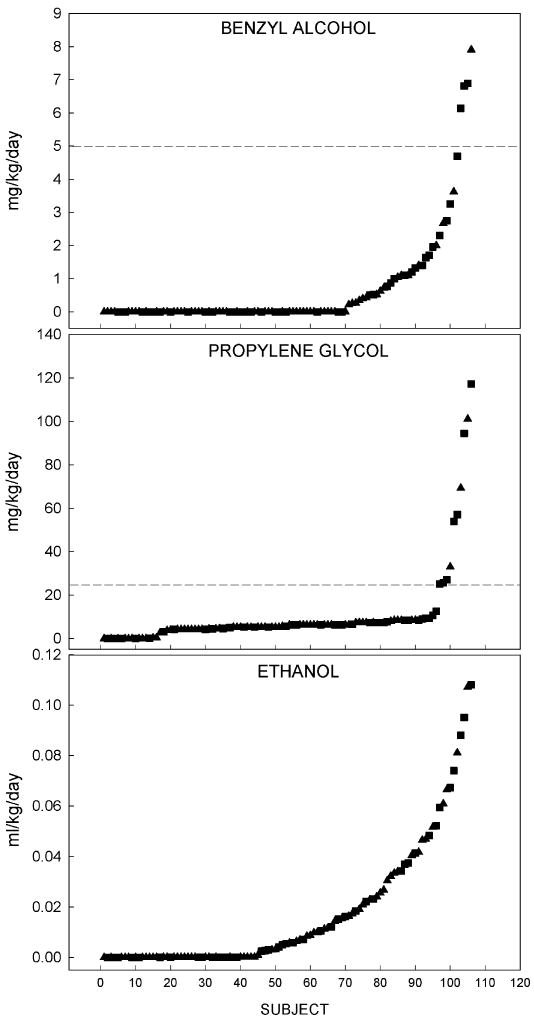
In total, 98% of subjects were exposed to at least one excipient. A total of 5 to 9% received doses higher than recommended for adults. Necrotizing enterocolitis, seizure, bronchopulmonary dysplasia and longer stay predicted higher excipient exposure.

CONCLUSION

The excipients examined are in medications commonly prescribed for VLBW neonates, and cumulative doses may exceed recommended exposures for adults. Although safety profiles have not been established, judicious use of medication containing these excipients is warranted for this population.

摘要

目的

新生儿重症监护病房使用的药物中含有辅料苯甲醇、丙二醇和乙醇。高剂量接触这些辅料可能会对新生儿产生不良影响。本研究的目的是量化极低出生体重(VLBW)新生儿的辅料接触量,并确定与较高接触量相关的风险因素。

研究设计

对1年内收治的VLBW婴儿进行回顾性记录审查。计算辅料接触量,并通过多变量回归分析确定接触量增加的风险因素。

结果

总体而言,98%的受试者接触过至少一种辅料。共有5%至9%的受试者接受的剂量高于成人推荐剂量。坏死性小肠结肠炎、癫痫、支气管肺发育不良和住院时间延长预示着辅料接触量较高。

结论

所检测的辅料存在于VLBW新生儿常用的药物中,累积剂量可能超过成人推荐接触量。尽管尚未确定其安全性,但对于该人群,谨慎使用含有这些辅料的药物是必要的。
https://cdn.ncbi.nlm.nih.gov/pmc/blobs/e116/5790602/dbcdf9ff57c0/nihms905917f1.jpg

相似文献

1
Excipient exposure in very low birth weight preterm neonates.极低出生体重早产儿的辅料暴露情况。
J Perinatol. 2018 Feb;38(2):169-174. doi: 10.1038/jp.2017.165. Epub 2017 Nov 2.
2
Exposure to the pharmaceutical excipients benzyl alcohol and propylene glycol among critically ill neonates.危重新生儿接触药用辅料苯甲醇和丙二醇的情况。
Pediatr Crit Care Med. 2009 Mar;10(2):256-9. doi: 10.1097/PCC.0b013e31819a383c.
3
Pharmaceutical excipients.药用辅料。
Neonatal Netw. 2000 Sep;19(6):67-70. doi: 10.1891/0730-0832.19.6.67.
4
The Cumulative Daily Tolerance Levels of Potentially Toxic Excipients Ethanol and Propylene Glycol Are Commonly Exceeded in Neonates and Infants.潜在毒性赋形剂乙醇和丙二醇的累积日耐受水平在新生儿和婴儿中经常超标。
Basic Clin Pharmacol Toxicol. 2018 May;122(5):523-530. doi: 10.1111/bcpt.12950. Epub 2018 Jan 17.
5
Possible effects of excipients used in the parenteral drugs administered in critically ill adults, children, and neonates.在危重症成人、儿童和新生儿中给予的肠外药物中使用的赋形剂可能产生的影响。
Expert Opin Drug Saf. 2020 Dec;19(12):1625-1640. doi: 10.1080/14740338.2020.1805431. Epub 2020 Aug 21.
6
Safe excipient exposure in neonates and small children - protocol for the SEEN project.新生儿和小儿安全辅料暴露——SEEN项目方案
Dan Med J. 2017 Feb;64(2).
7
Quantifying Medication Exposure in Very Low Birth Weight Neonates.量化极低出生体重儿的药物暴露量。
Am J Perinatol. 2021 Mar;38(4):383-391. doi: 10.1055/s-0039-1697669. Epub 2019 Nov 4.
8
Toxic additives in medication for preterm infants.早产儿药物中的有毒添加剂。
Arch Dis Child Fetal Neonatal Ed. 2009 Jul;94(4):F236-40. doi: 10.1136/adc.2008.146035. Epub 2009 Jan 21.
9
Changes in outcome and complication rates of very-low-birth-weight infants in one tertiary center in southern Taiwan between 2003 and 2010.2003年至2010年台湾南部某三级医疗中心极低出生体重儿的结局及并发症发生率变化
Pediatr Neonatol. 2014 Aug;55(4):291-6. doi: 10.1016/j.pedneo.2013.10.010. Epub 2014 Jan 10.
10
Association Between Antibiotic Use and Neonatal Mortality and Morbidities in Very Low-Birth-Weight Infants Without Culture-Proven Sepsis or Necrotizing Enterocolitis.抗生素使用与无培养证实败血症或坏死性小肠结肠炎的极低出生体重儿的新生儿死亡率和发病率的关系。
JAMA Pediatr. 2016 Dec 1;170(12):1181-1187. doi: 10.1001/jamapediatrics.2016.2132.

引用本文的文献

1
Weighing up the evidence on ethanol excipient use in common neonatal medications.权衡常见新生儿药物中乙醇辅料使用的证据。
Pediatr Res. 2025 Jun 17. doi: 10.1038/s41390-025-04211-w.
2
Ethanol metabolites increase over time in preterm infants receiving ethanol containing medications: a concern.接受含乙醇药物治疗的早产儿体内乙醇代谢物会随时间增加:一个值得关注的问题。
Pediatr Res. 2025 Mar 17. doi: 10.1038/s41390-025-03993-3.
3
Quantitative Investigation on Exposure to Potentially Harmful Excipients by Injection Drug Administration in Children Under 2 Years of Age and Analysis of Association with Adverse Events: A Single-Center, Retrospective Observational Study.

本文引用的文献

1
Essential medicines containing ethanol elevate blood acetaldehyde concentrations in neonates.含乙醇的基本药物会提高新生儿的血液乙醛浓度。
Eur J Pediatr. 2016 Jun;175(6):841-7. doi: 10.1007/s00431-016-2714-x. Epub 2016 Mar 21.
2
Births: Final Data for 2014.出生情况:2014年最终数据。
Natl Vital Stat Rep. 2015 Dec;64(12):1-64.
3
Fetal Alcohol Spectrum Disorders.胎儿酒精谱系障碍
儿童 2 岁以下人群注射用药时潜在有害辅料暴露的定量研究及其与不良事件的关联分析:一项单中心、回顾性观察研究。
Ther Innov Regul Sci. 2024 Mar;58(2):316-335. doi: 10.1007/s43441-023-00596-0. Epub 2023 Dec 6.
4
Binge-like ethanol exposure during the brain growth spurt disrupts the function of retrosplenial cortex-projecting anterior thalamic neurons in adolescent mice.在大脑生长突增期间类似 binge 的乙醇暴露会破坏青春期小鼠的后扣带回皮层投射前丘脑神经元的功能。
Neuropharmacology. 2023 Dec 15;241:109738. doi: 10.1016/j.neuropharm.2023.109738. Epub 2023 Sep 30.
5
Perioperative exposure to volatile organic compounds in neonates undergoing cardiac surgery.新生儿心脏手术围手术期暴露于挥发性有机化合物。
J Thorac Cardiovasc Surg. 2024 Mar;167(3):1166-1176.e2. doi: 10.1016/j.jtcvs.2023.07.049. Epub 2023 Aug 7.
6
The Current States, Challenges, Ongoing Efforts, and Future Perspectives of Pharmaceutical Excipients in Pediatric Patients in Each Country and Region.各国及各地区儿科患者药用辅料的现状、挑战、持续努力及未来展望
Children (Basel). 2022 Mar 23;9(4):453. doi: 10.3390/children9040453.
7
c4c: Paediatric pharmacovigilance: Methodological considerations in research and development of medicines for children - A c4c expert group white paper.儿童药物警戒:儿童用药物研发中的方法学考虑因素——儿童药物警戒合作中心专家小组白皮书。
Br J Clin Pharmacol. 2022 Dec;88(12):4997-5016. doi: 10.1111/bcp.15119. Epub 2021 Dec 18.
8
Availability of age-appropriate paediatric formulations in the Netherlands: the need in daily clinical practice remains.荷兰有适合年龄的儿科制剂供应:但在日常临床实践中仍有需求。
Eur J Hosp Pharm. 2021 Nov;28(6):306-312. doi: 10.1136/ejhpharm-2019-001977. Epub 2019 Nov 11.
9
Potentially harmful excipients in neonatal medications: a multicenter nationwide observational study in Japan.新生儿用药中潜在有害的辅料:日本一项全国多中心观察性研究
J Pharm Health Care Sci. 2021 Jul 1;7(1):23. doi: 10.1186/s40780-021-00208-9.
10
Characterization of motor function in mice developmentally exposed to ethanol using the Catwalk system: Comparison with the triple horizontal bar and rotarod tests.采用 Catwalk 系统对发育性暴露于乙醇的小鼠的运动功能进行特征分析:与三重水平棒和转棒试验的比较。
Behav Brain Res. 2021 Jan 1;396:112885. doi: 10.1016/j.bbr.2020.112885. Epub 2020 Aug 26.
Pediatrics. 2015 Nov;136(5):e1395-406. doi: 10.1542/peds.2015-3113. Epub 2015 Oct 19.
4
Potentially harmful excipients in neonatal medicines: a pan-European observational study.新生儿药物中潜在有害的辅料:一项泛欧洲观察性研究。
Arch Dis Child. 2015 Jul;100(7):694-9. doi: 10.1136/archdischild-2014-307793. Epub 2015 Apr 8.
5
Toxic excipients in medications for neonates in Brazil.巴西新生儿用药中的有毒辅料。
Eur J Pediatr. 2014 Jul;173(7):935-45. doi: 10.1007/s00431-014-2272-z. Epub 2014 Feb 6.
6
Hospitalised neonates in Estonia commonly receive potentially harmful excipients.爱沙尼亚住院新生儿通常会接受潜在有害的赋形剂。
BMC Pediatr. 2012 Aug 29;12:136. doi: 10.1186/1471-2431-12-136.
7
Developmental pharmacokinetics of propylene glycol in preterm and term neonates.早产儿和足月新生儿丙二醇的发育药代动力学。
Br J Clin Pharmacol. 2013 Jan;75(1):162-71. doi: 10.1111/j.1365-2125.2012.04312.x.
8
Prospective assessment of short-term propylene glycol tolerance in neonates.前瞻性评估新生儿短期丙二醇耐受情况。
Arch Dis Child. 2010 Dec;95(12):1054-8. doi: 10.1136/adc.2010.190330. Epub 2010 Oct 19.
9
Exposure to the pharmaceutical excipients benzyl alcohol and propylene glycol among critically ill neonates.危重新生儿接触药用辅料苯甲醇和丙二醇的情况。
Pediatr Crit Care Med. 2009 Mar;10(2):256-9. doi: 10.1097/PCC.0b013e31819a383c.
10
Toxic additives in medication for preterm infants.早产儿药物中的有毒添加剂。
Arch Dis Child Fetal Neonatal Ed. 2009 Jul;94(4):F236-40. doi: 10.1136/adc.2008.146035. Epub 2009 Jan 21.