Stetz Gabrielle, Tse Amanda, Verkhivker Gennady M
Department of Computational and Data Sciences, Schmid College of Science and Technology, Chapman University, Orange, California, United States of America.
Department of Biomedical and Pharmaceutical Sciences, Chapman University School of Pharmacy, Irvine, California, United States of America.
PLoS One. 2017 Nov 2;12(11):e0186089. doi: 10.1371/journal.pone.0186089. eCollection 2017.
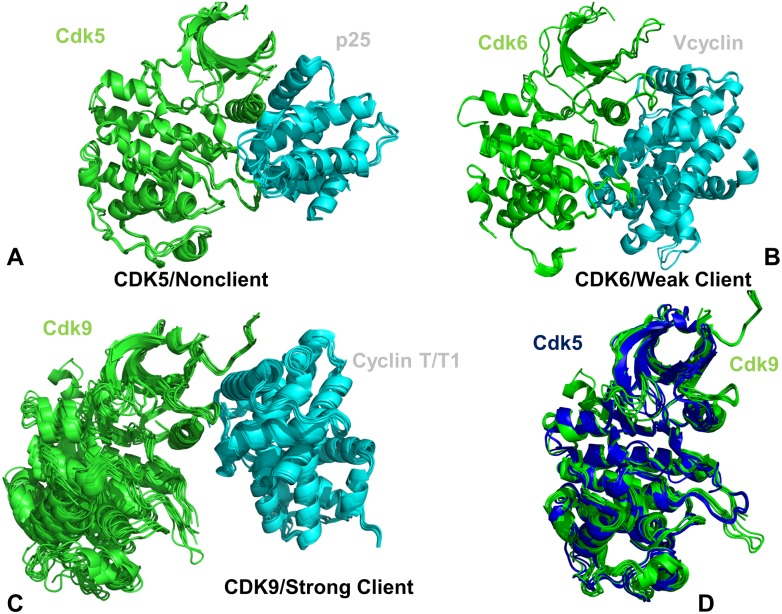
The overarching goal of delineating molecular principles underlying differentiation of protein kinase clients and chaperone-based modulation of kinase activity is fundamental to understanding activity of many oncogenic kinases that require chaperoning of Hsp70 and Hsp90 systems to attain a functionally competent active form. Despite structural similarities and common activation mechanisms shared by cyclin-dependent kinase (CDK) proteins, members of this family can exhibit vastly different chaperone preferences. The molecular determinants underlying chaperone dependencies of protein kinases are not fully understood as structurally similar kinases may often elicit distinct regulatory responses to the chaperone. The regulatory divergences observed for members of CDK family are of particular interest as functional diversification among these kinases may be related to variations in chaperone dependencies and can be exploited in drug discovery of personalized therapeutic agents. In this work, we report the results of a computational investigation of several members of CDK family (CDK5, CDK6, CDK9) that represented a broad repertoire of chaperone dependencies-from nonclient CDK5, to weak client CDK6, and strong client CDK9. By using molecular simulations of multiple crystal structures we characterized conformational ensembles and collective dynamics of CDK proteins. We found that the elevated dynamics of CDK9 can trigger imbalances in cooperative collective motions and reduce stability of the active fold, thus creating a cascade of favorable conditions for chaperone intervention. The ensemble-based modeling of residue interaction networks and community analysis determined how differences in modularity of allosteric networks and topography of communication pathways can be linked with the client status of CDK proteins. This analysis unveiled depleted modularity of the allosteric network in CDK9 that alters distribution of communication pathways and leads to impaired signaling in the client kinase. According to our results, these network features may uniquely define chaperone dependencies of CDK clients. The perturbation response scanning and rigidity decomposition approaches identified regulatory hotspots that mediate differences in stability and cooperativity of allosteric interaction networks in the CDK structures. By combining these synergistic approaches, our study revealed dynamic and network signatures that can differentiate kinase clients and rationalize subtle divergences in the activation mechanisms of CDK family members. The therapeutic implications of these results are illustrated by identifying structural hotspots of pathogenic mutations that preferentially target regions of the increased flexibility to enable modulation of activation changes. Our study offers a network-based perspective on dynamic kinase mechanisms and drug design by unravelling relationships between protein kinase dynamics, allosteric communications and chaperone dependencies.
描绘蛋白激酶底物分化和基于伴侣蛋白对激酶活性的调节作用背后的分子原理这一总体目标,对于理解许多致癌激酶的活性至关重要,这些激酶需要热休克蛋白70(Hsp70)和热休克蛋白90(Hsp90)系统的陪伴才能获得功能上具备活性的形式。尽管细胞周期蛋白依赖性激酶(CDK)蛋白具有结构相似性和共同的激活机制,但该家族成员可能表现出截然不同的伴侣蛋白偏好。蛋白激酶对伴侣蛋白依赖性的分子决定因素尚未完全了解,因为结构相似的激酶对伴侣蛋白可能常常引发不同的调节反应。CDK家族成员中观察到的调节差异特别令人感兴趣,因为这些激酶之间的功能多样化可能与伴侣蛋白依赖性的变化有关,并且可用于个性化治疗药物的药物发现。在这项工作中,我们报告了对CDK家族几个成员(CDK5、CDK6、CDK9)进行计算研究的结果,这些成员代表了广泛的伴侣蛋白依赖性范围——从非底物CDK5到弱底物CDK6,再到强底物CDK9。通过对多个晶体结构进行分子模拟,我们表征了CDK蛋白的构象集合和集体动力学。我们发现CDK9升高的动力学可以引发协同集体运动的失衡并降低活性折叠的稳定性,从而为伴侣蛋白干预创造一系列有利条件。基于集合的残基相互作用网络建模和群落分析确定了变构网络模块化差异和通信途径拓扑结构如何与CDK蛋白的底物状态相关联。该分析揭示了CDK蛋白变构网络模块化的耗尽,这改变了通信途径的分布并导致底物激酶中的信号传导受损。根据我们的结果,这些网络特征可能独特地定义了CDK底物对伴侣蛋白的依赖性。扰动响应扫描和刚性分解方法确定了调节热点,这些热点介导了CDK结构中变构相互作用网络稳定性和协同性的差异。通过结合这些协同方法,我们的研究揭示了能够区分激酶底物并使CDK家族成员激活机制中的细微差异合理化的动态和网络特征。通过识别优先靶向增加灵活性区域以实现激活变化调节的致病突变的结构热点,说明了这些结果的治疗意义。我们的研究通过揭示蛋白激酶动力学、变构通信和伴侣蛋白依赖性之间的关系,提供了一种基于网络的动态激酶机制和药物设计观点。