Verkhivker Gennady M, Agajanian Steve, Hu Guang, Tao Peng
Graduate Program in Computational and Data Sciences, Schmid College of Science and Technology, Chapman University, Orange, CA, United States.
Department of Biomedical and Pharmaceutical Sciences, Chapman University School of Pharmacy, Irvine, CA, United States.
Front Mol Biosci. 2020 Jul 9;7:136. doi: 10.3389/fmolb.2020.00136. eCollection 2020.
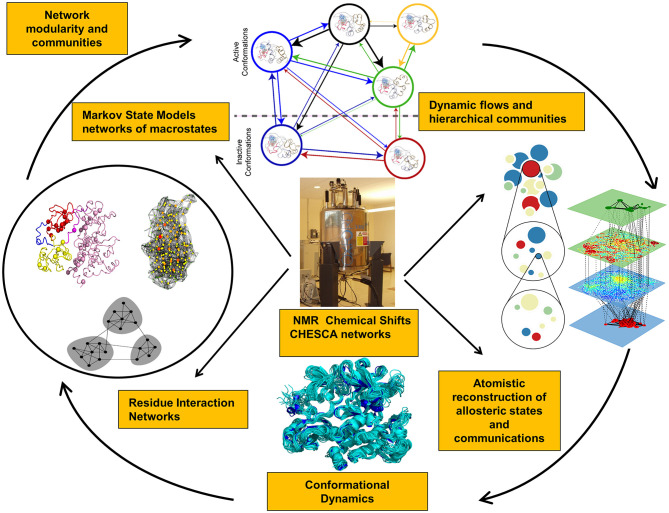
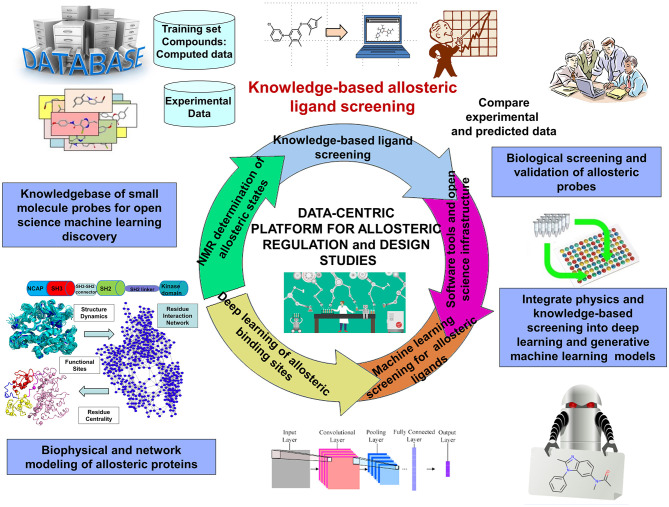
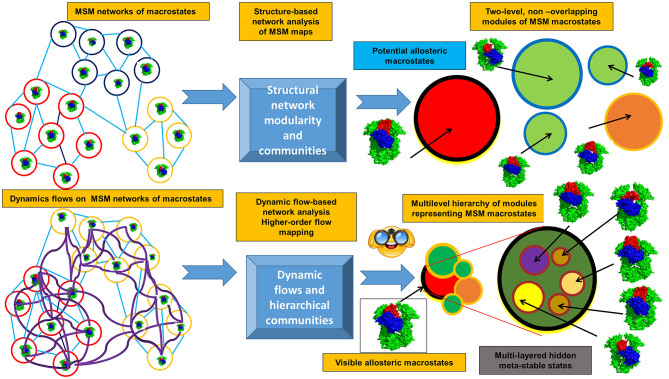
Allosteric regulation is a common mechanism employed by complex biomolecular systems for regulation of activity and adaptability in the cellular environment, serving as an effective molecular tool for cellular communication. As an intrinsic but elusive property, allostery is a ubiquitous phenomenon where binding or disturbing of a distal site in a protein can functionally control its activity and is considered as the "second secret of life." The fundamental biological importance and complexity of these processes require a multi-faceted platform of synergistically integrated approaches for prediction and characterization of allosteric functional states, atomistic reconstruction of allosteric regulatory mechanisms and discovery of allosteric modulators. The unifying theme and overarching goal of allosteric regulation studies in recent years have been integration between emerging experiment and computational approaches and technologies to advance quantitative characterization of allosteric mechanisms in proteins. Despite significant advances, the quantitative characterization and reliable prediction of functional allosteric states, interactions, and mechanisms continue to present highly challenging problems in the field. In this review, we discuss simulation-based multiscale approaches, experiment-informed Markovian models, and network modeling of allostery and information-theoretical approaches that can describe the thermodynamics and hierarchy allosteric states and the molecular basis of allosteric mechanisms. The wealth of structural and functional information along with diversity and complexity of allosteric mechanisms in therapeutically important protein families have provided a well-suited platform for development of data-driven research strategies. Data-centric integration of chemistry, biology and computer science using artificial intelligence technologies has gained a significant momentum and at the forefront of many cross-disciplinary efforts. We discuss new developments in the machine learning field and the emergence of deep learning and deep reinforcement learning applications in modeling of molecular mechanisms and allosteric proteins. The experiment-guided integrated approaches empowered by recent advances in multiscale modeling, network science, and machine learning can lead to more reliable prediction of allosteric regulatory mechanisms and discovery of allosteric modulators for therapeutically important protein targets.
别构调节是复杂生物分子系统在细胞环境中调节活性和适应性所采用的一种常见机制,是细胞通讯的有效分子工具。作为一种内在但难以捉摸的特性,别构是一种普遍现象,即蛋白质远端位点的结合或干扰可在功能上控制其活性,被视为“生命的第二个秘密”。这些过程在生物学上的根本重要性和复杂性需要一个多方面协同整合的方法平台,用于预测和表征别构功能状态、别构调节机制的原子结构重建以及发现别构调节剂。近年来别构调节研究的统一主题和总体目标一直是将新兴的实验方法与计算方法和技术相结合,以推进对蛋白质别构机制的定量表征。尽管取得了重大进展,但功能性别构状态、相互作用和机制的定量表征和可靠预测在该领域仍然是极具挑战性的问题。在本综述中,我们讨论了基于模拟的多尺度方法、实验指导的马尔可夫模型、别构的网络建模以及信息理论方法,这些方法可以描述别构状态的热力学和层次结构以及别构机制的分子基础。治疗上重要的蛋白质家族中丰富的结构和功能信息以及别构机制的多样性和复杂性为数据驱动研究策略的发展提供了一个非常合适的平台。利用人工智能技术以数据为中心整合化学、生物学和计算机科学已经获得了巨大的发展势头,并处于许多跨学科研究的前沿。我们讨论了机器学习领域的新发展以及深度学习和深度强化学习在分子机制和别构蛋白质建模中的应用。由多尺度建模、网络科学和机器学习的最新进展推动的实验指导综合方法可以导致对别构调节机制进行更可靠的预测,并发现针对治疗上重要蛋白质靶点的别构调节剂。