Children's Hospital of Philadelphia (CHOP), and the Lifespan Brain Institute, Philadelphia, PA.
University of Pennsylvania, Perelman School of Medicine, Philadelphia, and the Lifespan Brain Institute, Children's Hospital of Philadelphia.
J Am Acad Child Adolesc Psychiatry. 2017 Nov;56(11):975-982.e3. doi: 10.1016/j.jaac.2017.08.016. Epub 2017 Sep 14.
Deficits in executive function (EF) are common in neuropsychiatric disorders, but the specificity of these deficits remains unclear. The aim of the present study was to elucidate the pattern of EF impairment across psychopathologies in children and adolescents. Associations among components of EF with dimensions of psychopathology, including an overall psychopathology factor, were assessed.
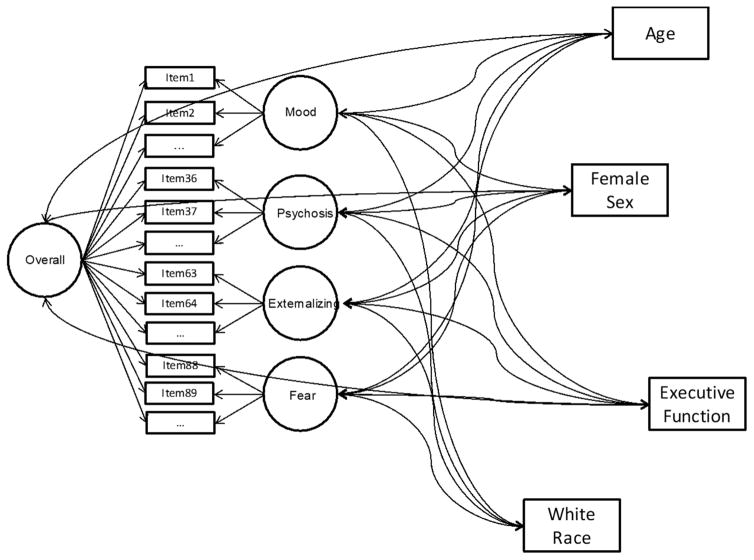
Participants (8-21 years) were from the Philadelphia Neurodevelopmental Cohort (N = 9,498). Data from a structured clinical screening interview were reduced to 5 dimensional domains using factor analyses: overall psychopathology, anxious-misery, fear, externalizing, and psychosis. EF components of attentional vigilance, response inhibition, conceptual flexibility, and working memory were assessed. Associations of clinical dimensions with general EF ability and with specific EF components were examined.
EF ability showed common and domain-specific associations with clinical symptoms. General EF was directly associated with the general psychopathology, anxious-misery, and psychosis domains but not with the fear or externalizing domains. For the EF subcomponents, differences emerged in the magnitude and direction of the association between components and clinical domains. Poorer EF was typically associated with increased symptoms across clinical domains; however, in some instances, better EF ability was associated with greater symptom burden, particularly in the fear domain.
EF has widespread associations with psychopathology in youth. Findings showed some overlap in the type of EF impairment across clinical phenotypes, as indicated by similar patterns of associations between some clinical symptoms and EF. However, findings also showed domain-specific associations with EF that differed across EF components and clinical domains.
执行功能(EF)缺陷在神经精神疾病中很常见,但这些缺陷的特异性仍不清楚。本研究旨在阐明儿童和青少年各种精神病理学中 EF 损伤的模式。评估 EF 成分与精神病理学维度之间的关联,包括整体精神病理学因子。
参与者(8-21 岁)来自费城神经发育队列(N=9498)。使用因子分析将来自结构化临床筛查访谈的数据简化为 5 个维度领域:整体精神病理学、焦虑痛苦、恐惧、外化和精神病。评估了注意力警觉、反应抑制、概念灵活性和工作记忆等 EF 成分。检查了临床维度与一般 EF 能力以及与特定 EF 成分的关联。
EF 能力与临床症状存在共同和特定领域的关联。一般 EF 与一般精神病理学、焦虑痛苦和精神病领域直接相关,但与恐惧或外化领域无关。对于 EF 子成分,在成分与临床领域之间的关联的大小和方向上出现了差异。较差的 EF 通常与跨临床领域的症状增加有关;然而,在某些情况下,更好的 EF 能力与更大的症状负担有关,特别是在恐惧领域。
EF 与青少年的精神病理学广泛相关。研究结果表明,EF 损伤的类型在临床表型之间存在一些重叠,这表明某些临床症状与 EF 之间存在类似的关联模式。然而,研究结果还表明,EF 与 EF 成分和临床领域之间存在特定领域的关联。