Klinge Johanna L, Warschburger Petra, Busching Robert, Klein Annette M
International Psychoanalytic University Berlin, Stromstr. 1, 10555, Berlin, Germany.
Department of Psychology, University of Potsdam, Karl-Liebknecht-Str. 24-25, 14476, Potsdam, Germany.
Child Adolesc Psychiatry Ment Health. 2023 Oct 17;17(1):120. doi: 10.1186/s13034-023-00670-3.
Internalizing symptoms are among the most common psychological symptoms in childhood and adolescence, are highly stable and can cause severe impairment. Current research discusses lower capacities of self-regulation (SR) as risk factors for the development of internalizing symptoms. The present study identifies trajectories of internalizing symptoms in the transition phase from middle childhood to adolescence and examines multiple SR facets as predictors of potentially unfavorable trajectories, also in the presence of other established risk factors.
The study utilized a community sample of N = 1453 (52.2% female) German children, who provided data at up to three measurement points (t1: 6-11 years, t2: 7-11 years, t3: 9-13 years). Trajectories of internalizing symptoms were based on parents' ratings of the emotional problems scale of the Strengths and Difficulties Questionnaire. SR facets were assessed using multiple methods and informants. Two multinomial regression analyses were conducted to predict class membership by (1) SR facets and gender and (2) SR facets, gender, and other established risk factors (education status, family adversity, peer problems).
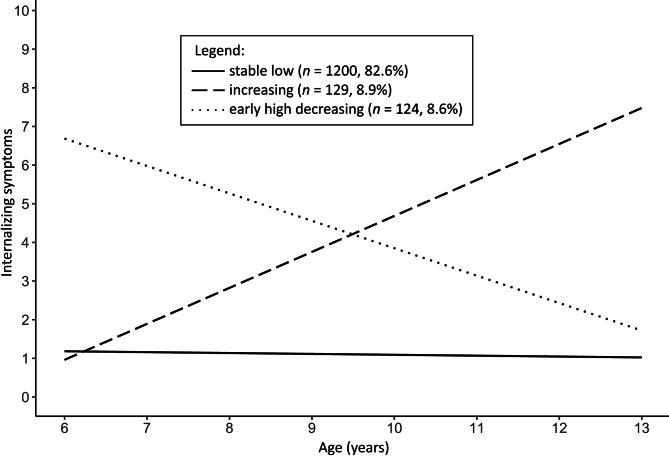
Using growth mixture modelling, we identified three trajectory classes with stable low (n = 1200), increasing (n = 124), and early high decreasing internalizing symptoms (n = 129). In the regression analysis controlling for risk factors, membership in the increasing trajectory was significantly predicted by higher emotional reactivity (OR = 2.65, p < .001), higher cognitive flexibility/set-shifting (OR = 1.48, p = .032), and higher family adversity (OR = 1.38, p = .046). Membership in the early high decreasing trajectory was significantly predicted by higher emotional reactivity (OR = 4.15, p < .001), higher inhibitory control (OR = 1.47, p = .045), lower working-memory updating (OR = 0.69, p = .016), lower delay of gratification (OR = 0.75, p = .028), and higher family adversity (OR = 1.63, p = .001).
SR facets incrementally and differentially predict potentially unfavorable trajectories of internalizing symptoms from age 6 to 13, surpassing the predictive value of gender or education status. Higher emotional reactivity emerged as the most influential factor, which could therefore be addressed in future prevention and intervention efforts.
内化症状是儿童和青少年中最常见的心理症状之一,具有高度稳定性,并可能导致严重损害。当前研究讨论了自我调节(SR)能力较低作为内化症状发展的风险因素。本研究确定了从中童年到青春期过渡阶段内化症状的轨迹,并检验了多个SR方面作为潜在不利轨迹的预测因素,同时也考虑了其他已确定的风险因素。
该研究使用了一个由1453名德国儿童组成的社区样本(52.2%为女性),这些儿童在多达三个测量点(t1:6 - 11岁,t2:7 - 11岁,t3:9 - 13岁)提供数据。内化症状的轨迹基于父母对优势与困难问卷中情绪问题量表的评分。SR方面使用多种方法和信息提供者进行评估。进行了两项多项回归分析,以通过(1)SR方面和性别以及(2)SR方面、性别和其他已确定的风险因素(教育状况、家庭逆境、同伴问题)来预测类别归属。
使用生长混合模型,我们确定了三个轨迹类别,分别是内化症状稳定低水平(n = 1200)、上升(n = 124)以及早期高水平后下降(n = 129)。在控制风险因素的回归分析中,情绪反应性较高(OR = 2.65,p <.001)、认知灵活性/任务切换能力较高(OR = 1.48,p =.032)以及家庭逆境较高(OR = 1.38,p =.046)显著预测了上升轨迹中的类别归属。早期高水平后下降轨迹中的类别归属显著由情绪反应性较高(OR = 4.15,p <.001)、抑制控制能力较高(OR = 1.47,p =.045)、工作记忆更新能力较低(OR = 0.69,p =.016)、延迟满足能力较低(OR = 0.75,p =.028)以及家庭逆境较高(OR = 1.63,p =.001)预测。
SR方面从6岁到13岁逐步且不同程度地预测了内化症状的潜在不利轨迹,超过了性别或教育状况的预测价值。较高的情绪反应性成为最具影响力的因素,因此在未来的预防和干预工作中可以加以应对。