Department of Gastroenterology, Qilu Hospital of Shandong University, Jinan, Shandong, China (mainland).
Department of Gastroenterology, Yantai Affiliated Hospital of Binzhou Medical University, Binzhou, Shandong, China (mainland).
Med Sci Monit. 2017 Nov 3;23:5237-5245. doi: 10.12659/msm.907326.
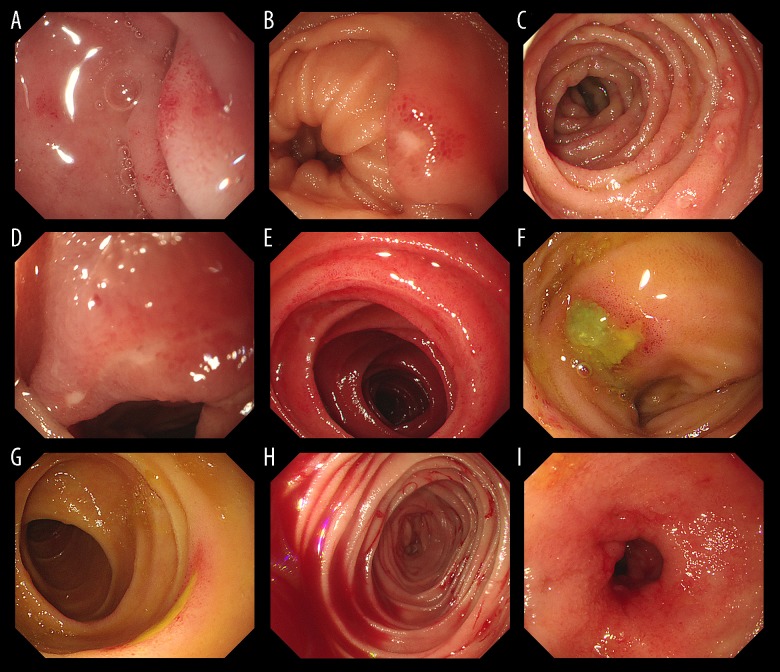
BACKGROUND The special features of nonsteroidal anti-inflammatory drugs (NSAIDs) enteropathy were partially clarified by single-balloon endoscopy(SBE). We aimed to investigate the characteristics of NSAIDs injuries that were differ from other ulcer diseases and efficacy of SBE compared with capsule endoscopy(CE). MATERIAL AND METHODS 1,644 symptomatic patients (221 patients taking NSAIDs) hospitalized between January 2006 and March 2016 were recruited and underwent SBE and/or CE. RESULTS NSAIDs damages were identified in 110 patients (49.77%). The special features of NSAIDs lesions included: variform, superficial, multiple and irregular arrangement; <1 cm in diameter (67.27%); the location in jejunum and ileum was similar; ileocecal valve was rarely influenced (20.91%). The specificity and positive predictive value of SBE for diagnosing NSAIDs breaks were higher than CE (95.74% vs. 80.00%; 95.45% vs. 81.63%, p<0.05). There were no differences in the detection rate and the diagnostic accuracy rate of small bowel diseases between SBE and CE in the NSAIDs group (69.4% vs. 66.3% and 83.58% vs. 80.65%, p>0.05 respectively). The consistency in diagnosing NSAIDs breaks for the 2 methods was 82.61%. More tiny lesions at the distal ileum were detected by SBE. Four patients misdiagnosed by CE got accurate diagnose through biopsy by SBE. Three patients with active bleeding caused by NSAIDs-induced ulcers underwent hemostasis successfully by SBE. CONCLUSIONS NSAIDs injuries might be distinguished from other diseases by endoscopic features and biopsy through SBE, which appeared to be an effective method for diagnosis and treatment.
单气囊小肠镜(SBE)部分阐明了非甾体抗炎药(NSAIDs)相关性肠病的特殊特征。我们旨在研究 NSAIDs 损伤与其他溃疡病的区别特征,以及 SBE 相对于胶囊内镜(CE)的疗效。
2006 年 1 月至 2016 年 3 月期间,共招募了 1644 名有症状的患者(221 名服用 NSAIDs 的患者),并进行了 SBE 和/或 CE 检查。
在 110 名患者(49.77%)中发现了 NSAIDs 损伤。NSAIDs 病变的特征包括:多样、浅表、多发和不规则排列;<1cm 直径(67.27%);部位在空肠和回肠相似;回盲瓣受累较少(20.91%)。SBE 对诊断 NSAIDs 破裂的特异性和阳性预测值均高于 CE(95.74%比 80.00%;95.45%比 81.63%,p<0.05)。在 NSAIDs 组中,SBE 和 CE 在小肠疾病的检出率和诊断准确率方面无差异(69.4%比 66.3%和 83.58%比 80.65%,p>0.05)。两种方法在诊断 NSAIDs 破裂方面的一致性为 82.61%。SBE 检测到更多的远端回肠微小病变。4 名被 CE 误诊的患者通过 SBE 活检得到了准确诊断。3 名因 NSAIDs 诱导溃疡导致活动性出血的患者通过 SBE 成功止血。
SBE 通过内镜特征和活检可将 NSAIDs 损伤与其他疾病区分开来,这似乎是一种有效的诊断和治疗方法。