State Key Laboratory of Surface Physics and Department of Physics, Fudan University, 200433, Shanghai, China.
Collaborative Innovation Center of Advanced Microstructures, 210093, Nanjing, China.
Nat Commun. 2017 Nov 2;8(1):1272. doi: 10.1038/s41467-017-01438-y.
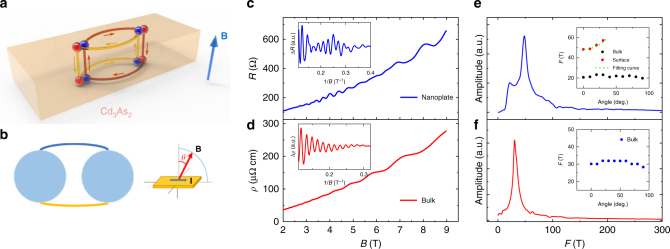
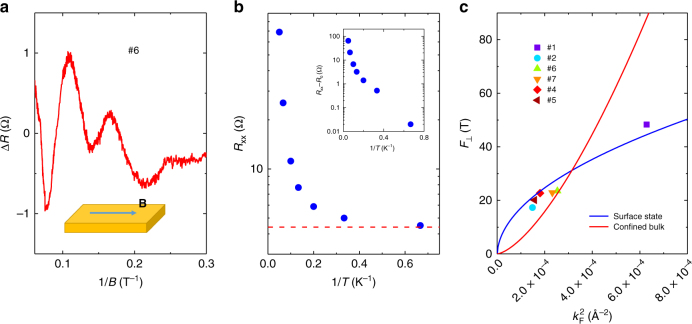
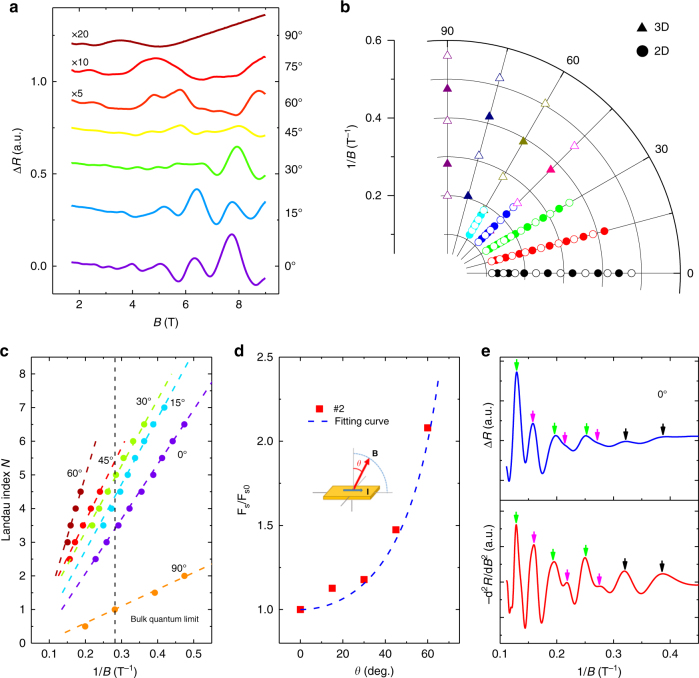
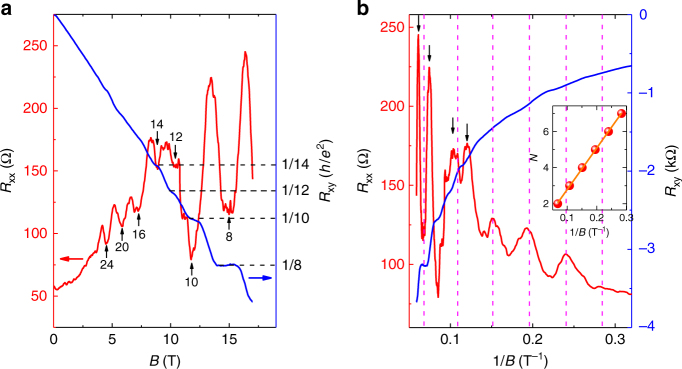
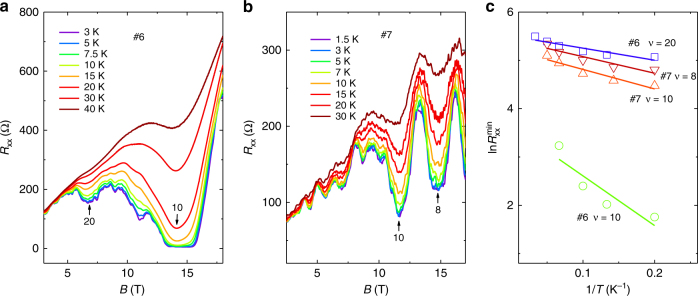
Owing to the coupling between open Fermi arcs on opposite surfaces, topological Dirac semimetals exhibit a new type of cyclotron orbit in the surface states known as Weyl orbit. Here, by lowering the carrier density in CdAs nanoplates, we observe a crossover from multiple-frequency to single-frequency Shubnikov-de Haas (SdH) oscillations when subjected to out-of-plane magnetic field, indicating the dominant role of surface transport. With the increase of magnetic field, the SdH oscillations further develop into quantum Hall state with non-vanishing longitudinal resistance. By tracking the oscillation frequency and Hall plateau, we observe a Zeeman-related splitting and extract the Landau level index as well as sub-band number. Different from conventional two-dimensional systems, this unique quantum Hall effect may be related to the quantized version of Weyl orbits. Our results call for further investigations into the exotic quantum Hall states in the low-dimensional structure of topological semimetals.
由于正反两个表面的开尔芬费米弧的耦合,拓扑狄拉克半金属在表面态中表现出一种新的回旋轨道,即 Weyl 轨道。在这里,通过降低 CdAs 纳米板中的载流子密度,当受到面外磁场时,我们观察到从多频到单频的舒布尼科夫-德哈斯(SdH)振荡的转变,表明表面输运的主导作用。随着磁场的增加,SdH 振荡进一步发展为具有非零纵向电阻的量子霍尔态。通过跟踪振荡频率和 Hall 平台,我们观察到与塞曼相关的分裂,并提取出朗道能级指数和子带数。与传统的二维系统不同,这种独特的量子霍尔效应可能与 Weyl 轨道的量子化版本有关。我们的结果呼吁进一步研究拓扑半金属的低维结构中的奇异量子霍尔态。