Laboratory for Systems Biology and Bio-inspired Engineering, Department of Bio and Brain Engineering, Korea Advanced Institute of Science and Technology (KAIST), Daejeon 34141, Republic of Korea.
Nat Commun. 2017 Nov 2;8(1):1270. doi: 10.1038/s41467-017-01171-6.
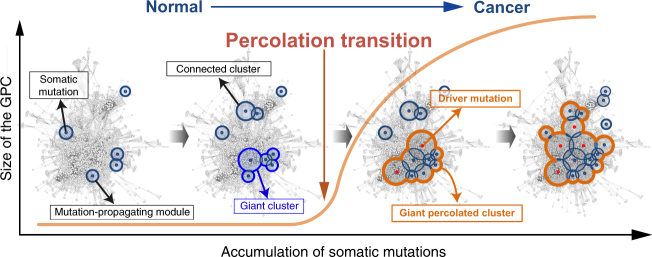
Cancer is caused by the accumulation of multiple genetic mutations, but their cooperative effects are poorly understood. Using a genome-wide analysis of all the somatic mutations in colorectal cancer patients in a large-scale molecular interaction network, here we find that a giant cluster of mutation-propagating modules in the network undergoes a percolation transition, a sudden critical transition from scattered small modules to a large connected cluster, during colorectal tumorigenesis. Such a large cluster ultimately results in a giant percolated cluster, which is accompanied by phenotypic changes corresponding to cancer hallmarks. Moreover, we find that the most commonly observed sequence of driver mutations in colorectal cancer has been optimized to maximize the giant percolated cluster. Our network-level percolation study shows that the cooperative effect rather than any single dominance of multiple somatic mutations is crucial in colorectal tumorigenesis.
癌症是由多个基因突变的积累引起的,但它们的协同作用仍不清楚。在这里,我们使用大规模分子相互作用网络中对结直肠癌患者所有体细胞突变的全基因组分析,发现网络中一个传播突变的巨型模块簇发生了渗流相变,即从分散的小模块到大型连通簇的突然关键转变,发生在结直肠肿瘤发生过程中。这样一个大的簇最终导致一个巨大的渗流簇,伴随着与癌症标志相对应的表型变化。此外,我们发现结直肠癌中最常见的驱动突变序列已经被优化,以最大限度地增加巨大的渗流簇。我们的网络级渗流研究表明,在结直肠肿瘤发生过程中,多个体细胞突变的协同作用而非任何单一优势是至关重要的。