Wai Kyi Mar, Mar Ohn, Kosaka Satoko, Umemura Mitsutoshi, Watanabe Chiho
Department of Human Ecology, the University of Tokyo, Tokyo, 113-0033, Japan.
Department of Physiology, University of Medicine 1, Yangon 130404, Myanmar.
Int J Environ Res Public Health. 2017 Nov 3;14(11):1339. doi: 10.3390/ijerph14111339.
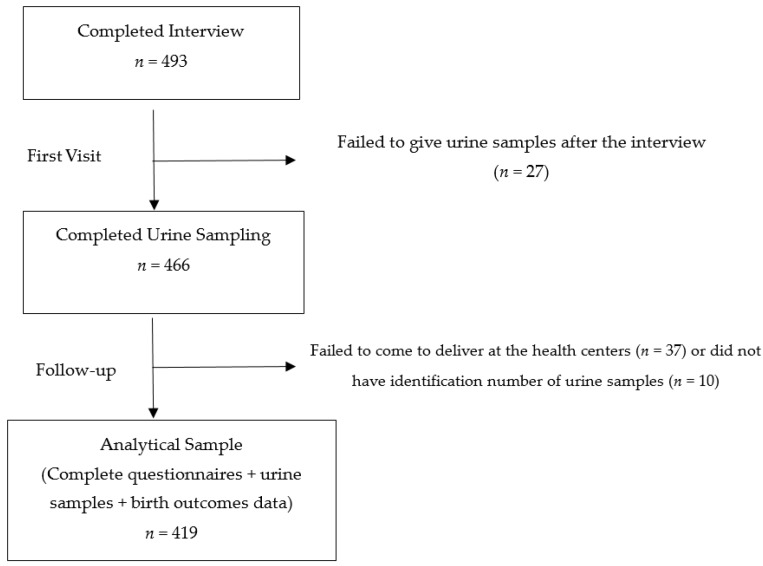
Arsenic, cadmium and lead are well-known environmental contaminants, and their toxicity at low concentration is the target of scientific concern. In this study, we aimed to identify the potential effects of prenatal heavy metal exposure on the birth outcomes among the Myanmar population. This study is part of a birth-cohort study conducted with 419 pregnant women in the Ayeyarwady Division, Myanmar. Face-to-face interviews were performed using a questionnaire, and maternal spot urine samples were collected at the third trimester. Birth outcomes were evaluated at delivery during the follow up. The median values of adjusted urinary arsenic, cadmium, selenium and lead concentration were 74.2, 0.9, 22.6 and 1.8 μg/g creatinine, respectively. Multivariable logistic regression revealed that prenatal cadmium exposure (adjusted odds ratio (OR) = 1.10; 95% confidence interval (CI): 1.01-1.21; = 0.043), gestational age (adjusted OR = 0.83; 95% CI: 0.72-0.95; = 0.009) and primigravida mothers (adjusted OR = 4.23; 95% CI: 1.31-13.65; = 0.016) were the predictors of low birth weight. The present study identified that Myanmar mothers were highly exposed to cadmium. Prenatal maternal cadmium exposure was associated with an occurrence of low birth weight.
砷、镉和铅是众所周知的环境污染物,它们在低浓度下的毒性是科学关注的目标。在本研究中,我们旨在确定产前重金属暴露对缅甸人群出生结局的潜在影响。本研究是对缅甸伊洛瓦底省419名孕妇进行的出生队列研究的一部分。使用问卷进行面对面访谈,并在孕晚期收集孕妇的即时尿样。在随访期间分娩时评估出生结局。调整后的尿砷、镉、硒和铅浓度的中位数分别为74.2、0.9、22.6和1.8μg/g肌酐。多变量逻辑回归显示,产前镉暴露(调整后的优势比(OR)=1.10;95%置信区间(CI):1.01-1.21;P=0.043)、孕周(调整后的OR=0.83;95%CI:0.72-0.95;P=0.009)和初产妇母亲(调整后的OR=4.23;95%CI:1.31-13.65;P=0.016)是低出生体重的预测因素。本研究发现缅甸母亲镉暴露水平较高。产前母亲镉暴露与低出生体重的发生有关。