Oh Jong Jin, Park Seunghyun, Lee Sang Eun, Hong Sung Kyu, Lee Sangchul, Kim Tae Jin, Lee In Jae, Ho Jin-Nyoung, Yoon Sungroh, Byun Seok-Soo
Department of Urology, Seoul National University College of Medicine, Seoul National University Bundang Hospital, Seongnam, Korea.
Department of Electrical and Computer Engineering, Seoul National University, Seoul, Korea.
Oncotarget. 2017 May 26;8(44):75979-75988. doi: 10.18632/oncotarget.18275. eCollection 2017 Sep 29.
To investigate the genetic risk score (GRS) from a large-scale exome-wide association study as a tool of prediction for biochemical recurrence (BCR) after radical prostatectomy (RP) in prostate cancer (PCa).
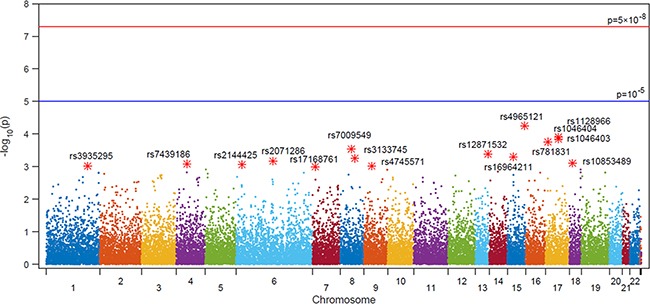
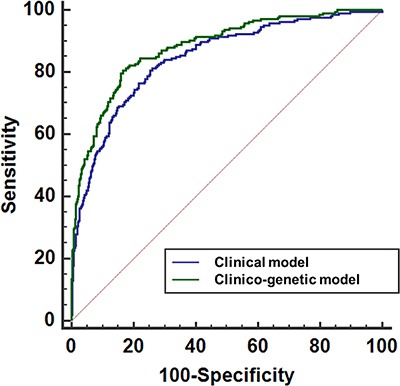
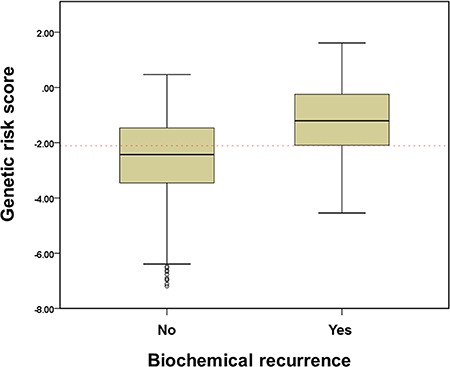
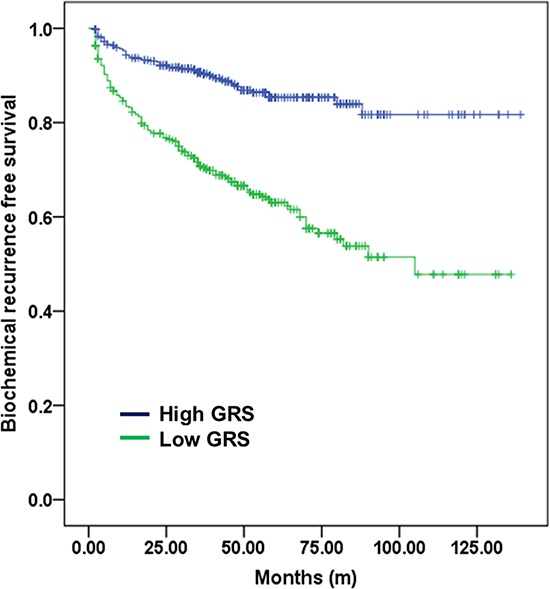
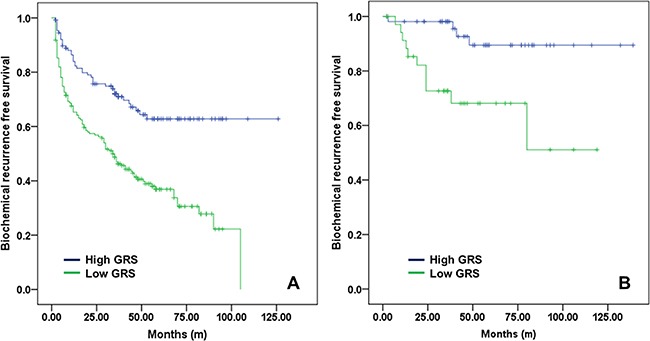
The 16 SNPs were selected as significant predictors of BCR. The GRS in men experiencing BCR was -1.21, significantly higher than in non-BCR patients (-2.43) ( 0.001). The 10-year BCR-free survival rate was 46.3% vs. 81.8% in the high-versus low GRS group, respectively ( 0.001). The GRS was a significant factor after adjusting for other variables in Cox proportional hazard models (HR:1.630, 0.001). The predictive ability of the multivariate model without GRS was 84.4%, increased significantly to 88.0% when GRS was included ( = 0.0026).
Total 912 PCa patients were enrolled who had received RP and genotype analysis using Exome chip (HumanExome BeadChip). Genetic results were obtained by the methods of logistic regression analysis which measured the odds ratio (OR) to BCR. The GRS was calculated by the sum of each weighted-risk allele count multiplied by the natural logarithm of the respective ORs. Survival analyses were performed using the GRS. We compared the accuracy of separate multivariate models incorporating clinicopathological factors that either included or excluded the GRS.
GRS had additional predictive gain of BCR after RP in PCa. The addition of personally calculated GRS significantly increased the BCR prediction rate. After validation of these results, GRS of BCR could be potential biomarker to predict clinical outcomes.
研究来自大规模外显子组全基因组关联研究的遗传风险评分(GRS),作为预测前列腺癌(PCa)根治性前列腺切除术(RP)后生化复发(BCR)的工具。
选择16个单核苷酸多态性(SNP)作为BCR的显著预测因子。发生BCR的男性的GRS为-1.21,显著高于未发生BCR的患者(-2.43)(P<0.001)。高GRS组与低GRS组的10年无BCR生存率分别为46.3%和81.8%(P<0.001)。在Cox比例风险模型中,调整其他变量后,GRS是一个显著因素(风险比:1.630,P<0.001)。不包含GRS的多变量模型的预测能力为84.4%,纳入GRS后显著提高到88.0%(P = 0.0026)。
共纳入912例接受RP并使用外显子芯片(HumanExome BeadChip)进行基因分型分析的PCa患者。通过逻辑回归分析方法获得遗传结果,该方法测量BCR的比值比(OR)。GRS通过将每个加权风险等位基因计数的总和乘以各自OR的自然对数来计算。使用GRS进行生存分析。我们比较了包含或排除GRS的临床病理因素的单独多变量模型的准确性。
GRS对PCa患者RP后的BCR具有额外的预测价值。加入个人计算的GRS显著提高了BCR预测率。在验证这些结果后,BCR的GRS可能成为预测临床结局的潜在生物标志物。