Department of Urology, Seoul National University Bundang Hospital, Seongnam, Korea.
Department of Medical Device Development, Seoul National University College of Medicine, Seoul, Korea.
Investig Clin Urol. 2021 May;62(3):256-266. doi: 10.4111/icu.20210124.
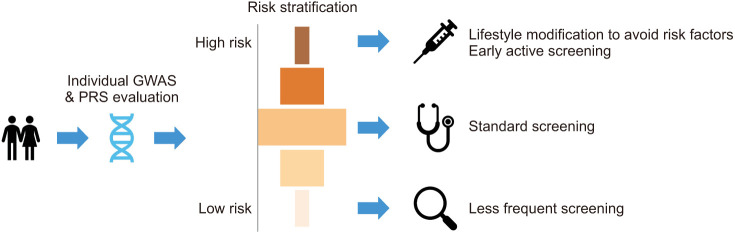
Decreasing costs of genetic testing and interest in disease inheritance has changed the landscape of cancer prediction in prostate cancer (PCa), and guidelines now include genetic testing for high-risk groups. Familial and hereditary PCa comprises approximately 20% and 5% of all PCa, respectively. Multifaceted disorders like PCa are caused by a combinatory effect of rare genes of high penetrance and smaller genetic variants of relatively lower effect size. Polygenic risk score (PRS) is a novel tool utilizing PCa-associated single nucleotide polymorphisms (SNPs) identified from genome-wide association study (GWAS) to generate an additive estimate of an individual's lifetime genetic risk for cancer. However, most PRS are developed based on GWAS collected from mainly European populations and do not address ethnic differences in PCa genetics. This review highlights the attempts to generate a PRS tailored to Asian males including data from Korea, China, and Japan, and discuss the clinical implications for prediction of early onset and aggressive PCa.
降低基因检测成本和对疾病遗传的关注改变了前列腺癌 (PCa) 的癌症预测格局,目前指南包括对高危人群进行基因检测。家族性和遗传性 PCa 分别约占所有 PCa 的 20%和 5%。像 PCa 这样的多因素疾病是由高外显率的罕见基因和相对较低效应大小的较小遗传变异的组合效应引起的。多基因风险评分 (PRS) 是一种利用全基因组关联研究 (GWAS) 中鉴定的与 PCa 相关的单核苷酸多态性 (SNP) 的新工具,可生成个体终生遗传癌症风险的累加估计值。然而,大多数 PRS 是基于主要来自欧洲人群的 GWAS 开发的,并未解决 PCa 遗传学中的种族差异。这篇综述重点介绍了为亚洲男性生成量身定制的 PRS 的尝试,包括来自韩国、中国和日本的数据,并讨论了其在预测早期发病和侵袭性 PCa 方面的临床意义。