Chen Shih-Ming, Wang Bing-Yen, Lee Che-Hsin, Lee Hsueh-Te, Li Jung-Jung, Hong Guan-Ci, Hung Yu-Chieh, Chien Peng-Ju, Chang Che-Ying, Hsu Li-Sung, Chang Wen-Wei
Institute of Biochemistry, Microbiology and Immunology, Chung Shan Medical University, Taichung, Taiwan.
Division of Thoracic Surgery, Department of Surgery, Changhua Christian Hospital, Changhua City, Taiwan.
Oncotarget. 2017 Jun 27;8(44):76057-76068. doi: 10.18632/oncotarget.18648. eCollection 2017 Sep 29.
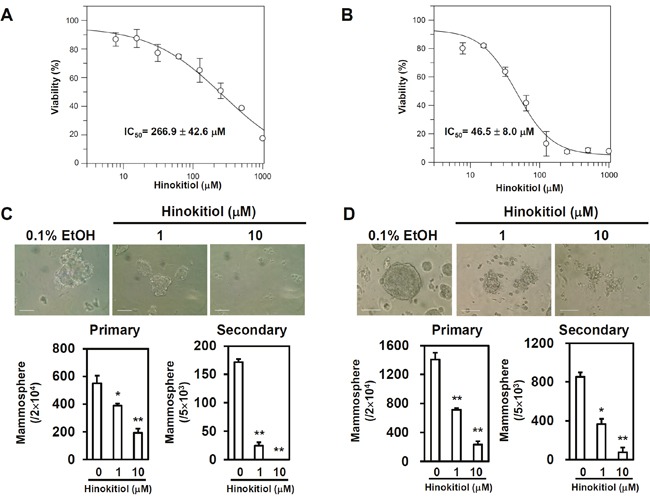
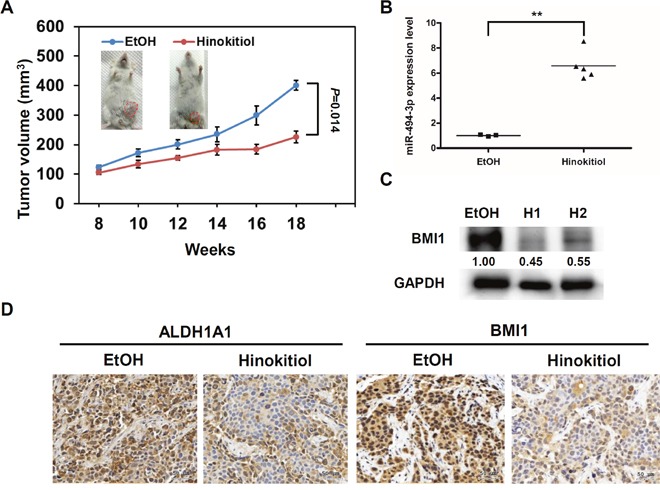
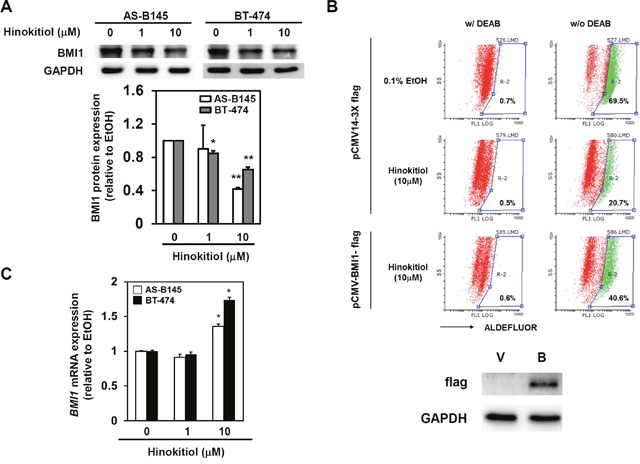
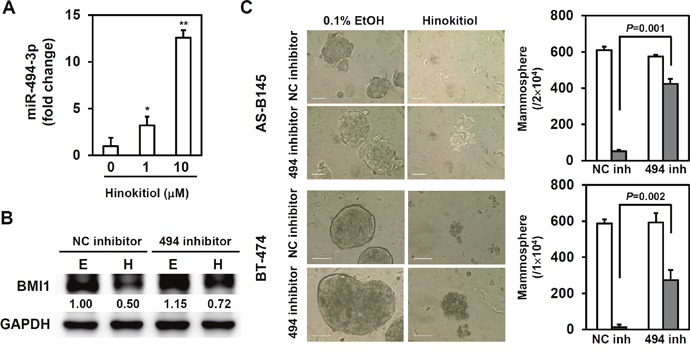
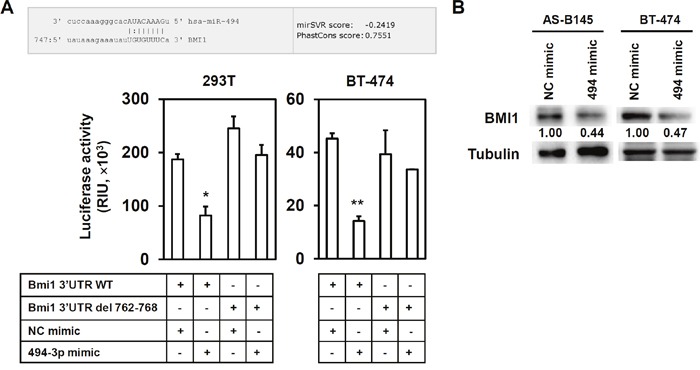
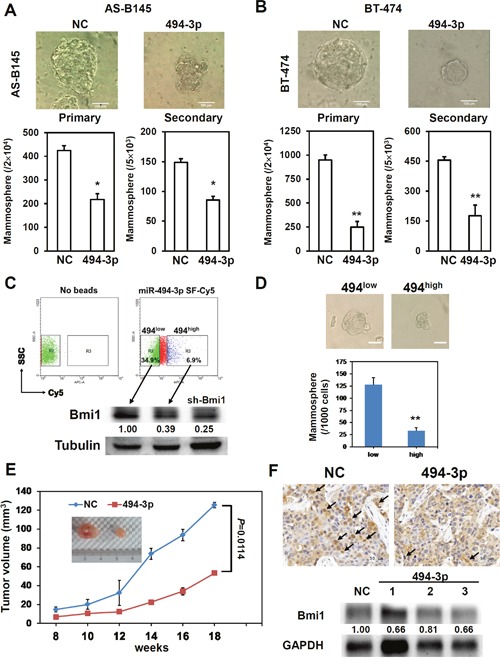
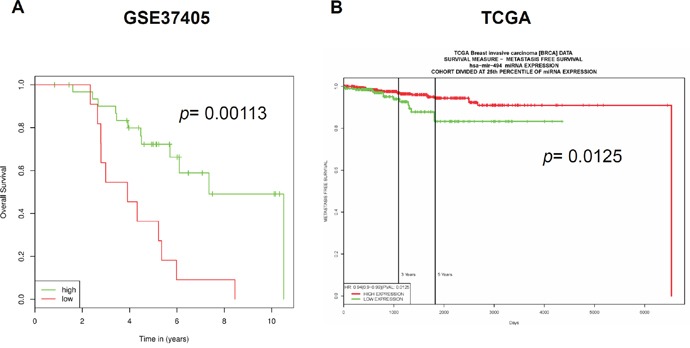
Hinokitiol (β-thujaplicin) is a tropolone-related compound that has anti-microbe, anti-inflammation, and anti-tumor effects. Cancer stem/progenitor cells (CSCs) are a subpopulation of cancer cells with tumor initiation, chemoresistant, and metastatic properties and have been considered the important therapeutic target in future cancer therapy. Previous studies reported that hinokitiol exhibits an anti-cancer activity against murine tumor cells through the induction of autophagy. The current research revealed that hinokitiol suppressed the self-renewal capabilities of human breast CSCs (BCSCs) and inhibited the expression of BMI1 at protein level without suppressing its mRNA. Treatment of hinokitiol in mammospheres induced the expression of miR-494-3p and inhibition of miR-494-3p expression in BCSCs. This treatment abolished the suppressive effects of hinokitiol in mammosphere formation and BMI1 expression. BMI1 is a target of miR-494-3p by luciferase-based 3'UTR reporter assay. Overexpression of miR-494-3p in BCSCs caused the down-regulation of BMI1 protein, inhibition of mammosphere forming capability, and suppression of their tumorigenicity. Moreover, miR-494-3p expression was significantly and inversely correlated with patient survival in two independent public database sets. Furthermore, treatment of hinokitiol suppressed the growth of xenograft human breast tumors as well as the expression of BMI1 and ALDH1A1 in xenograft tumors. In conclusion, these data suggest that hinokitiol targets BCSCs through the miR-494-3p-mediated down-modulation of BMI1 expression.
扁柏酚(β-崖柏素)是一种与托酚酮相关的化合物,具有抗微生物、抗炎和抗肿瘤作用。癌症干细胞/祖细胞(CSCs)是癌细胞的一个亚群,具有肿瘤起始、抗化疗和转移特性,被认为是未来癌症治疗的重要靶点。先前的研究报道,扁柏酚通过诱导自噬对小鼠肿瘤细胞表现出抗癌活性。目前的研究表明,扁柏酚抑制人乳腺癌症干细胞(BCSCs)的自我更新能力,并在不抑制其mRNA的情况下抑制BMI1蛋白的表达。在乳腺球中用扁柏酚处理可诱导miR-494-3p的表达,并抑制BCSCs中miR-494-3p的表达。这种处理消除了扁柏酚对乳腺球形成和BMI1表达的抑制作用。通过基于荧光素酶的3'UTR报告基因检测,BMI1是miR-494-3p的靶点。在BCSCs中过表达miR-494-3p导致BMI1蛋白下调、乳腺球形成能力受到抑制以及其致瘤性受到抑制。此外,在两个独立的公共数据库集中,miR-494-3p的表达与患者生存率显著负相关。此外,扁柏酚处理可抑制异种移植人乳腺肿瘤的生长以及异种移植肿瘤中BMI1和ALDH1A1的表达。总之,这些数据表明扁柏酚通过miR-494-3p介导的BMI1表达下调靶向BCSCs。