Liu Yong, Meucci Stefano, Sheng Liming, Keilholz Ulrich
Surgical Department of Colorectal Cancer, Zhejiang Cancer Hospital, Hangzhou, Zhejiang Province, China.
Charité Comprehensive Cancer Center, Labor AG Keilholz, Berlin, Germany.
Oncotarget. 2017 May 26;8(44):77928-77941. doi: 10.18632/oncotarget.18272. eCollection 2017 Sep 29.
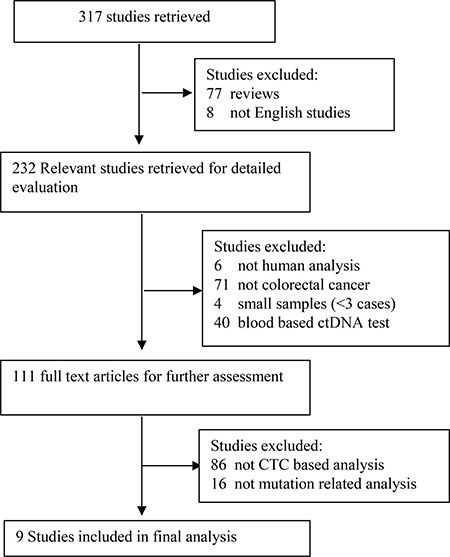
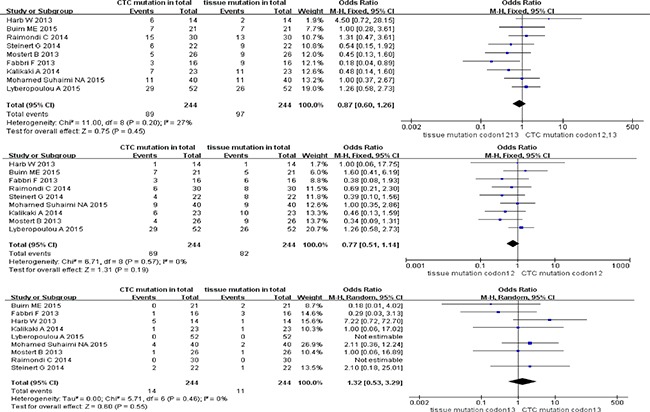
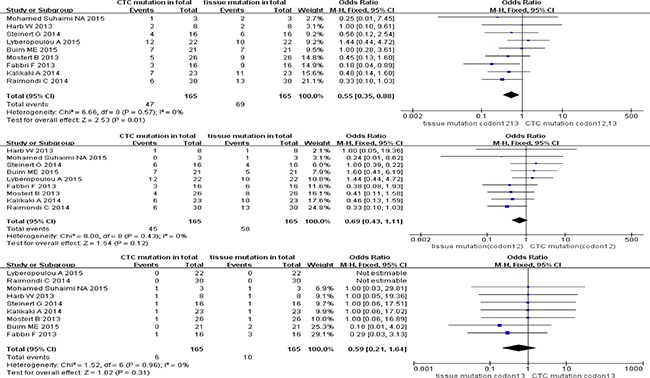
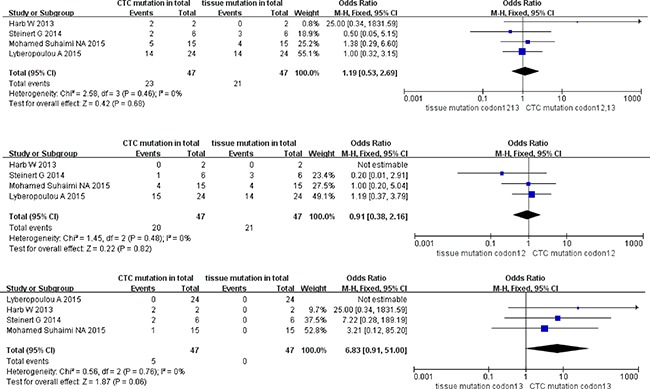
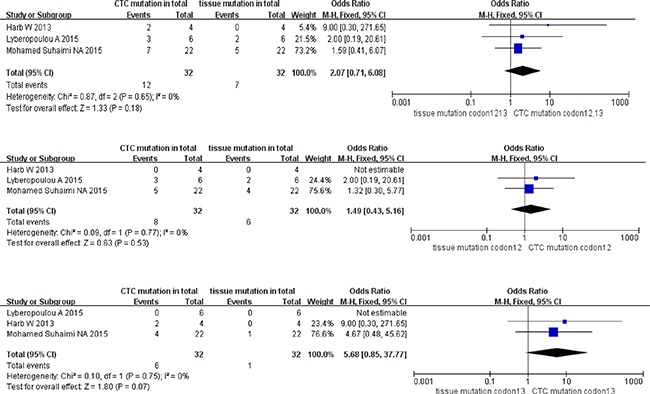
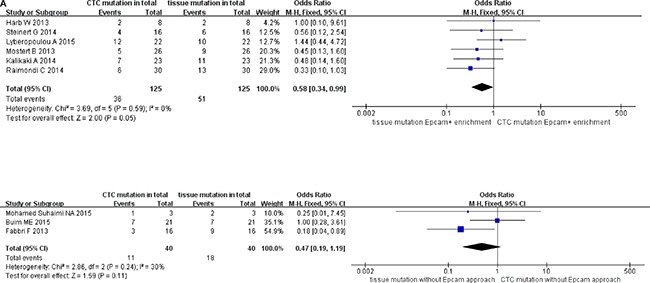
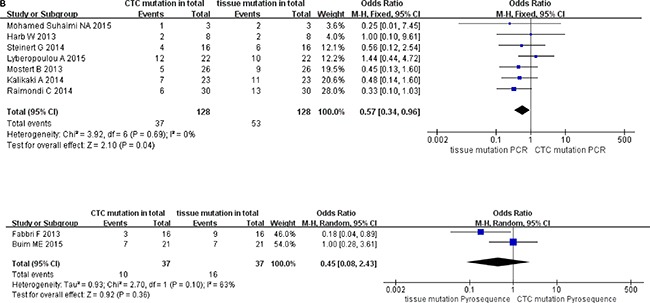
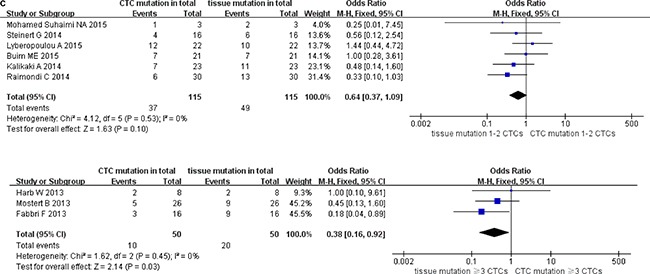
As predictive markers for anti-EGFR therapy, KRAS and BRAF mutations are routinely detected in primary and metastatic colorectal cancer (CRC) cells, but seldom in circulating tumor cells (CTCs). Detecting mutations in CTCs could help explain mutational differences between tumor cells at local sites and distant metastases, thereby improving treatment outcomes. Here, we conducted a systematic review and meta-analysis to compare KRAS and BRAF mutations in paired CTCs and primary tumors from CRC patients, to detect any possible discordance. A total of 244 CRC patients from nine studies were included. Our subgroup meta-analysis demonstrated that the total odds ratio for mutations in CTCs was only 55% of that in primary tumors in the stage IV subgroup. We also found low heterogeneity among studies and differences in mutations between CTCs and primary tumors in the stage IV subgroup (I = 0%, = 0.01). We observed a higher frequency of KRAS mutations in CTCs than in primary tumors at early stages (I + II), a similar frequency in stage III, and a lower frequency in stage IV. There were also differences among the Epcam-targeted CTC enrichment, PCR-based mutation profiling, and ≥ 3 CTCs enriched (I = 0%, = 0.03) subgroups. These finding indicate mutational discordance between CTCs and primary CRCs, particularly in the stage IV and KRAS subgroups. We suggest large-sample studies stratified by clinical stage and KRAS subtype are urgently warranted to accurately evaluate mutational variations in CTCs compared to primary and metastatic CRC cells.
作为抗表皮生长因子受体(EGFR)治疗的预测标志物,KRAS和BRAF突变通常在原发性和转移性结直肠癌(CRC)细胞中检测到,但在循环肿瘤细胞(CTC)中很少见。检测CTC中的突变有助于解释局部肿瘤细胞与远处转移灶之间的突变差异,从而改善治疗效果。在此,我们进行了一项系统综述和荟萃分析,以比较CRC患者配对的CTC和原发性肿瘤中的KRAS和BRAF突变,检测任何可能的不一致性。共纳入了来自9项研究的244例CRC患者。我们的亚组荟萃分析表明,在IV期亚组中,CTC中突变的总比值比仅为原发性肿瘤中的55%。我们还发现各研究之间异质性较低,且IV期亚组中CTC与原发性肿瘤之间存在突变差异(I = 0%,P = 0.01)。我们观察到,在早期阶段(I + II期),CTC中KRAS突变的频率高于原发性肿瘤,在III期频率相似,在IV期频率较低。在靶向EpCAM的CTC富集、基于PCR的突变分析以及富集≥3个CTC的亚组之间也存在差异(I = 0%,P = 0.03)。这些发现表明CTC与原发性结直肠癌之间存在突变不一致性,特别是在IV期和KRAS亚组中。我们建议迫切需要开展按临床分期和KRAS亚型分层的大样本研究,以准确评估与原发性和转移性CRC细胞相比,CTC中的突变变异情况。