Department of Medical Informatics, College of Medicine, The Catholic University of Korea, Seoul, Republic of Korea.
Department of Urology, Seoul St. Mary's Hospital, College of Medicine, The Catholic University of Korea, Seoul, Republic of Korea.
BMC Cancer. 2020 Dec 7;20(1):1203. doi: 10.1186/s12885-020-07684-6.
While circulating tumor cells may serve as minimally invasive cancer markers for bladder cancers, the relationship between primary bladder cancers and circulating tumor cells in terms of somatic mutations is largely unknown. Genome sequencing of bladder tumor and circulating tumor cells is highlighted to identify the somatic mutations of primary bladder cancer.
Bladder cancer tissue was collected by transurethral resection of the bladder and preserved by snap-freezing. Circulating tumor cells were Isolated from the blood obtained before treatment. We performed whole exome sequencing of 20 matched pairs of primary bladder cancers and circulating tumor cells to identify and compare somatic mutations of these two different genomic resources.
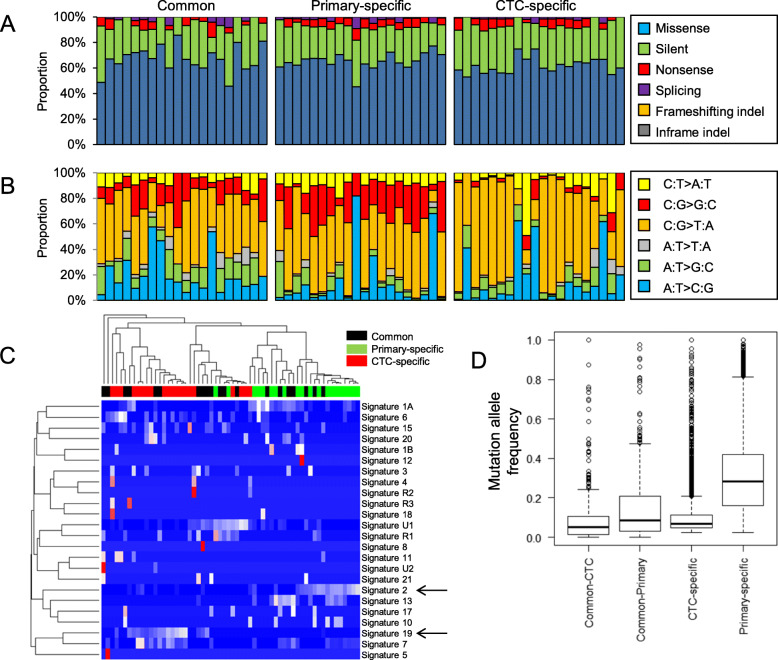
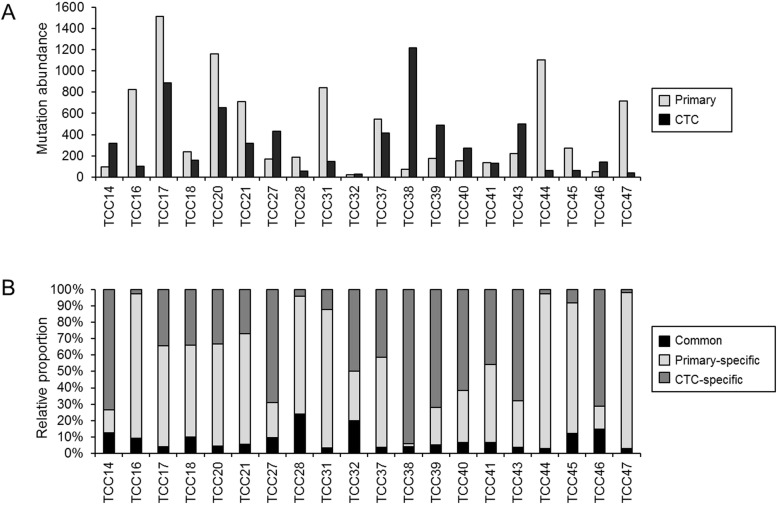
We observed that mutation abundances of primary bladder cancers and circulating tumor cells were highly variable. The mutation abundance was not significantly correlated between matched pairs. Of note, the mutation concordance between two resources was only 3-24% across 20 pairs examined, suggesting that the circulating tumor cell genomes of bladder cancer patients might be genetically distinct from primary bladder cancers. A relative enrichment of mutations belonging to APOBEC-related signature and a depletion of C-to-G transversions were observed for primary- and circulating tumor cells specific mutations, respectively, suggesting that distinct mutation forces might have been operative in respective lesions during carcinogenesis.
The observed discrepancy of mutation abundance and low concordance level of mutations between genomes of primary bladder cancers and circulating tumor cells should be taken into account when evaluating clinical utility of circulating tumor cells for treatments and follow-up of bladder cancers.
Patients were selected and registered retrospectively, and medical records were evaluated.
循环肿瘤细胞可作为膀胱癌的微创性肿瘤标志物,但原发性膀胱癌与循环肿瘤细胞之间的体细胞突变关系尚不清楚。对膀胱癌肿瘤和循环肿瘤细胞进行基因组测序,以鉴定原发性膀胱癌的体细胞突变。
通过经尿道膀胱肿瘤切除术采集膀胱癌组织,并通过快速冷冻保存。从治疗前获得的血液中分离循环肿瘤细胞。我们对 20 对配对的原发性膀胱癌和循环肿瘤细胞进行了全外显子组测序,以鉴定和比较这两种不同基因组资源的体细胞突变。
我们观察到原发性膀胱癌和循环肿瘤细胞的突变丰度高度可变。配对之间的突变丰度没有显著相关性。值得注意的是,在 20 对受检样本中,两种资源之间的突变一致性仅为 3-24%,这表明膀胱癌患者的循环肿瘤细胞基因组可能与原发性膀胱癌在遗传上存在差异。在原发性和循环肿瘤细胞特异性突变中分别观察到 APOBEC 相关特征的突变富集和 C 到 G 颠换的缺失,这表明在癌变过程中,不同的突变力量可能在各自的病变中起作用。
在评估循环肿瘤细胞在膀胱癌治疗和随访中的临床应用时,应考虑到原发性膀胱癌和循环肿瘤细胞基因组中突变丰度的差异和突变一致性水平低的问题。
患者是回顾性选择和注册的,评估了病历。