State Key Laboratory for Conservation and Utilization of Bio-Resources in Yunnan, Yunnan Agricultural University, Kunming, 650201, China.
College of Animal Science and Technology, Yunnan Agricultural University, Kunming, China.
J Transl Med. 2017 Nov 3;15(1):224. doi: 10.1186/s12967-017-1327-0.
Pigs have many features that make them attractive as biomedical models for various diseases, including cancer. P53 is an important tumor suppressor gene that exerts a central role in protecting cells from oncogenic transformation and is mutated in a large number of human cancers. P53 mutations occur in almost every type of tumor and in over 50% of all tumors. In a recent publication, pigs with a mutated P53 gene were generated that resulted in lymphoma and renal and osteogenic tumors. However, approximately 80% of human tumors have dysfunctional P53. A P53-deficient pig model is still required to elucidate.
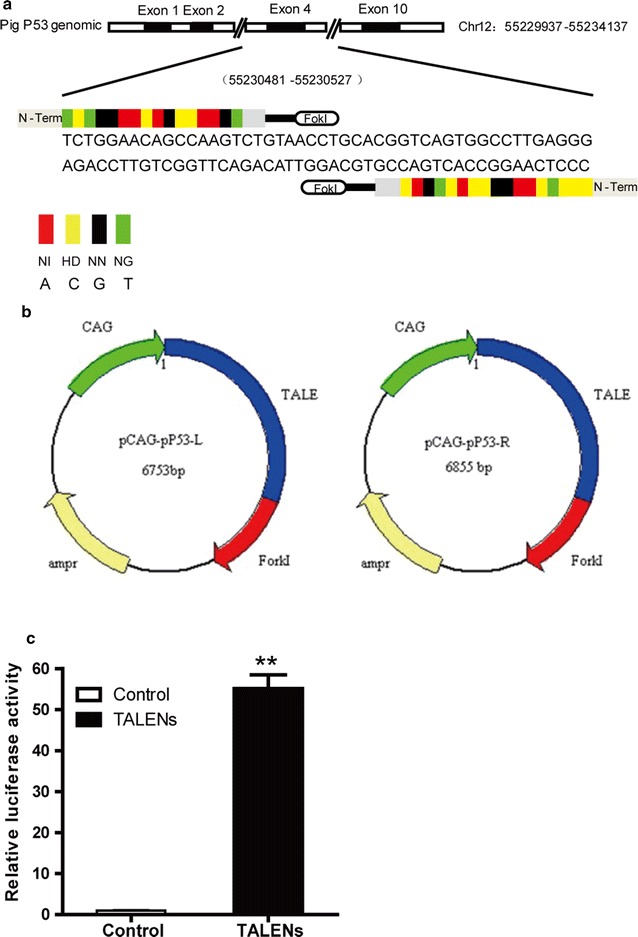
Transcription activator-like effector nucleases (TALENs) were designed to target porcine P53 exon 4. The targeting activity was evaluated using a luciferase SSA recombination assay. P53 biallelic knockout (KO) cell lines were established from single-cell colonies of fetal fibroblasts derived from Diannan miniature pigs followed by electroporation with TALENs plasmids. One cell line was selected as the donor cell line for somatic cell nuclear transfer (SCNT) for the generation of P53 KO pigs. P53 KO stillborn fetuses and living piglets were obtained. Gene typing of the collected cloned individuals was performed by T7EI assay and sequencing. Fibroblast cells from Diannan miniature piglets with a P53 biallelic knockout or wild type were analyzed for the P53 response to doxorubicin treatment by confocal microscopy and western blotting.
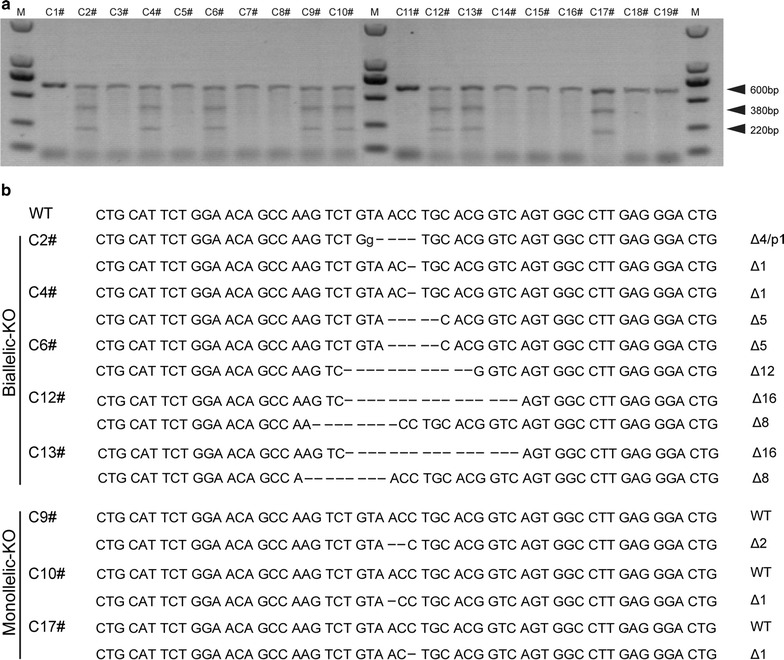
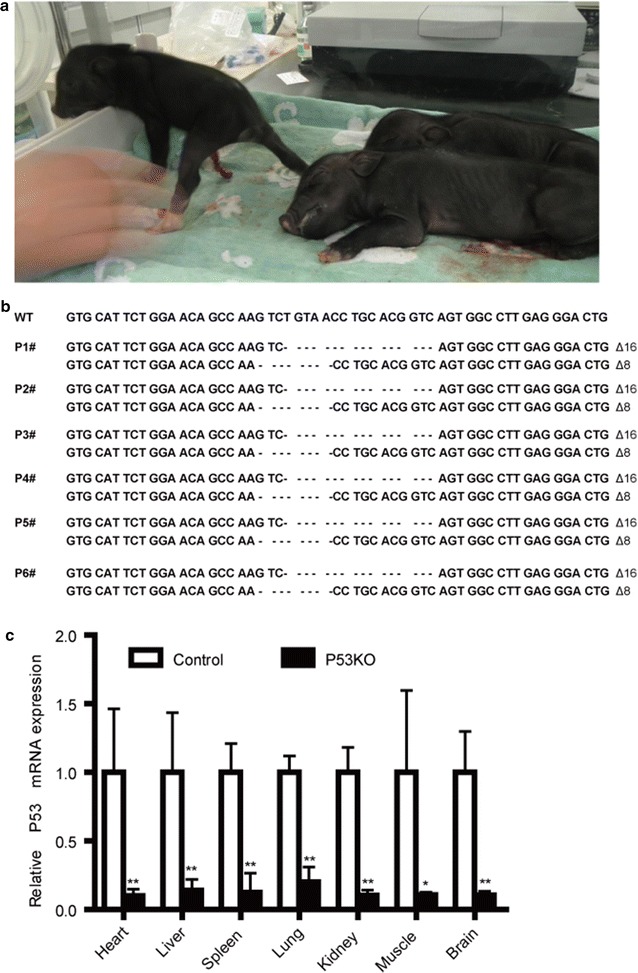
The luciferase SSA recombination assay revealed that the targeting activities of the designed TALENs were 55.35-fold higher than those of the control. Eight cell lines (8/19) were mutated for P53, and five of them were biallelic knockouts. One of the biallelic knockout cell lines was selected as nuclear donor cells for SCNT. The cloned embryos were transferred into five recipient gilts, three of them becoming pregnant. Five live fetuses were obtained from one surrogate by caesarean section after 38 days of gestation for genotyping. Finally, six live piglets and one stillborn piglet were collected from two recipients by caesarean section. Sequencing analyses of the target site confirmed the P53 biallelic knockout in all fetuses and piglets, consistent with the genotype of the donor cells. The qPCR analysis showed that the expression of the P53 mRNA had significant reduction in various tissues of the knockout piglets. Furthermore, confocal microscopy and western blotting analyses demonstrated that the fibroblast cells of Diannan miniature piglets with a P53 biallelic knockout were defective in mediating DNA damage when incubated with doxorubicin.
TALENs combined with SCNT was successfully used to generate P53 KO Diannan miniature pigs. Although these genetically engineered Diannan miniature pigs had no tumorigenic signs, the P53 gene was dysfunctional. We believe that these pigs will provide powerful new resources for preclinical oncology and basic cancer research.
猪具有许多使其成为各种疾病(包括癌症)生物医学模型的特征。P53 是一种重要的肿瘤抑制基因,在保护细胞免受致癌转化方面发挥着核心作用,并且在大量人类癌症中发生突变。P53 突变发生在几乎每一种肿瘤中,并且发生在超过 50%的所有肿瘤中。在最近的一篇出版物中,生成了携带突变 P53 基因的猪,导致淋巴瘤、肾和骨肿瘤。然而,大约 80%的人类肿瘤存在功能失调的 P53。仍然需要建立 P53 缺陷型猪模型来阐明这一点。
设计了转录激活因子样效应物核酸酶(TALENs)来靶向猪 P53 外显子 4。使用荧光素酶 SSA 重组测定评估靶向活性。从滇南微型猪胎儿成纤维细胞的单细胞克隆中建立了 P53 双等位基因敲除(KO)细胞系,然后用电穿孔法用 TALENs 质粒转染。选择一个细胞系作为体细胞核移植(SCNT)的供体细胞系,用于生成 P53 KO 猪。获得了 P53 KO 死胎和活仔猪。通过 T7EI 测定和测序对收集的克隆个体进行基因分型。通过共聚焦显微镜和 Western blot 分析滇南微型猪的 P53 双等位基因敲除或野生型成纤维细胞对阿霉素治疗的 P53 反应。
荧光素酶 SSA 重组测定显示,设计的 TALENs 的靶向活性比对照高 55.35 倍。8 个细胞系(8/19)发生 P53 突变,其中 5 个为双等位基因敲除。其中一个双等位基因敲除细胞系被选为 SCNT 的核供体细胞。克隆胚胎被转移到五头受体母猪中,其中三头怀孕。通过剖腹产从一名代孕母猪中获得了五只活胎儿,在 38 天妊娠后进行了基因分型。最后,从两名受体中通过剖腹产获得了六头活仔猪和一头死产仔猪。通过测序分析确认了所有胎儿和仔猪的 P53 双等位基因敲除,与供体细胞的基因型一致。qPCR 分析显示,敲除仔猪各组织中 P53 mRNA 的表达显著降低。此外,共聚焦显微镜和 Western blot 分析表明,当用阿霉素孵育时,携带 P53 双等位基因敲除的滇南微型猪的成纤维细胞在介导 DNA 损伤方面存在缺陷。
TALENs 与 SCNT 相结合成功地用于生成 P53 KO 滇南微型猪。尽管这些基因工程滇南微型猪没有肿瘤形成迹象,但 P53 基因功能失调。我们相信,这些猪将为临床前肿瘤学和基础癌症研究提供强大的新资源。