Smith Micholas Dean, Cheng Xiaolin, Petridis Loukas, Mostofian Barmak, Smith Jeremy C
Center for Molecular Biophysics, University of Tennessee/Oak Ridge National Laboratory, Oak Ridge, TN, 37830, USA.
Department of Biochemistry and Cellular and Molecular Biology, University of Tennessee, Knoxville, TN, 37996, USA.
Sci Rep. 2017 Nov 3;7(1):14494. doi: 10.1038/s41598-017-15048-7.
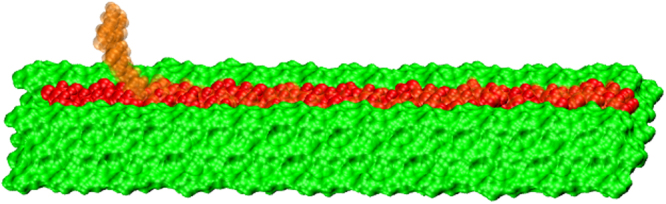
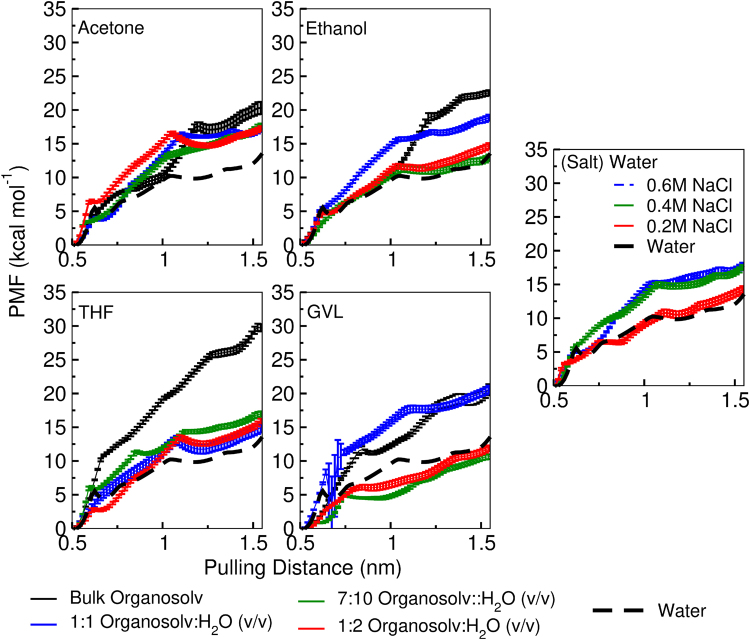
Deconstruction of cellulose is crucial for the chemical conversion of lignocellulose into fuel/bioproduct precursors. Recently, a water-organosolv cosolvent system (THF-water) has been shown to both phase-separate on cellulose surfaces and partially deconstruct Avicel (cellulose) in the absence of acid. Here we employ molecular dynamics simulations to determine whether other common water-organosolv cosolvent systems (acetone, ethanol, and γ-valerolactone) exhibit phase separation at cellulose surface and whether this alters a purely physical cellulose dissociation pathway. Despite finding varied degrees of phase-separation of organosolv on cellulose surfaces, physical dissociation is not enhanced. Interestingly, however, the total amount the median water-cellulose contact lifetimes increases for the cosolvent systems in the order of THF > acetone > ethanol > γ-valerolactone. Together our results indicate two points: a purely physical process for deconstruction of cellulose is unlikely for these cosolvents, and in THF-water, unlike γ-valerolactone- (and some concentrations of acetone and ethanol) water cosolvents, a significant fraction of surface water is slowed. This slowing may be of importance in enhancing chemical deconstruction of cellulose, as it permits an increase in potential THF-water-cellulose reactions, even while the amount of water near cellulose is decreased.
纤维素的解构对于将木质纤维素化学转化为燃料/生物产品前体至关重要。最近,一种水-有机溶剂共溶剂体系(四氢呋喃-水)已被证明在纤维素表面会发生相分离,并且在无酸的情况下能部分解构微晶纤维素(纤维素)。在此,我们采用分子动力学模拟来确定其他常见的水-有机溶剂共溶剂体系(丙酮、乙醇和γ-戊内酯)在纤维素表面是否会发生相分离,以及这是否会改变纯粹的物理纤维素解离途径。尽管发现有机溶剂在纤维素表面存在不同程度的相分离,但物理解离并未增强。然而,有趣的是,共溶剂体系中,水与纤维素的中位接触寿命总量按四氢呋喃>丙酮>乙醇>γ-戊内酯的顺序增加。我们的结果共同表明两点:对于这些共溶剂而言,纤维素解构的纯粹物理过程不太可能发生,并且在四氢呋喃-水体系中,与γ-戊内酯-(以及某些浓度的丙酮和乙醇)水共溶剂不同,相当一部分表面水的运动速度减慢。这种减慢可能对增强纤维素的化学解构很重要,因为它允许潜在的四氢呋喃-水-纤维素反应增加,即便纤维素附近的水量减少。