Institute of Pharmacology, Polish Academy of Sciences, Department of Neurobiology, Laboratory of Trace Elements Neurobiology, Smetna Street 12, 31-343, Krakow, Poland.
Department of Human Physiology, Institute of Clinical and Experimental Medicine, Medical Faculty, University of Rzeszow, Al. Kopisto Street 2a, 35-959, Rzeszow, Poland.
Neurotox Res. 2018 Feb;33(2):448-460. doi: 10.1007/s12640-017-9835-5. Epub 2017 Nov 4.
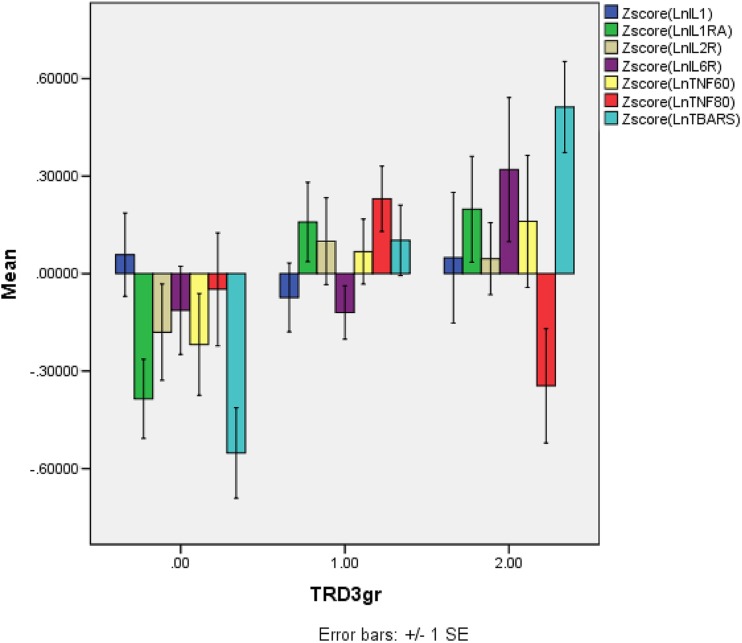
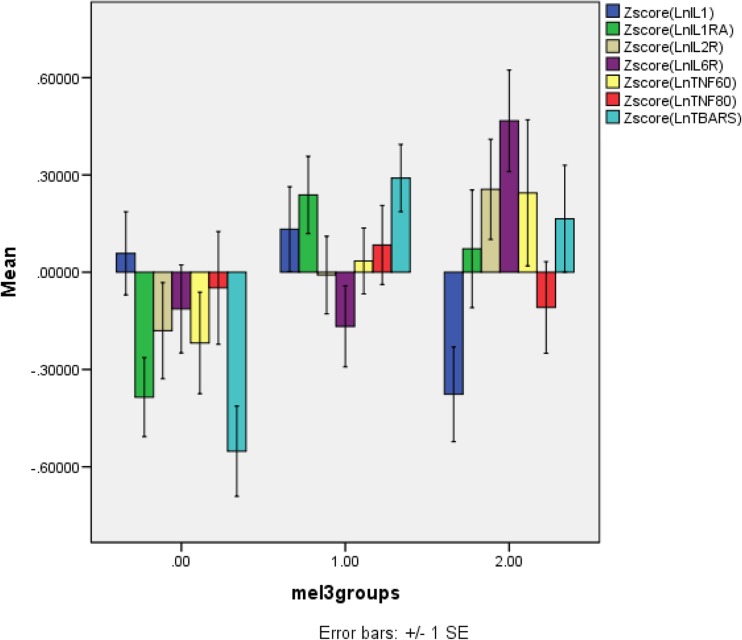
To examine immune-inflammatory and oxidative (I&O) biomarkers in major depression (MDD) and its related phenotypes, we recruited 114 well-phenotyped depressed patients and 50 healthy controls and measured serum levels of interleukin (IL)-1α, soluble IL-1 receptor antagonist (sIL-1RA), soluble IL-2 receptor (sIL-2R), soluble IL-6 receptor (sIL-6R), soluble tumor necrosis factor receptor 60 and 80 kDa (sTNF-R1/R2), and thiobarbituric acid reactive substances (TBARS). Obtained results indicate that MDD is characterized by increased sIL-1RA, sTNF-R1, and TBARS concentrations. Melancholic depression is associated with increased sIL-6R but lowered IL-1α levels. A current episode of depression is accompanied by significantly increased sIL-6R compared to the remitted state. Treatment-resistant depression (TRD) is accompanied by increased sIL-6R and TBARS but lowered sTNF-R2 levels compared to non-TRD patients. These immune markers are not significantly correlated with Hamilton Depression Rating Scale (HDRS), Montgomery-Asberg Depression Scale (MADRS), number episodes, or age at onset. Our findings show that increased sIL-1RA, sTNF-R1, and TBARS levels may be trait markers of depression, while increased sIL-6R levels may be a state marker of melancholia and an acute phase of depression. MDD is accompanied by increased lipid peroxidation and simultaneous activation of immune pathways, and the compensatory anti-inflammatory reflex system (CIRS). TRD is characterized by highly increased oxidative stress and probably increased TNFα and IL-6 trans-signalling. Novel treatments for major depression should target oxidative stress pathways, while new treatments for TRD should primary target lipid peroxidation and also activated immune-inflammatory pathways.
为了研究重度抑郁症(MDD)及其相关表型中的免疫炎症和氧化(I&O)生物标志物,我们招募了 114 名症状明确的抑郁患者和 50 名健康对照者,并测量了血清中白细胞介素(IL)-1α、可溶性白细胞介素-1 受体拮抗剂(sIL-1RA)、可溶性白细胞介素-2 受体(sIL-2R)、可溶性白细胞介素-6 受体(sIL-6R)、可溶性肿瘤坏死因子受体 60 和 80 kDa(sTNF-R1/R2)以及硫代巴比妥酸反应物质(TBARS)的水平。研究结果表明,MDD 的特征是 sIL-1RA、sTNF-R1 和 TBARS 浓度增加。忧郁性抑郁症与 sIL-6R 增加但 IL-1α 水平降低有关。与缓解状态相比,当前发作的抑郁症患者 sIL-6R 显著增加。与非 TRD 患者相比,治疗抵抗性抑郁症(TRD)患者的 sIL-6R 和 TBARS 增加,而 sTNF-R2 水平降低。这些免疫标志物与汉密尔顿抑郁评定量表(HDRS)、蒙哥马利-阿斯伯格抑郁评定量表(MADRS)、发作次数或发病年龄无显著相关性。我们的研究结果表明,sIL-1RA、sTNF-R1 和 TBARS 水平的增加可能是抑郁症的特征标志物,而 sIL-6R 水平的增加可能是忧郁症和抑郁症急性期的状态标志物。MDD 伴有脂质过氧化增加和同时激活免疫途径,以及代偿性抗炎反射系统(CIRS)。TRD 的特点是氧化应激显著增加,可能伴有 TNFα 和 IL-6 转导信号增加。治疗重度抑郁症的新方法应该针对氧化应激途径,而治疗 TRD 的新方法应该首先针对脂质过氧化和激活的免疫炎症途径。