Edea Zewdu, Jeoung Yeong Ho, Shin Sung-Sub, Ku Jaeul, Seo Sungbo, Kim Il-Hoi, Kim Sang-Wook, Kim Kwan-Suk
Department of Animal Science, Chungbuk National University, Cheongju 28644, Korea.
Korea Animal Improvement Association, Seoul 06668, Korea.
Asian-Australas J Anim Sci. 2018 Mar;31(3):327-334. doi: 10.5713/ajas.17.0276. Epub 2017 Nov 3.
The objective of the present study was to validate genes and genomic regions associated with carcass weight using a low-density single nucleotide polymorphism (SNP) Chip in Hanwoo cattle breed.
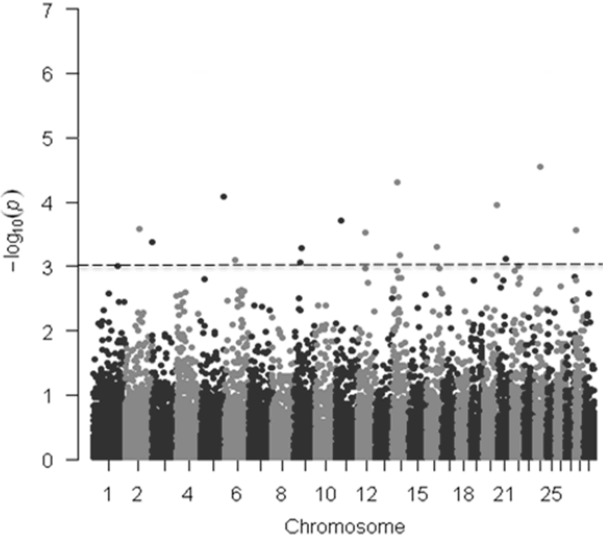
Commercial Hanwoo steers (n = 220) were genotyped with 20K GeneSeek genomic profiler BeadChip. After applying the quality control of criteria of a call rate ≥90% and minor allele frequency (MAF) ≥0.01, a total of 15,235 autosomal SNPs were left for genome-wide association (GWA) analysis. The GWA tests were performed using single-locus mixed linear model. Age at slaughter was fitted as fixed effect and sire included as a covariate. The level of genome-wide significance was set at 3.28×10 (0.05/15,235), corresponding to Bonferroni correction for 15,235 multiple independent tests.
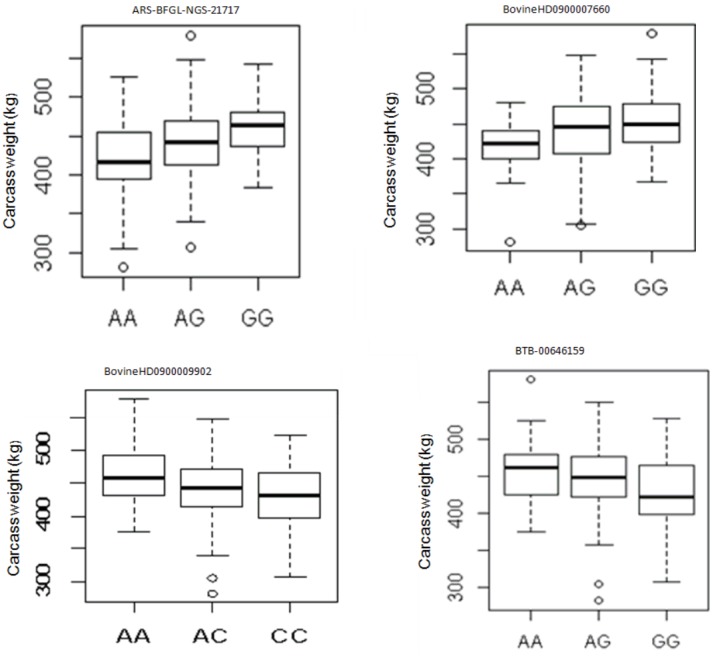
By employing EMMAX approach which is based on a mixed linear model and accounts for population stratification and relatedness, we identified 17 and 16 loci significantly (p<0.001) associated with carcass weight for the additive and dominant models, respectively. The second most significant (p = 0.000049) SNP (ARS-BFGL-NGS-28234) on bovine chromosome 4 (BTA4) at 21 Mb had an allele substitution effect of 43.45 kg. Some of the identified regions on BTA2, 6, 14, 22, and 24 were previously reported to be associated with quantitative trait loci for carcass weight in several beef cattle breeds.
This is the first genome-wide association study using SNP chips on commercial Hanwoo steers, and some of the loci newly identified in this study may help to better DNA markers that determine increased beef production in commercial Hanwoo cattle. Further studies using a larger sample size will allow confirmation of the candidates identified in this study.
本研究的目的是使用低密度单核苷酸多态性(SNP)芯片在韩牛品种中验证与胴体重量相关的基因和基因组区域。
对220头商用韩牛阉牛进行20K GeneSeek基因组分析芯片基因分型。在应用呼叫率≥90%和次要等位基因频率(MAF)≥0.01的标准进行质量控制后,共留下15235个常染色体SNP用于全基因组关联(GWA)分析。使用单基因座混合线性模型进行GWA测试。屠宰年龄作为固定效应,父亲作为协变量。全基因组显著性水平设定为3.28×10(0.05/15235),对应于对15235次多个独立测试的Bonferroni校正。
通过采用基于混合线性模型并考虑群体分层和相关性的EMMAX方法,我们分别在加性模型和显性模型中鉴定出17个和16个与胴体重量显著相关(p<0.001)的基因座。牛4号染色体(BTA4)上21 Mb处第二显著(p = 0.000049)的SNP(ARS-BFGL-NGS-28234)的等位基因替代效应为43.45 kg。先前在几个肉牛品种中报道,BTA2、6、14、22和24上的一些鉴定区域与胴体重量的数量性状基因座相关。
这是首次在商用韩牛阉牛上使用SNP芯片进行全基因组关联研究,本研究中新鉴定的一些基因座可能有助于更好地确定商用韩牛增加牛肉产量的DNA标记。使用更大样本量的进一步研究将有助于确认本研究中鉴定的候选基因。