Department of Pharmacology, Wakayama Medical University, Wakayama 641-0012, Japan.
Int J Mol Sci. 2017 Nov 1;18(11):2296. doi: 10.3390/ijms18112296.
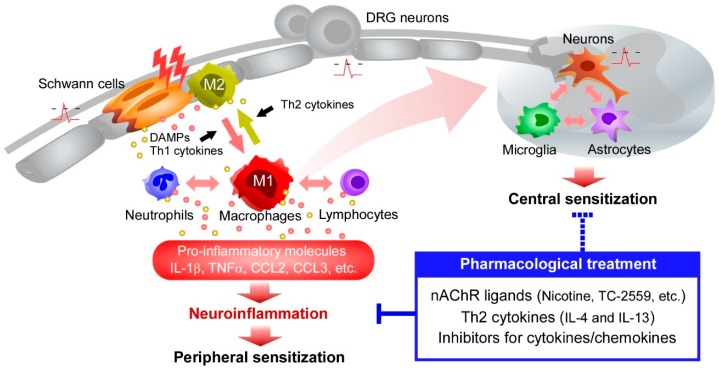
Neuropathic pain can have a major effect on quality of life but current therapies are often inadequate. Growing evidence suggests that neuropathic pain induced by nerve damage is caused by chronic inflammation. Upon nerve injury, damaged cells secrete pro-inflammatory molecules that activate cells in the surrounding tissue and recruit circulating leukocytes to the site of injury. Among these, the most abundant cell type is macrophages, which produce several key molecules involved in pain enhancement, including cytokines and chemokines. Given their central role in the regulation of peripheral sensitization, macrophage-derived cytokines and chemokines could be useful targets for the development of novel therapeutics. Inhibition of key pro-inflammatory cytokines and chemokines prevents neuroinflammation and neuropathic pain; moreover, recent studies have demonstrated the effectiveness of pharmacological inhibition of inflammatory (M1) macrophages. Nicotinic acetylcholine receptor ligands and T helper type 2 cytokines that reduce M1 macrophages are able to relieve neuropathic pain. Future translational studies in non-human primates will be crucial for determining the regulatory mechanisms underlying neuroinflammation-associated neuropathic pain. In turn, this knowledge will assist in the development of novel pharmacotherapies targeting macrophage-driven neuroinflammation for the treatment of intractable neuropathic pain.
神经病理性疼痛会对生活质量产生重大影响,但目前的治疗方法往往不够有效。越来越多的证据表明,由神经损伤引起的神经病理性疼痛是由慢性炎症引起的。在神经损伤后,受损细胞会分泌促炎分子,激活周围组织中的细胞,并将循环白细胞募集到损伤部位。在这些细胞中,最丰富的细胞类型是巨噬细胞,它产生几种与疼痛增强有关的关键分子,包括细胞因子和趋化因子。鉴于它们在调节外周敏化中的核心作用,巨噬细胞衍生的细胞因子和趋化因子可能是开发新型治疗方法的有用靶点。抑制关键的促炎细胞因子和趋化因子可以预防神经炎症和神经病理性疼痛;此外,最近的研究表明,抑制炎症(M1)巨噬细胞的药理学方法是有效的。减少 M1 巨噬细胞的烟碱型乙酰胆碱受体配体和辅助性 T 细胞 2 型细胞因子能够缓解神经病理性疼痛。在非人类灵长类动物中进行未来的转化研究对于确定与神经炎症相关的神经病理性疼痛的调节机制至关重要。反过来,这方面的知识将有助于开发针对巨噬细胞驱动的神经炎症的新型药物疗法,以治疗难治性神经病理性疼痛。