Liu Chun-Ting, Wu Bei-Yu, Hung Yu-Chiang, Wang Lin-Yi, Lee Yan-Yuh, Lin Tsu-Kung, Lin Pao-Yen, Chen Wu-Fu, Chiang Jen-Huai, Hsu Sheng-Feng, Hu Wen-Long
Department of Chinese Medicine, Kaohsiung Chang Gung Memorial Hospital and School of Traditional Chinese Medicine, Chang Gung University College of Medicine, Kaohsiung, Taiwan.
School of Chinese Medicine for Post Baccalaureate, I-Shou University, Kaohsiung, Taiwan.
Oncotarget. 2017 Jul 8;8(45):79680-79692. doi: 10.18632/oncotarget.19094. eCollection 2017 Oct 3.
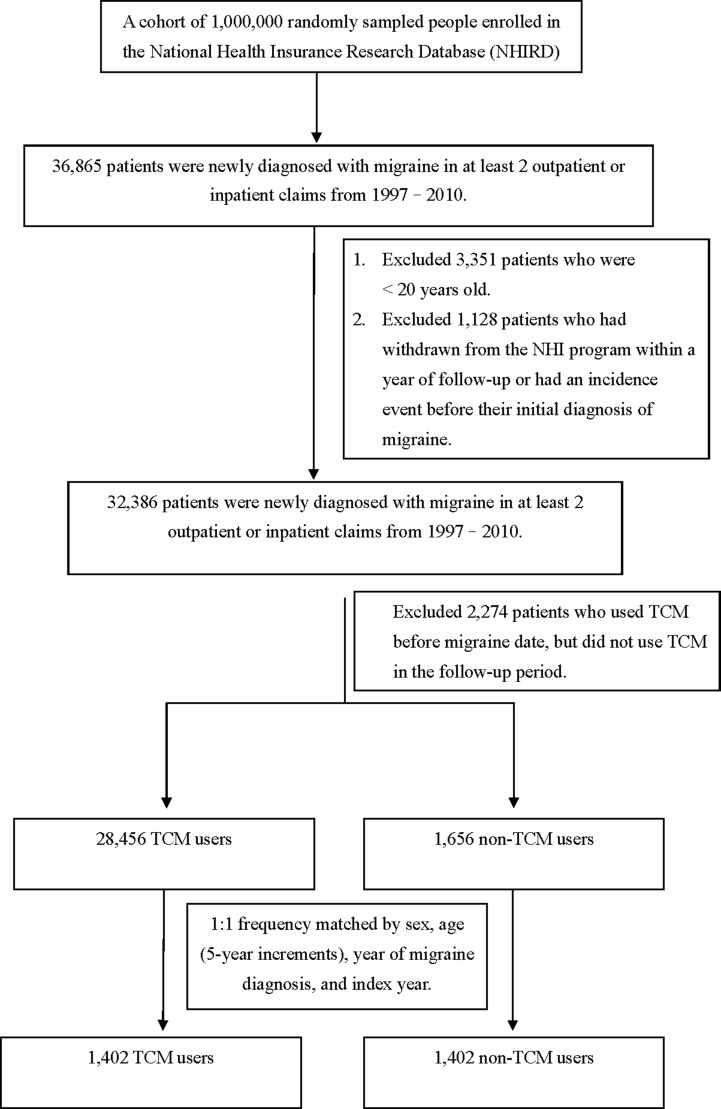
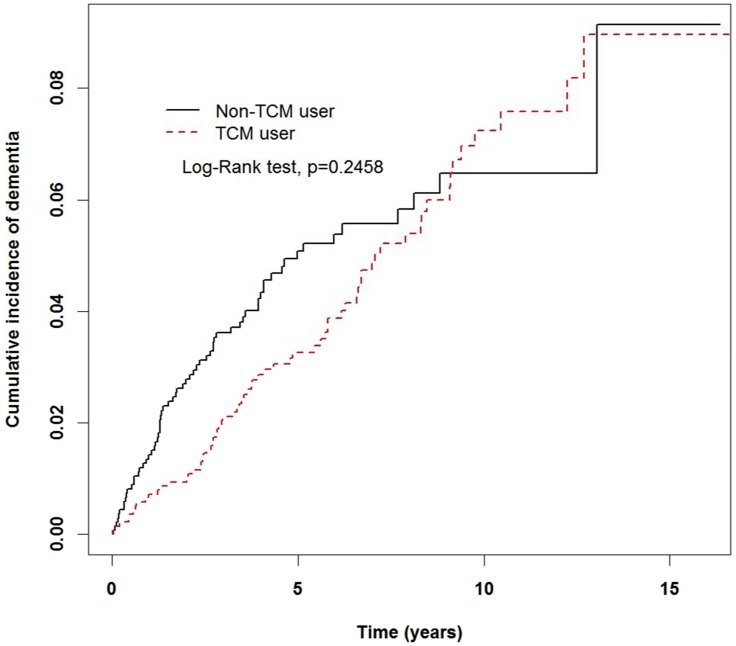
Patients with migraine are reportedly at increased risk of developing dementia. We aimed to investigate the association between traditional Chinese medicine (TCM) use and dementia risk in migraine patients. This longitudinal cohort study used the Taiwanese National Health Insurance Research Database to identify 32,386 diagnosed migraine patients aged 20 years and above who received treatment from 1997 to 2010. To balance comparability between TCM users and non-TCM users, we randomly selected equal numbers from each group, and compared subgroups compiled based on combinations of age, sex, index year, and year of migraine diagnosis. All enrollees received follow-up until the end of 2013 to measure dementia incidence. We identified 1,402 TCM users and non-TCM users after frequency matching. A total of 134 subjects were newly diagnosed with dementia during the follow-up period. TCM users were significantly less likely to develop dementia than non-TCM users. The most frequently prescribed formulae and single Chinese herbal products were Jia-Wei-Xiao-Yao-San and Yan-Hu-Suo, respectively. This population-based study revealed a decreased dementia risk in migraine patients with TCM use. These findings may provide a reference for dementia prevention strategies, and help integrate TCM into clinical intervention programs that provide a favorable prognosis for migraine patients.
据报道,偏头痛患者患痴呆症的风险增加。我们旨在研究偏头痛患者使用中药与痴呆症风险之间的关联。这项纵向队列研究利用台湾国民健康保险研究数据库,确定了1997年至2010年期间接受治疗的32386名20岁及以上的确诊偏头痛患者。为了平衡中药使用者和非中药使用者之间的可比性,我们从每组中随机选择相等数量的患者,并比较了根据年龄、性别、索引年份和偏头痛诊断年份组合编制的亚组。所有参与者均接受随访至2013年底,以测量痴呆症发病率。在频率匹配后,我们确定了1402名中药使用者和非中药使用者。在随访期间,共有134名受试者被新诊断为痴呆症。中药使用者患痴呆症的可能性明显低于非中药使用者。最常开具的方剂和单味中药产品分别是加味逍遥散和延胡索。这项基于人群的研究表明,使用中药的偏头痛患者患痴呆症的风险降低。这些发现可能为痴呆症预防策略提供参考,并有助于将中药纳入可为偏头痛患者提供良好预后的临床干预方案。