Department of Nutrition and Health Sciences, Taipei Medical University, Taipei 11031, Taiwan.
Research Center of Geriatric Nutrition, College of Nutrition, Taipei Medical University, Taipei 11031, Taiwan.
Nutrients. 2017 Oct 29;9(11):1187. doi: 10.3390/nu9111187.
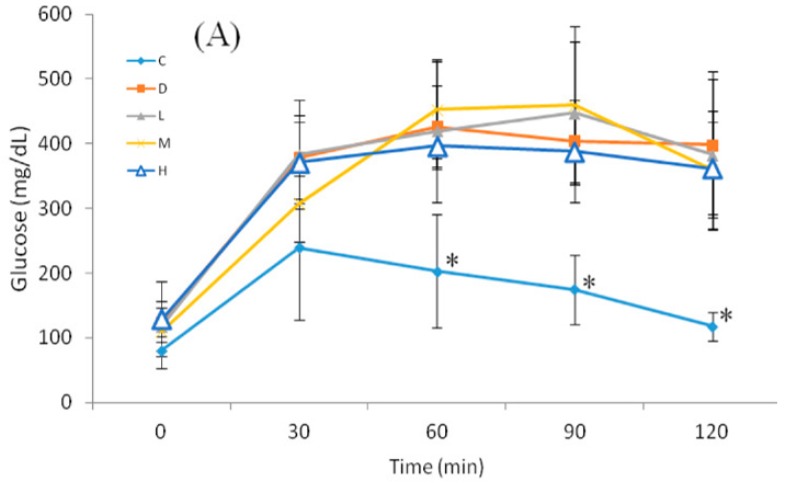
Diabetes is often associated with decreased melatonin level. The aim was to investigate the effects of different dosage of melatonin on glucose hemostasis, antioxidant ability and adipokines secretion in diabetic institute for cancer research (ICR) mice. Forty animals were randomly divided into five groups including control (C), diabetic (D), low-dosage (L), medium-dosage (M), and high-dosage (H) groups. Groups L, M, and H, respectively, received oral melatonin at 10, 20, and 50 mg/kg of BW (body weight) daily after inducing hyperglycemia by nicotinamide (NA)/ streptozotocin (STZ). After the six-week intervention, results showed that melatonin administration increased insulin level and performed lower area under the curve (AUC) in H group ( < 0.05). Melatonin could lower hepatic Malondialdehyde (MDA) level in all melatonin-treated groups and increase superoxide dismutase activity in H group ( < 0.05). Melatonin-treated groups revealed significant higher adiponectin in L group, and lower leptin/adiponectin ratio and leptin in M and H groups ( < 0.05). Melatonin could lower cholesterol and triglyceride in liver and decrease plasma cholesterol and low-density lipoprotein-cholesterol (LDL-C) in L group, and increase plasma high-density lipoprotein-cholesterol (HDL-C) in H group ( < 0.05). Above all, melatonin could decrease oxidative stress, increase the adiponectin level and improve dyslipidemia, especially in H group. These data support melatonin possibly being a helpful aid for treating hyperglycemia-related symptoms.
糖尿病常与褪黑素水平降低有关。本研究旨在探讨不同剂量褪黑素对糖尿病 ICR 小鼠血糖稳态、抗氧化能力和脂肪因子分泌的影响。将 40 只动物随机分为 5 组,包括对照组(C)、糖尿病组(D)、低剂量组(L)、中剂量组(M)和高剂量组(H)。L、M 和 H 组分别在诱导高血糖后,每天口服给予 10、20 和 50mg/kg BW 的褪黑素。经过 6 周的干预,结果显示褪黑素给药可增加胰岛素水平,并降低 H 组的曲线下面积(AUC)(<0.05)。褪黑素可降低所有褪黑素治疗组的肝丙二醛(MDA)水平,并增加 H 组的超氧化物歧化酶活性(<0.05)。褪黑素治疗组的脂联素在 L 组显著升高,而瘦素/脂联素比值和 M 组和 H 组的瘦素降低(<0.05)。褪黑素可降低肝脏胆固醇和甘油三酯,降低 L 组的血浆胆固醇和低密度脂蛋白胆固醇(LDL-C),并增加 H 组的血浆高密度脂蛋白胆固醇(HDL-C)(<0.05)。总之,褪黑素可降低氧化应激,增加脂联素水平,改善血脂异常,尤其是在 H 组。这些数据支持褪黑素可能有助于治疗与高血糖相关的症状。