National Vision Research Institute, Australian College of Optometry, Carlton, Victoria, Australia.
Department of Optometry and Vision Sciences, University of Melbourne, Parkville, Victoria, Australia.
Sci Rep. 2017 Nov 6;7(1):14591. doi: 10.1038/s41598-017-14954-0.
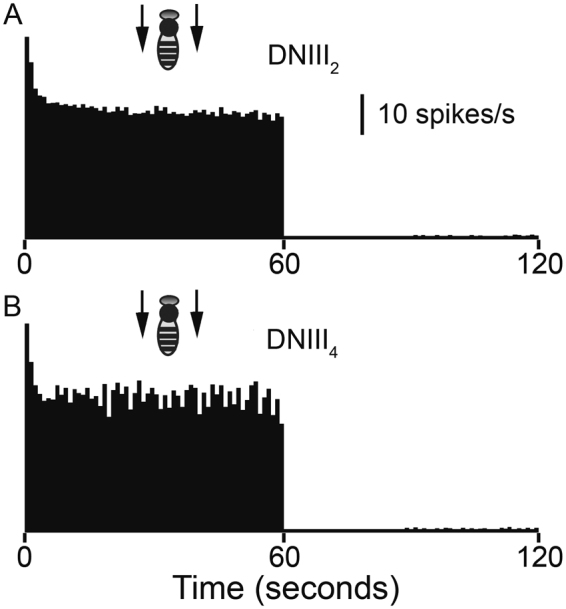
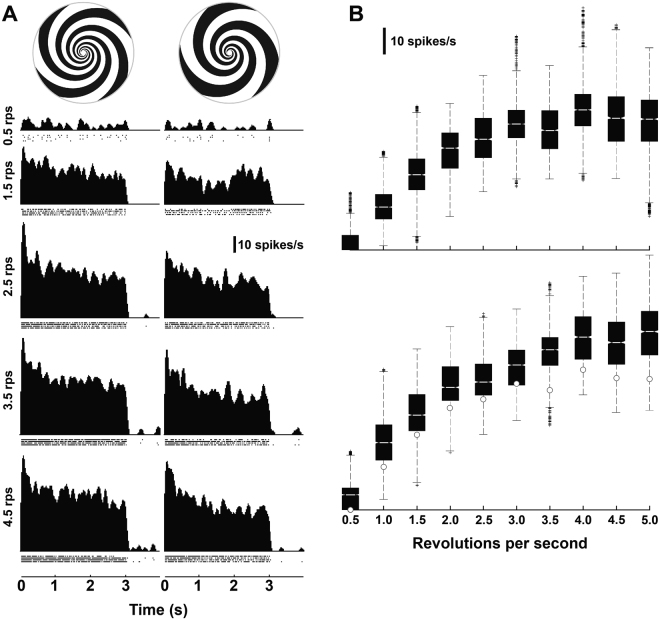
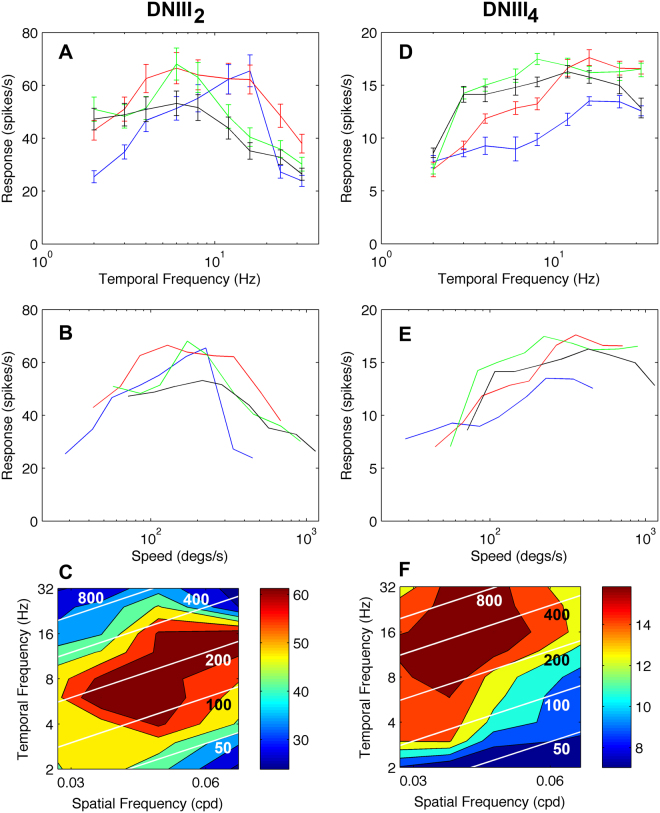
The impressive repertoire of honeybee visually guided behaviors, and their ability to learn has made them an important tool for elucidating the visual basis of behavior. Like other insects, bees perform optomotor course correction to optic flow, a response that is dependent on the spatial structure of the visual environment. However, bees can also distinguish the speed of image motion during forward flight and landing, as well as estimate flight distances (odometry), irrespective of the visual scene. The neural pathways underlying these abilities are unknown. Here we report on a cluster of descending neurons (DNIIIs) that are shown to have the directional tuning properties necessary for detecting image motion during forward flight and landing on vertical surfaces. They have stable firing rates during prolonged periods of stimulation and respond to a wide range of image speeds, making them suitable to detect image flow during flight behaviors. While their responses are not strictly speed tuned, the shape and amplitudes of their speed tuning functions are resistant to large changes in spatial frequency. These cells are prime candidates not only for the control of flight speed and landing, but also the basis of a neural 'front end' of the honeybee's visual odometer.
蜜蜂令人印象深刻的视觉引导行为 repertoire,以及它们的学习能力使它们成为阐明行为视觉基础的重要工具。与其他昆虫一样,蜜蜂对光流执行 optomotor 航向修正,这是一种依赖于视觉环境空间结构的反应。然而,蜜蜂在向前飞行和着陆时也可以区分图像运动的速度,以及估计飞行距离(odometry),而与视觉场景无关。这些能力的神经通路尚不清楚。在这里,我们报告了一群下行神经元 (DNIIIs),它们被证明具有在垂直表面上向前飞行和着陆期间检测图像运动所需的方向调谐特性。它们在长时间的刺激下具有稳定的放电率,并对广泛的图像速度做出反应,使它们适合检测飞行行为期间的图像流。虽然它们的反应不是严格的速度调谐,但它们的速度调谐函数的形状和幅度对空间频率的大幅变化具有抵抗力。这些细胞不仅是控制飞行速度和着陆的主要候选者,也是蜜蜂视觉里程计的神经“前端”的基础。