Madhyastha Prashanthi Sampath, Hegde Shreya, Srikant N, Kotian Ravindra, Iyer Srividhya Sriraman
Department of Dental Materials, Manipal College of Dental Sciences, Manipal University, Mangalore, Karnataka, India.
Department of Conservative Dentistry and Endodontics, Manipal College of Dental Sciences, Manipal University, Mangalore, Karnataka, India.
Dent Res J (Isfahan). 2017 Sep-Oct;14(5):326-330. doi: 10.4103/1735-3327.215962.
Surface roughness associated with improper finishing/polishing of restorations can result in plaque accumulation, gingival irritation, surface staining, and poor esthetic of restored teeth. The study aimed to evaluate the efficiency of various finishing and polishing systems and time using various procedures on surface roughness of some esthetic restorative materials.
In this study, samples of two composite materials, compomer and glass ionomer cement (GIC) materials, were fabricated. Finishing and polishing were done immediately ( = 40) and after 1 week ( = 40) using four systems (diamond bur + soflex discs; diamond bur + Astropol polishing brush; tungsten carbide bur + soflex discs; tungsten carbide bur + Astropol polishing brush). Surface roughness was measured using surface profilometer. Data were statistically analyzed by -test (for each material and time period) and one-way analysis of variance followed by Tukey's (for finishing and polishing systems) at a significant level of < 0.05.
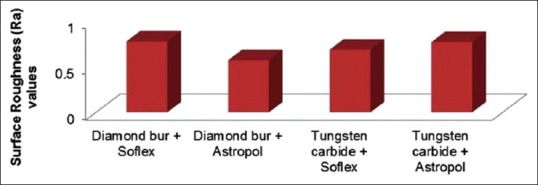
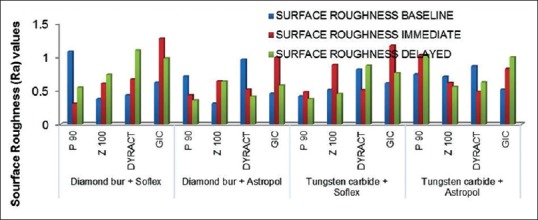
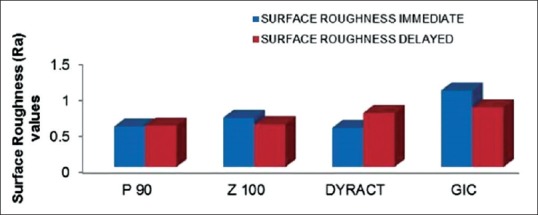
Analysis of time period, irrespective of finishing and polishing system showed that Ra values were greater ( < 0.05) in delayed polishing in GIC > Z100 > Filtek P90 > Dyract AP, suggesting immediate polishing is better. Among the materials, Filtek P90 had the least Ra values indicating the smoothest surface among all materials, followed by Z100, Dyract AP, and GIC. Comparison of polishing and finishing systems irrespective of materials showed that Ra values were lower ( > 0.05) in diamond + Astropol combination whereas diamond + soflex had the greatest Ra values.
It might be concluded that: (i) Filtek P90 showed least Ra values followed by < Z100 < Dyract < GIC; (ii) immediate (24 h) finishing/polishing of materials is better than delayed; and (iii) among all these polishing systems, diamond bur-Astropol and Astrobrush showed good surface finish.
修复体打磨/抛光不当导致的表面粗糙度会致使菌斑积聚、牙龈刺激、表面染色以及修复牙齿美观度欠佳。本研究旨在评估不同的打磨和抛光系统以及不同操作时间对某些美学修复材料表面粗糙度的影响。
本研究制作了两种复合材料样本、复合体以及玻璃离子水门汀(GIC)材料。分别在即刻(n = 40)和1周后(n = 40)使用四种系统(金刚石车针 + 超柔抛光碟;金刚石车针 + 阿斯托波尔抛光刷;碳化钨车针 + 超柔抛光碟;碳化钨车针 + 阿斯托波尔抛光刷)进行打磨和抛光。使用表面轮廓仪测量表面粗糙度。数据通过t检验(针对每种材料和时间段)以及单因素方差分析和Tukey检验(针对打磨和抛光系统)进行统计学分析,显著性水平为P < 0.05。
无论打磨和抛光系统如何,对时间段的分析表明,GIC中延迟抛光时的Ra值更大(P < 0.05),顺序为GIC > Z100 > Filtek P90 > Dyract AP,这表明即刻抛光效果更佳。在所有材料中,Filtek P90的Ra值最小,表明其表面最光滑,其次是Z100、Dyract AP和GIC。无论材料如何,对抛光和打磨系统的比较表明,金刚石 + 阿斯托波尔组合的Ra值较低(P > 0.05),而金刚石 + 超柔组合的Ra值最大。
可以得出以下结论:(i)Filtek P90的Ra值最小,其次是Z100 < Dyract < GIC;(ii)材料的即刻(2小时)打磨/抛光优于延迟打磨/抛光;(iii)在所有这些抛光系统中,金刚石车针 - 阿斯托波尔和阿斯托刷表现出良好的表面光洁度。